The pandemic a few years ago put us all in the throes of history and pushed thinking in many ways, not only medically, but also regarding human connections. And here we have a children’s book by Zewlan Moor impacted by creative greetings that widened the scope of greetings in the animal world.
Giveaway!! Leave a comment below to be in the drawing for a copy of SAY HELLO LIKE AN ARMADILLO!
Widening the Scope in an Animal Concept Book
by Zewlan Moor
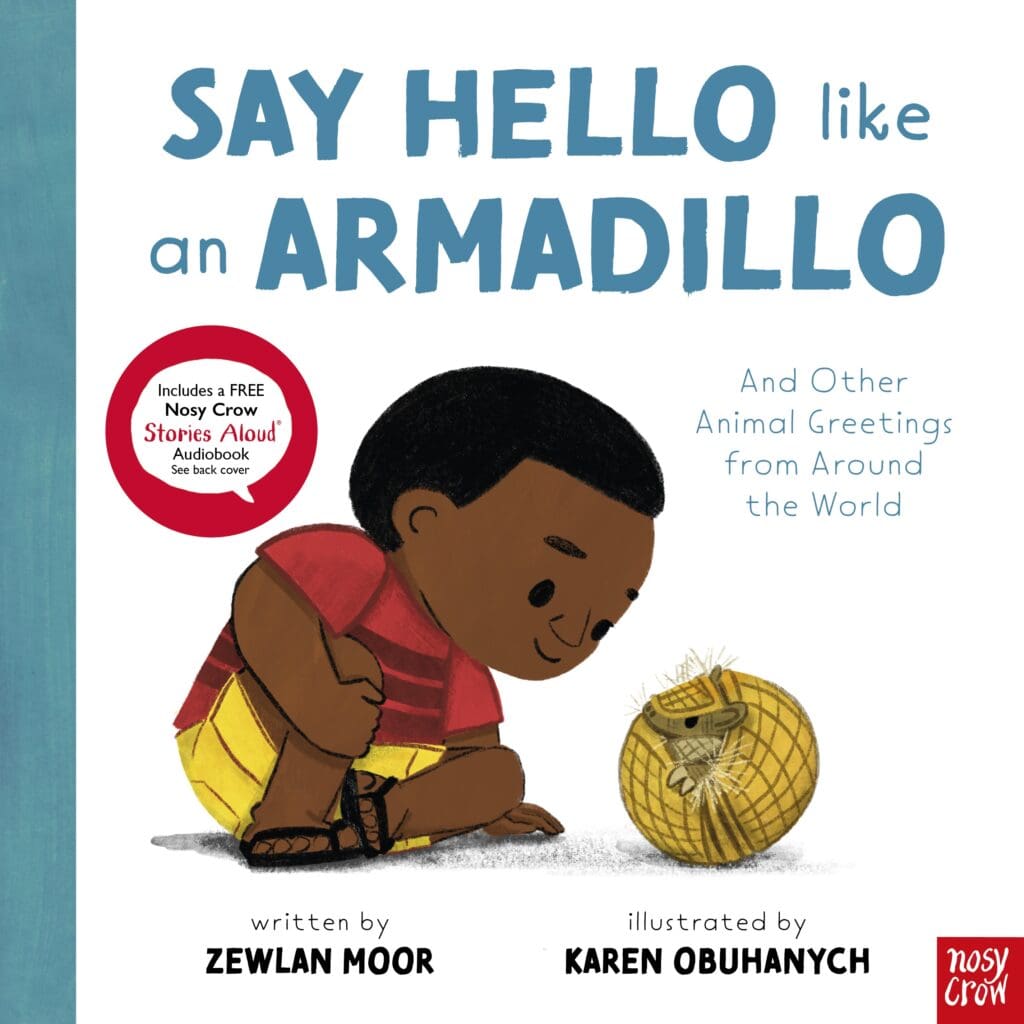
I have spoken briefly about the inspiration for Say Hello Like an Armadillo (illustrated by Karen Obuhanych, Nosy Crow 2026). It was inspired by a commission to write a public health early reader about social distancing after COVID. I had also come across a listicle of animal greetings online while researching the early reader. That list formed the structural backbone of a picture book that was originally called Armadillo Hello.
When my agent, Amy Thrall Flynn, read my manuscript, she liked it but suggested I consider adding in other possible greetings. She told me about a phenomenon where celebrated teachers greet each child with a personalized dance move or handshake, and sent me this video about a teacher adapting his individualised greetings post-COVID. She asked if there was any possibility of incorporating some of these “out-there” human greetings into the manuscript.
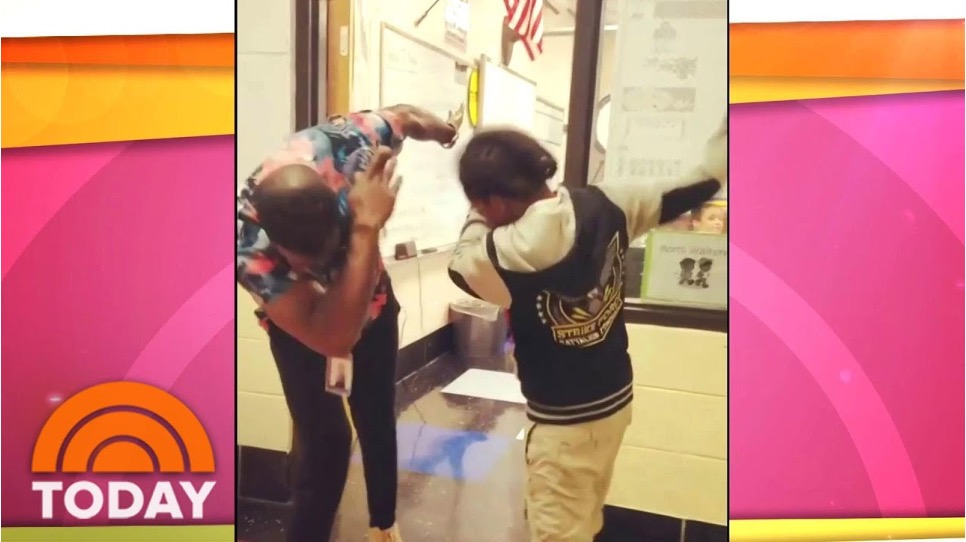
I was excited by the idea and immediately set to work adding in as many of the cool greetings as I could. By this time, social distancing requirements were easing, so I added in high-fives that required touch, but they could all be modified to be non-contact if needed. This acknowledges that some children prefer not to hug or touch other people, raising the issue of greeting consent.
I had so much fun researching greetings from many cultures, ranging from urban African American hip-hop dabs to colonial square-dancing do-si-dos. These all went into the text as options kids could choose to act out when saying hello. Or . . . they could say hello like a mole rat! Bop. Bop. Bop. This is a form of head-banging hello the demon mole rat does to tell its mate where it is in the underground tunnels it digs and travels through. How hilarious that there is a small mammal that could head-bang with Wayne and Garth to “Bohemian Rhapsody”!
My agent sent the manuscript out to a round of publishers as a “vibrant non-fiction”. I suspect my STEM credentials as a medical doctor helped to guide that framing, although you definitely do not need to be a qualified zoologist to write a fun animal concept read-aloud! Amy saw “the creative possibilities and room for discussion around animal behavior and social emotional themes . . . Not to mention the listening, thinking, and motor skills exercised in this whole-body activity, and the empowering ability to convey personal boundaries in preferred greetings.”
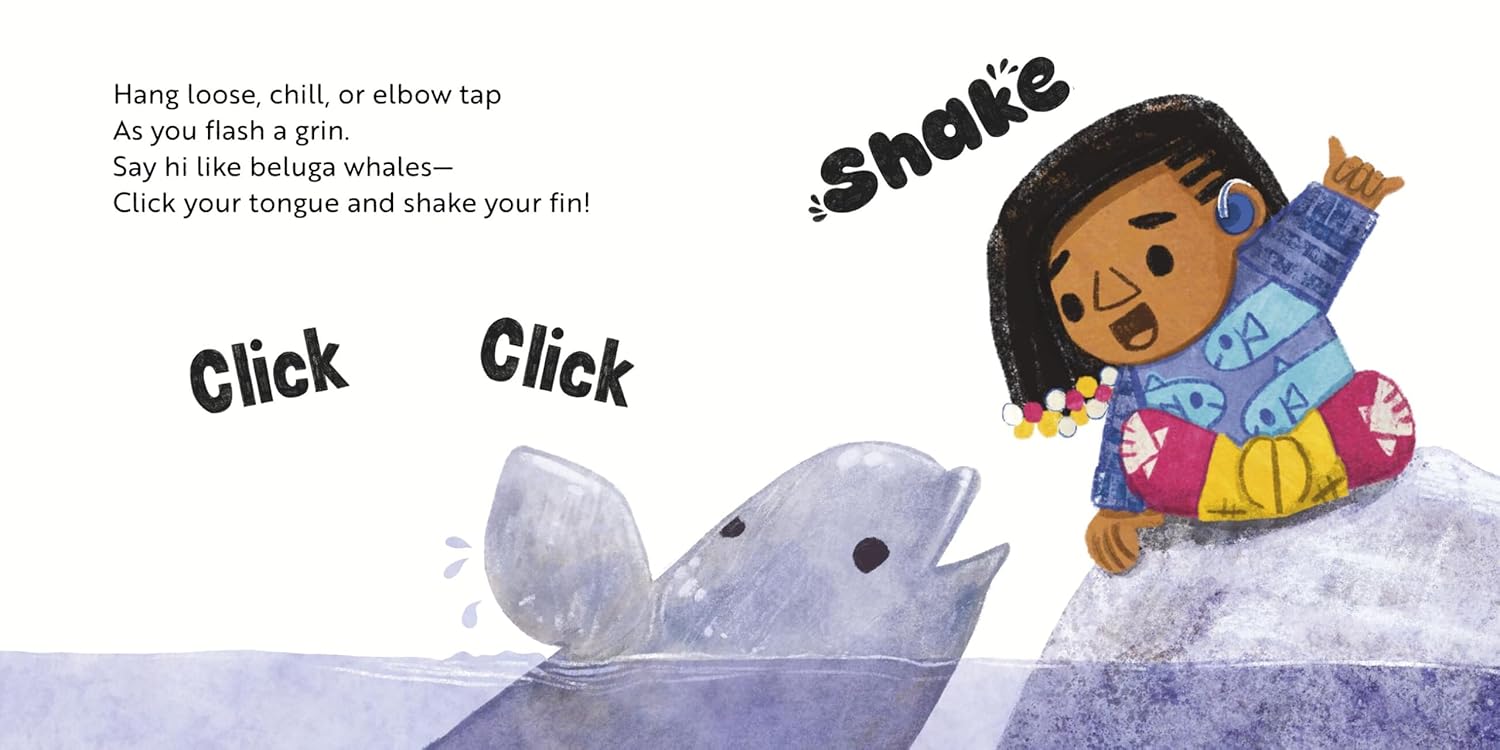
My publishers at Nosy Crow have had great feedback from educators at a Montessori conference earlier this year, who can see themselves using this book in those creative ways. When I attended library story time with my children when they were babies, toddlers and then preschoolers, we enjoyed sitting still to listen to quiet stories. But sometimes we also loved having an opportunity to let our wriggles and giggles out with some action stories.
Many of the greetings in my book are a bit tricky, even for me! My favorite is the “triple scoop” ice-cream greeting, but I often have to concentrate hard to remember how to do it! There should be one favorite greeting for every child, no matter their age or ability, to master. And they can all join in with the animal move refrains.
The book ends with how to say hello like an armadillo. It involves curling in a ball on the carpet and then unrolling and stretching to say hello. At the time of COVID school closures, it was a good final nod to all those kids who were attending school online. And it continues to be relevant with the rise of home-schooling, virtual school visits and read-alouds.
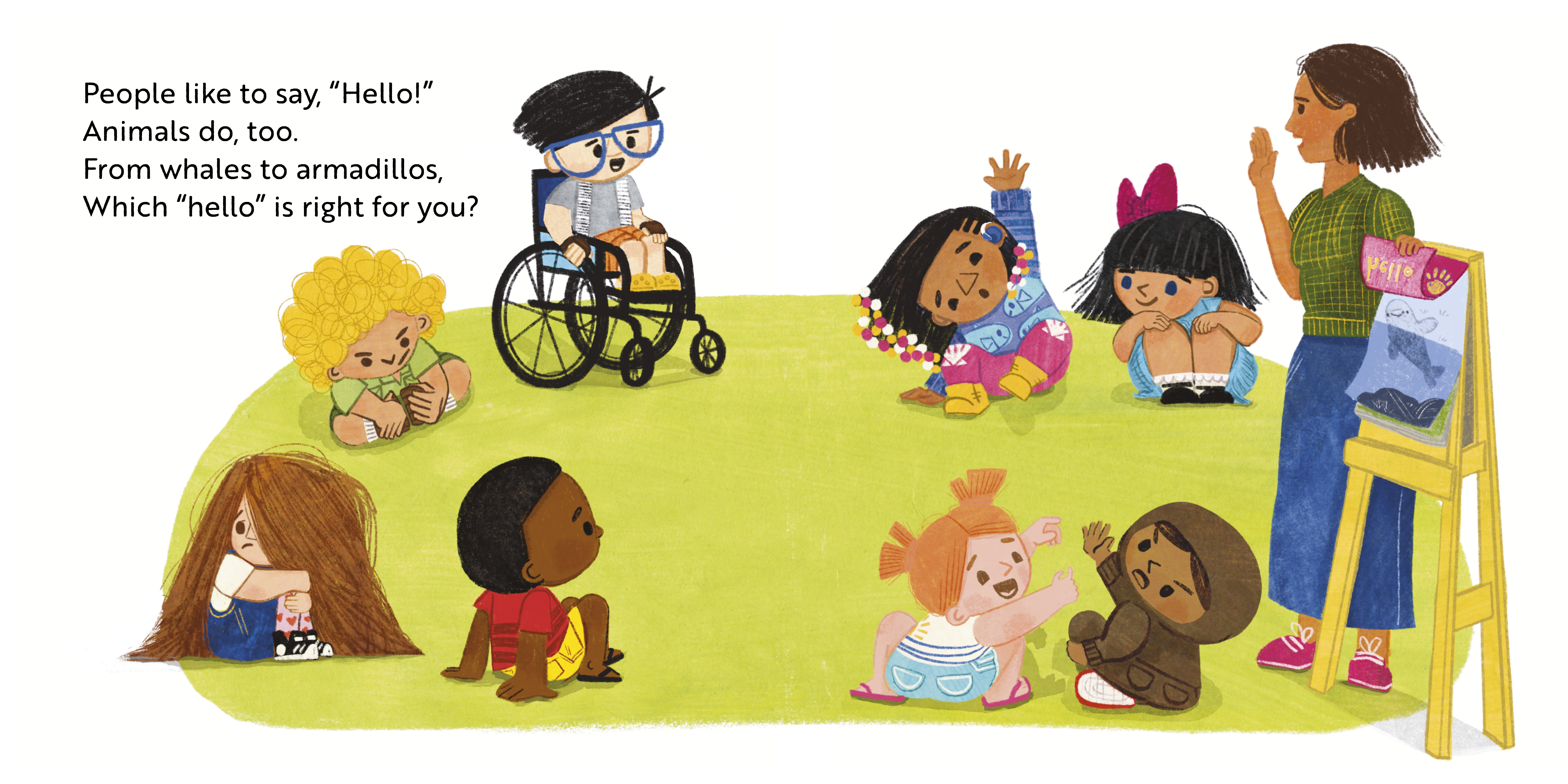
In summary, I am so grateful to my agent for challenging me to add a bit of pizazz to what could have simply ended up as a rehashing of that original quirky animal greetings listicle. The addition of the left-field human greetings added heart, because it was based on that wonderful teacher who showed his students he was thinking of them and seeing them as individuals. That was the perfect special sauce for a social-emotional learning book.
Even if you’re not lucky enough to have a creatively minded, collaborative fairy godmother agent, we can all be fairy godmothers to each other. For example, do you keep a selection of resources from pop culture? A journal of articles, overheard conversations, and other snippets, or a folder of ideas from social media scrolling? What if you made a conscious effort to bring one of those tidbits out to share with a critique partner? Especially if they are struggling with a manuscript, or if it lacks lustre. Imagine what new possibilities await!
Don’t forget to leave a comment below to get in the drawing for a copy of SAY HELLO LIKE AN ARMADILLO! (US addresses only, please. Winner announced 6/26/26)
Bio: Zewlan Moor (pronounced “SHOO-len”) is a children’s author, medical doctor, and bibliotherapist. To keep up, she writes while wearing her surgical scrubs, in between dashing off to the hospital. Despite living on the Gold Coast of Australia, she prefers books and boardgames to the beach. She can say hello-and not much else-in her heritage languages of Tagalog, Spanish, Mandarin, and German. But her favorite way to say hello is the triple scoop! If you would like her to demonstrate and do a virtual read-aloud with your class or writing group, please get in touch via zewlanmoor.com
When you enjoy a book, please leave online reviews to support authors and illustrators. 😃


I think kids will love the action and energy in this book, as well as all the choices to say hello. Congratulations Zewlan!
LikeLiked by 1 person
Thanks so much! I’m hoping kids get a chance to get their wriggles out with this book 🙂
LikeLiked by 1 person
I love this concept – the combination of human greetings, animal greetings, and movement! Looking foward to reading!
LikeLiked by 1 person
Thanks Laura! Good luck with the giveaway 😉
LikeLiked by 1 person
What an amazing concept, Zewlan! I hope many kids and adults read this book. I’m excited to check it out.
LikeLiked by 1 person
Thank you, Robin. I hope you enjoy it! I just received the author copies from the publisher, and it was a delight to scan the Stories Aloud feature as well. I got to revisit the back matter, which brought a smile to my face 🙂
LikeLiked by 1 person
The idea is fantastic. Also so wonderful to have a collabrative creative agent
LikeLiked by 1 person
It sure is wonderful. I’m so lucky!
LikeLiked by 1 person
So clever and such re-readability! Love how kids can interact with these fun, novel greetings and connect with one another.
LikeLiked by 1 person
Thank you, Cathy. I feel like it will definitely be re-readable. I just hope the children think so too!
LikeLiked by 2 people
What a great idea for a book!
LikeLiked by 1 person
Thanks. It’s funny where ideas come from. We have to stay open to them–I definitely get so many ideas when I’m just daydreaming, but also when I’m busy doing something else! Just have to keep a notepad/app on hand to jot them down.
LikeLiked by 1 person
The title alone is great, but reading about the content made me even more excited to get my hands on a copy! Congratulations, Zewlan!
LikeLiked by 1 person
Thank you, Kim! I’m so glad you like the title. I really liked my orginal title, Armadillo Hello, because it was simple and slant rhyme-y. But I let the sales and marketing team convince me that Say Hello Like an Armadillo is much better at signalling what the book is about. The subtitle, And Other Animal Greetings from Around the World, also helps to highlight the non-fiction aspect. Hopefully, sales and marketing are right!
LikeLiked by 1 person
Yup, I enjoyed this–from strong idea to stronger book–reading about the process is so enlightening!
LikeLiked by 1 person
Great, I’m so glad you found it helpful. Hope you enjoy the book as much as the blogpost!
LikeLiked by 1 person