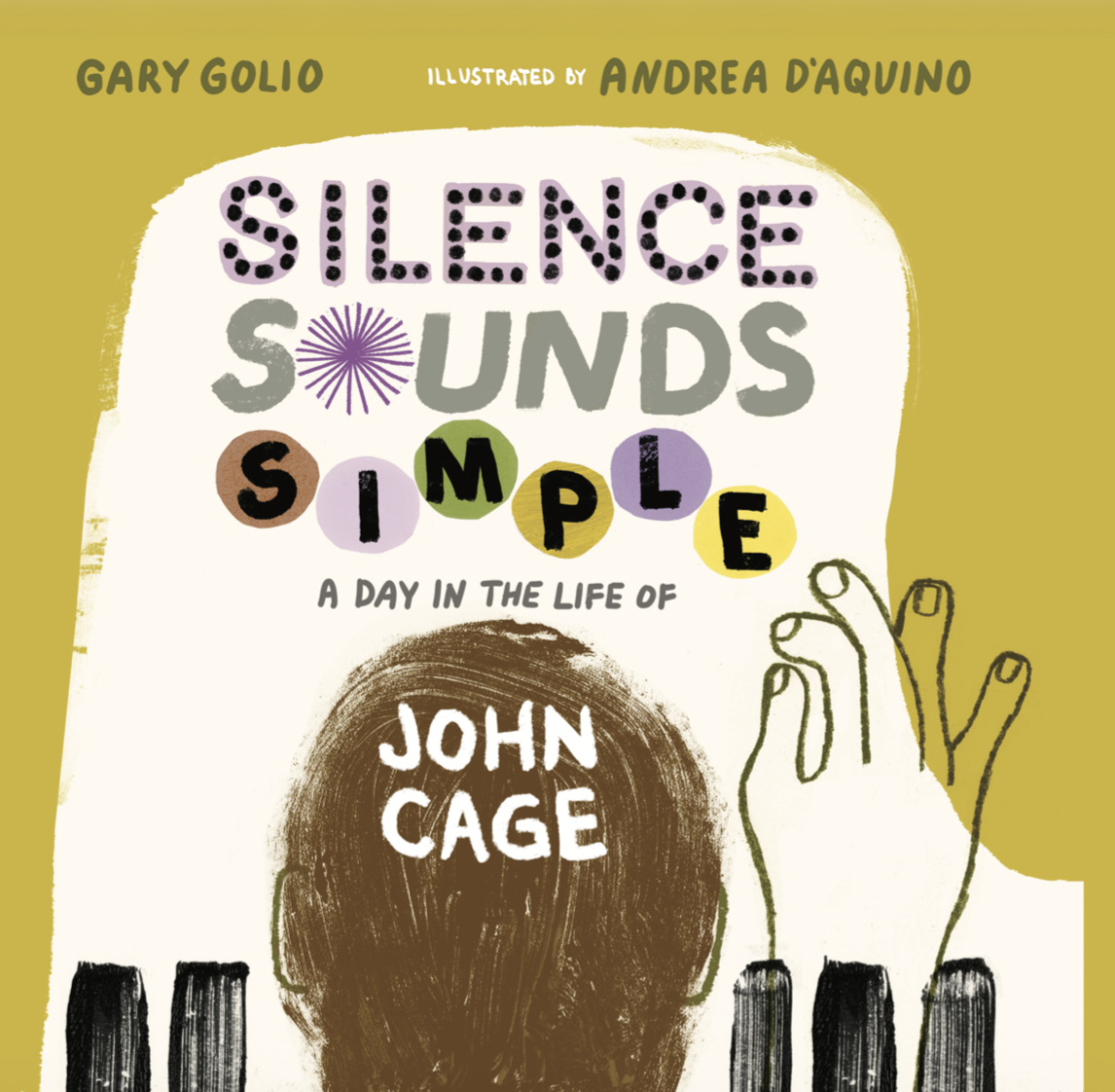
Finding your own deep connection to a person, topic, or event can create the path to finding the heart of the story. In this post, author Gary Golio shares his experience with his latest release, SILENCE SOUNDS SIMPLE: A DAY IN THE LIFE OF JOHN CAGE.
GIVEAWAY! We’ve got a copy of SILENCE SOUNDS SIMPLE for one lucky person who comments below!
Congratulations to Barbara Ann Mojica, winner of Her Name Was Mary Katharine from Dow Phumiruk!
“Kindred Spirits” by Gary Golio
I was a child drawn to solitude. Without siblings, I was surrounded by adults and given a great deal of independence. On any given day I was to be found roaming and exploring nearby woods and streams, investigating the natural world on my own terms, and reveling in my freedom. Birdsong, the aroma of leaves and flowers, the play of light on trees and the ground, fascinated me from an early age. I especially enjoyed solitude when combined with stillness or quiet.
My parents and I lived in the same house as my beloved maternal grandmother, and I spent a lot of time in her apartment on the floor below us. When I couldn’t go outside, I’d sometimes sneak into her large walk-in clothes closet, lined with heavy winter coats, blankets and towels, which together provided thick acoustic insulation. There, I would be continually surprised by what resembled a gentle whirring, the sound of far-off crickets, or a swirling tune made by some strange, imaginary instrument. This delightful and comforting experience was my first introduction to what I can only call the sound of silence (many years before the Paul Simon song of 1966). I had similar experiences as an adult when I began meditating after studying Zen Buddhism and various yogas.
Throughout my life, I’ve nurtured a deep interest in musical styles and genres. These included Indian ragas, Japanese shakuhachi, American and English folksong, Gregorian chants, new wave Brazilian pop, American jazz, and Black blues. I was particularly influenced by the work of musical experimentalists like Jimi Hendrix and John Coltrane, because they saw their instruments primarily as sound machines, unfettered by tradition and capable of endless sonic possibilities. I continued my own music-making as part of a personal immersion experience, as well.
Several years ago I began researching composer/musician/writer/philosopher John Cage. The more I read (by and about him) and the more I listened (to his early and later compositions), the clearer it became that John and I were kindred spirits. His parents encouraged him to not simply find, but create his own path in life, to continually explore, and to unapologetically present his findings to the world, in whatever form he chose. He was an early student of Zen Buddhism in the U.S., brought concepts of meditation into his musical pieces, and approached the various aspects and meaning of silence from a number of directions. His personal study of mushrooms led to books and teaching on the subject, and reflected a deep love of the natural world that infused his work.
Perhaps more than anything John was fascinated by the interconnections among what we call noise, music, sound, and silence. For that reason, I entitled my book Silence Sounds Simple, because it hints at a greater understanding of what we think we know. Interestingly, the rhythm and musicality of the text were directly influenced by the melody of “Waters of March” (“Águas de Março”), a popular song written by Brazilian composer Antônio Carlos Jobim. The “story” of Silence Sounds Simple is an impressionistic description in free verse of the sounds John would hear throughout his day, in sections given musical names (Overture, Apartment Arabesque, Street Serenade, Interlude, and Woods Waltz). It follows him from the time he wakes, shuffles through his apartment, walks through city streets, travels by subway, and finally roams the woods in search of wild mushrooms, musing on whether or not “mushroom spores/hitting the ground/don’t make a sound”. To her great credit (and my good fortune), artist Andrea D’Aquino both enriched and illuminated the story with spirited and playful illustrations that would have brought a smile to John Cage’s lips.
And while this book represents another step in my own personal exploration of sound/silence, it also encourages young readers (with additional backmatter) to consider possibilities and look beyond what we’ve been taught and think we know. To that end, it is an homage to the master of silence, sound, and the unexpected, John Milton Cage.
Don’t forget to leave a comment below for a chance to win a copy of SILENCE SOUNDS SIMPLE! (US addresses only, please. Winner announced 7/10/26.)
If you enjoy a book, please support authors and illustrators by leaving online reviews. 😍


How fascinating, Gary. I can relate to this quite well. I hope many kids (and adults) find this book as part of their journey of creating and exploring, opening the door to many possibilities.
LikeLiked by 1 person
Thank you, Beth. And thank you, Gary Golio, for your books. Reading this article made me feel some of that kindred energy myself — “no wonder.” Can’t wait to read this new one.
LikeLiked by 1 person
Thanks for sharing so much of what drew your interest in John Cage, why you felt you were kindred spirits, and why you wrote the book. I had never heard of John Cage until a previous picture book about him was announced, BEAUTIFUL NOISE: The Music of John Cage written by my friend, Lisa Rogers and illustrated by Il Sung Na.
Then earlier this spring I saw your book announced in a New York Times post with two other picture books! Congratulations, Gary! And thank you Beth for sharing this post.
LikeLiked by 1 person
I pretty much love every book of Golio’s I’ve read, and just recommended several of them to a new SCBWI member who’s a band teacher at a local school. I’m not surprised that Golio decided to explore silence, as I’ve always been fascinated, too, by what is allowed to enter into a seemingly empty space. I spent a lot of time alone in nature as a kid, and I cherish those moments as an adult. Can’t wait to read this book!
LikeLiked by 1 person
This is one of those picture books that truly is for children and adults. I really look forward to reading it! Congratulations.
LikeLiked by 1 person
As a musician and the mother of an oboist, I need to read this book and learn more about this fascinating man. Congratulations!
LikeLiked by 1 person