I am thrilled to share this post from Ashley Yazdani, illustrator of THE PATRIOTS AND THE POX: GEORGE WASHINGTON’S BATTLE TO SAVE THE CONTINENTAL ARMY! It’s always fascinating for me to learn about the illustration process, and I’m sure you’ll find this interesting, too! My immense gratitude to Ashley for her amazing work on THE PATRIOTS AND THE POX and for sharing a bit of her process here for you!
AND don’t miss the GIVEAWAY for a copy of THE PATRIOTS AND THE POX! Just leave a comment below to get in the drawing. 😃
Congrats to Karen D., the winner of a copy of WILD MEDICINE: INVENTING WAYS TO SAVE ENDANGERED ANIMALS from Nora Nickum!
George and Me
by Ashley Yazdani
When my agent approached me with the manuscript for The Patriots and the Pox I was incredibly enthusiastic about it. Colonial era history? Yes please! Vaccine science? Oh yeah!! But one thing did make me feel trepidation: creating a likeness of the best known figure in our country’s history? Well, I wouldn’t say that I was sweating bullets, but I wasn’t not sweating either.
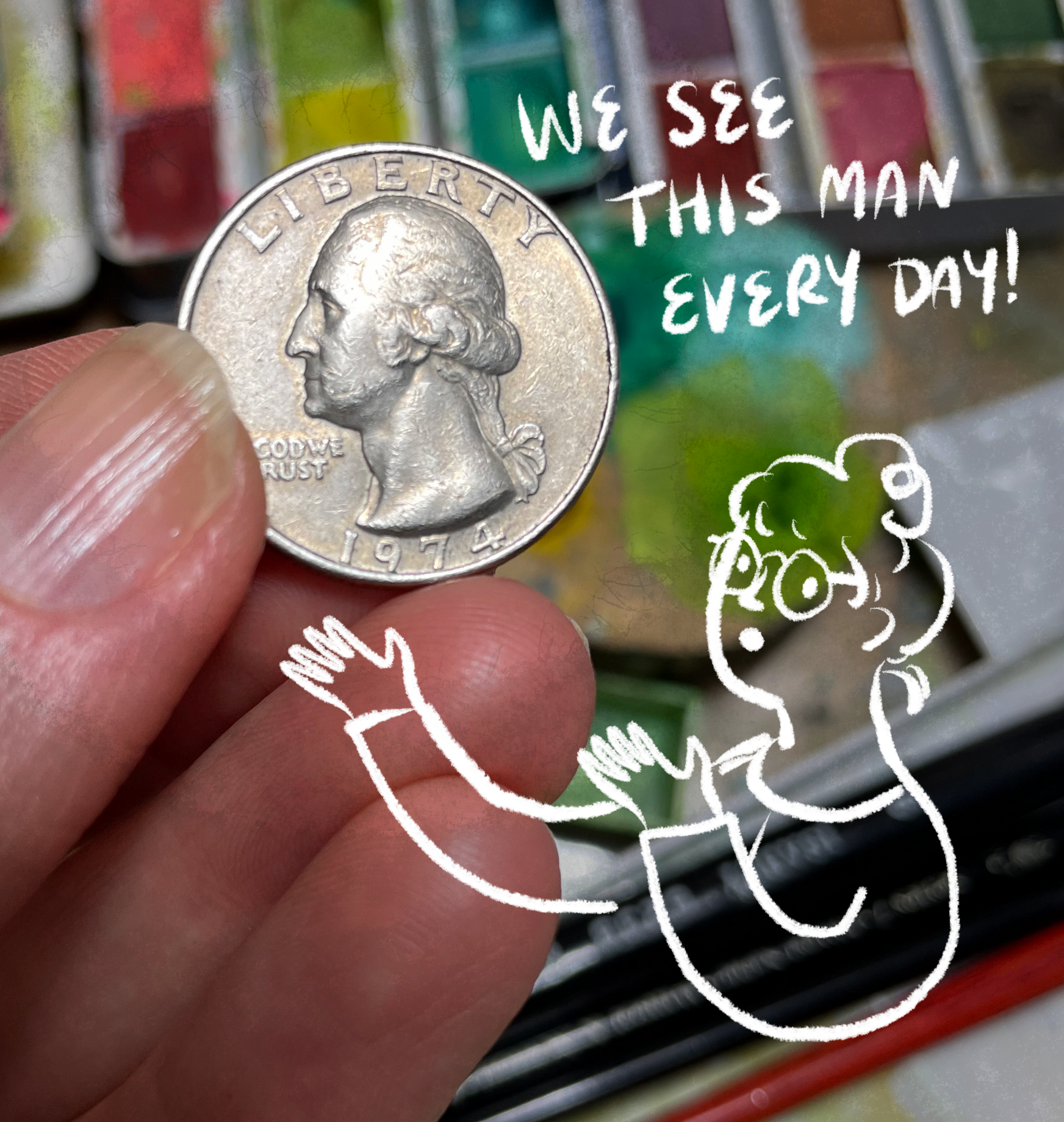
I really love making portraits and designing historical characters, and always enjoy the process. That being said, portraiture can be challenging for any artist, and I am no exception to this. Sometimes a portrait will end up looking like someone else entirely. At other times, through the magic of the artist’s hand, a portrait will mysteriously end up looking like the artist that painted it: every portrait an accidental self portrait. Historical research into George only served to reinforce this difficulty.
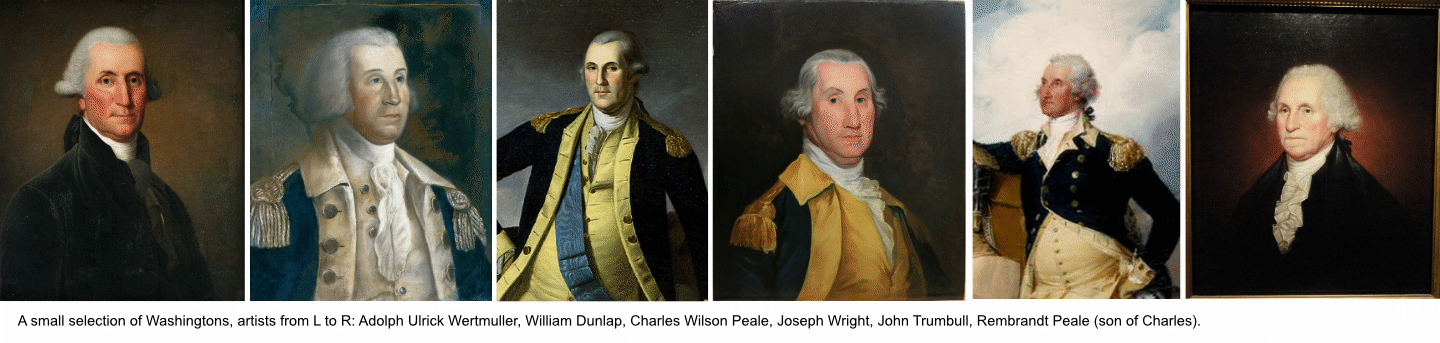
These are all the same man, painted by different men. I suspect that George is often wearing the artist’s face here, and I can sympathize with it. When we are learning to capture a likeness the most patient and reliable subject to practice on is always ourselves. It’s natural for our styles to be shaped by what we see in the mirror, and what we draw the most. But back to these portraits: even with all their differences, we can see a through line from one image to the next. There is an Essence of George across them all. How would I capture this essence?
The first step in creating a likeness is always studying your subject, so I did a lot of looking at George. First I looked at those portraits above, but I quickly realized that they wouldn’t be much help (aside from the costuming, which is gorgeous and very helpful). The faces all look pretty different. I considered Gilbert Stuart’s portraits, which are said to be quite a faithful likeness, but they all felt too old. At the start of the Revolutionary War George was just 44, and I wanted to capture that youth (or ok, middle-aged-ness). Fortunately we have an artifact that perfectly captures George near the time of the Revolution: his life mask.
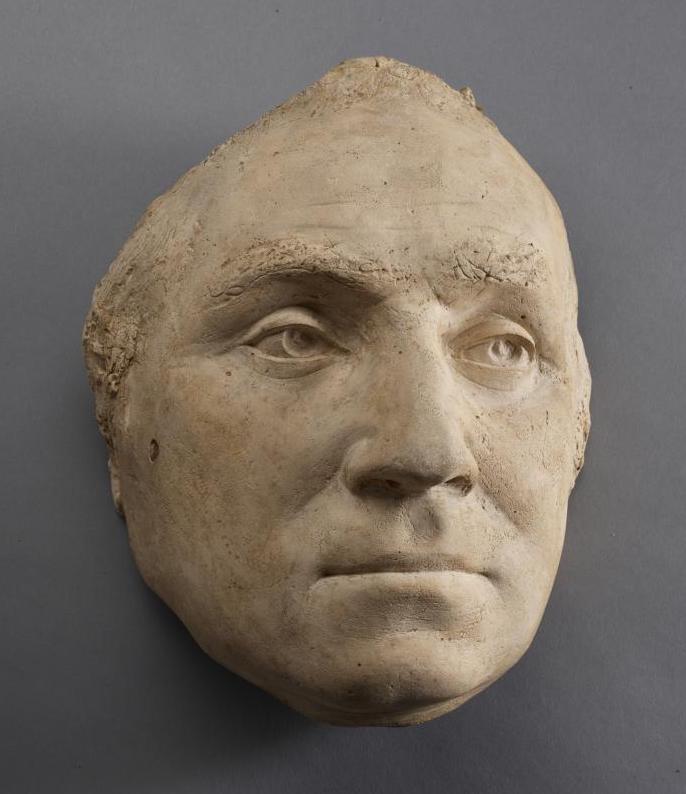
You may have heard of a death mask, which is a plaster cast taken directly from a person’s face post-mortem. A life mask is the same thing, just with a living subject. George Washington had one done in 1785, shortly after the Revolutionary War. Renowned sculptor Jean-Antoine Houdon came to visit him at Mount Vernon in preparation for making a marble statue of Washington for the Virginia State legislature. During his visit he created a life mask, which allowed him to bring Washington’s likeness back to his own studio for further study. George was fascinated by the casting process, and wrote about it extensively in his diary.
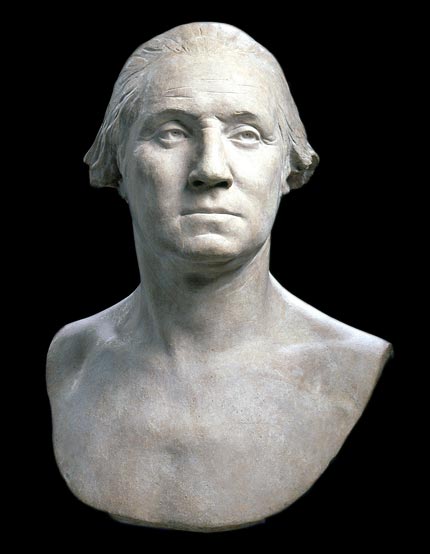
What resulted from that casting session is a perfect likeness of George’s face. Houdon used it to create a terracotta bust of Washington during his Mount Vernon visit, and it still resides there today. The original life mask itself is currently at the Morgan Library Museum. The only thing that was altered after casting were the eyes: they had to remain closed as the plaster was on his face, so Houdon carved them into the final cast based on his in-person observations of Washington. Although there was no photography back then, thanks to this bust and the life cast, we know exactly what Washington’s face looked like. This would be the key to trying to capture my own version of George’s likeness.
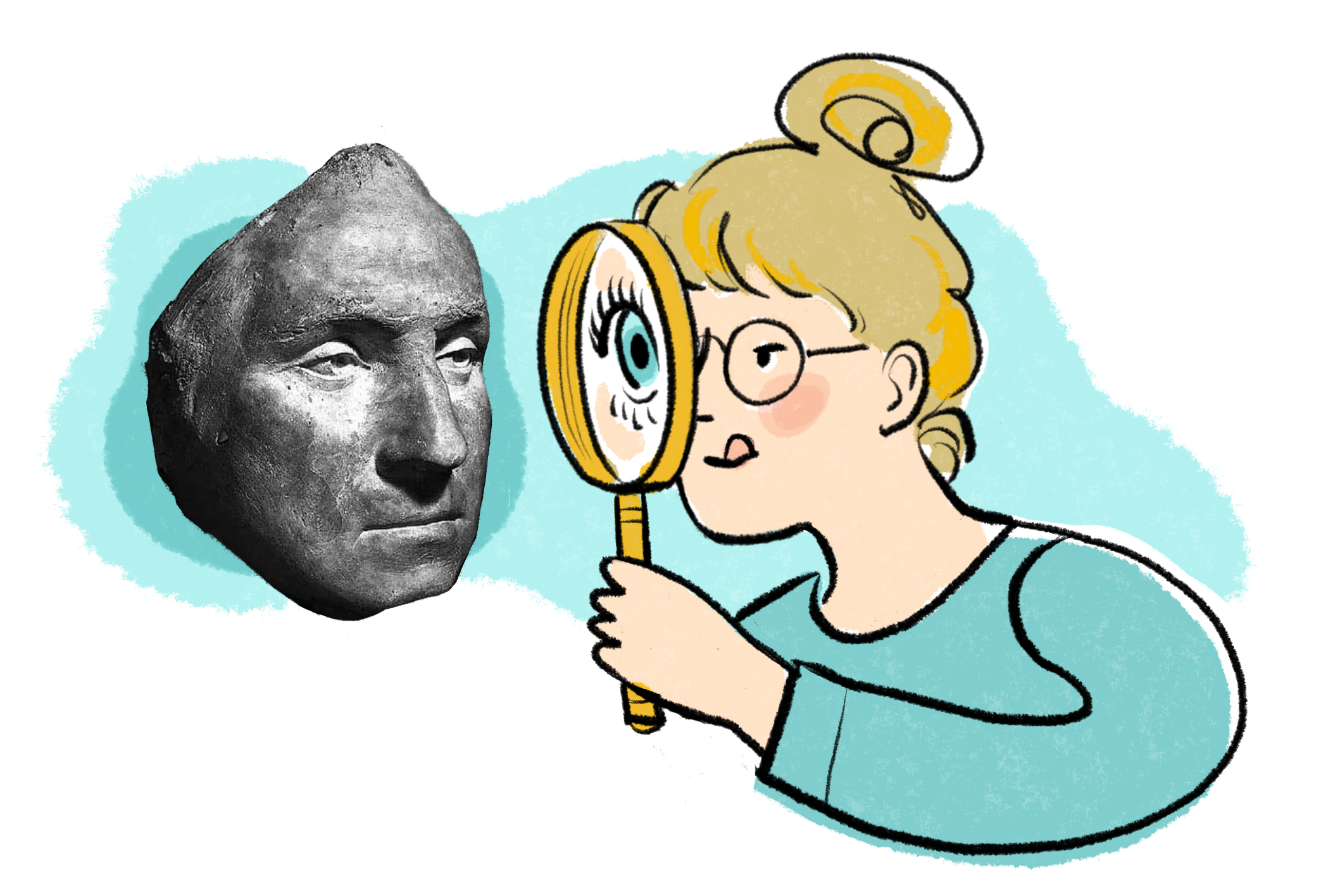
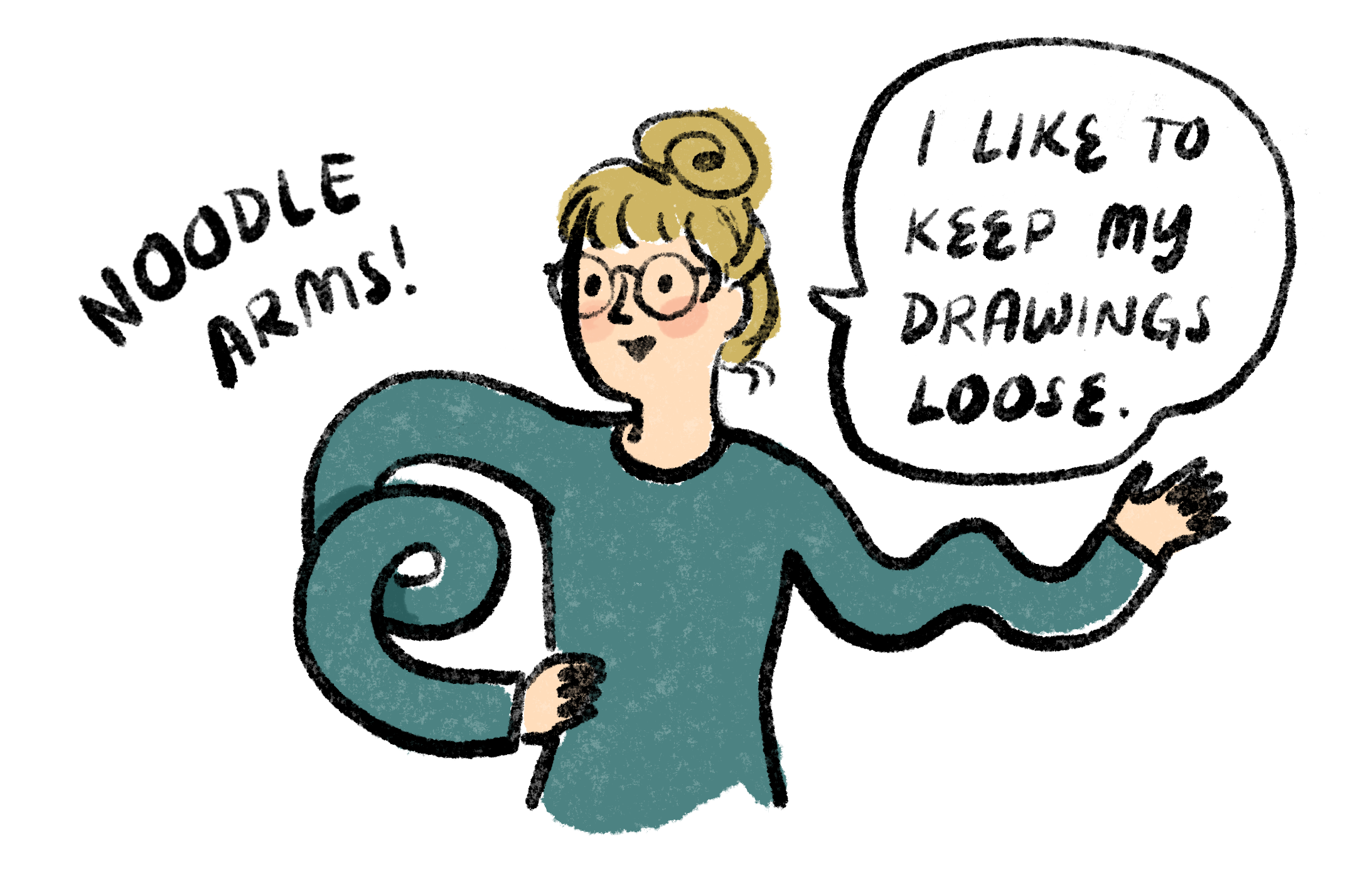
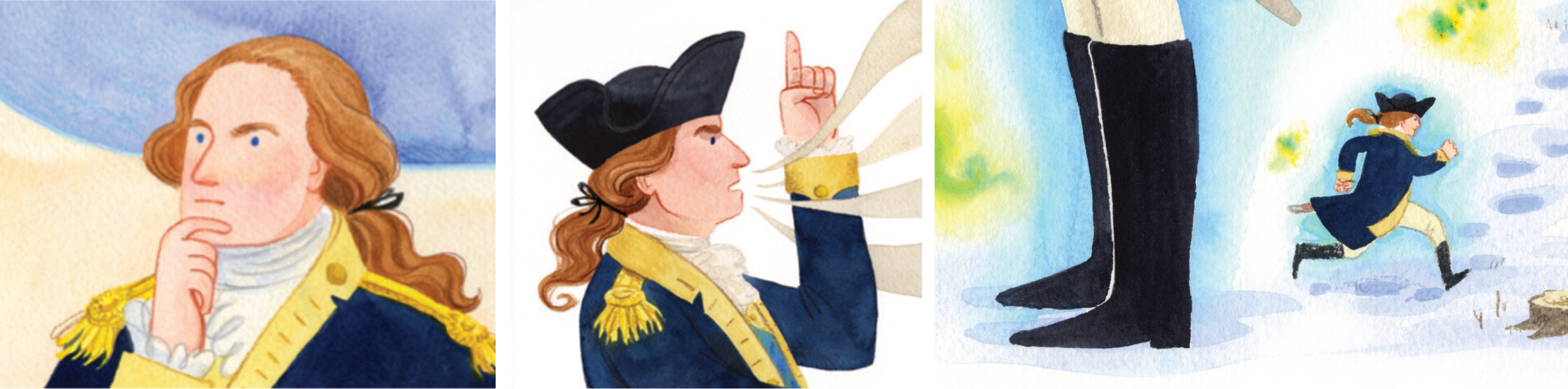
George’s life mask and I spent lots of time together. I found photos of it from as many angles as possible and used it to assemble a portrait of Washington in my own style. Fortunately my drawing style relies on simple elements which can be easily adjusted to the subject: dot eyes, a swish of a nose, a single line mouth, and noodle arms.
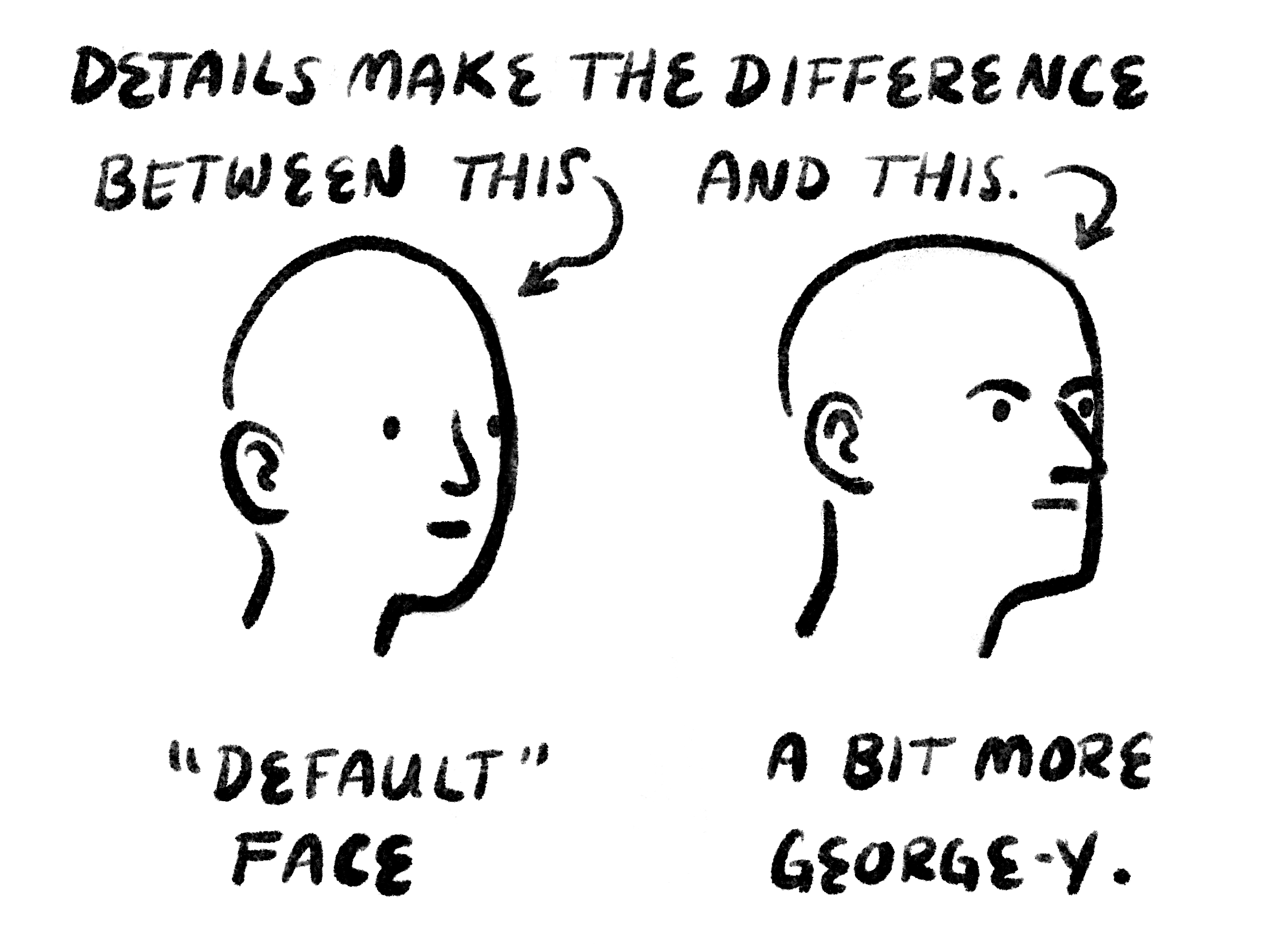
The elements may be simple, but each must still be tailored to capture that Essence of George. The aspects of his face I focused on most were his face shape (mostly round), his nose (strong and slightly broad, flat-bottomed, with a soft tip), his brow (a very even arch, with evident worry lines at the inner edges suggesting a frequently furrowed brow), and the set of his jaw (a softened square shape, protruding just a bit, and with softness under his chin).
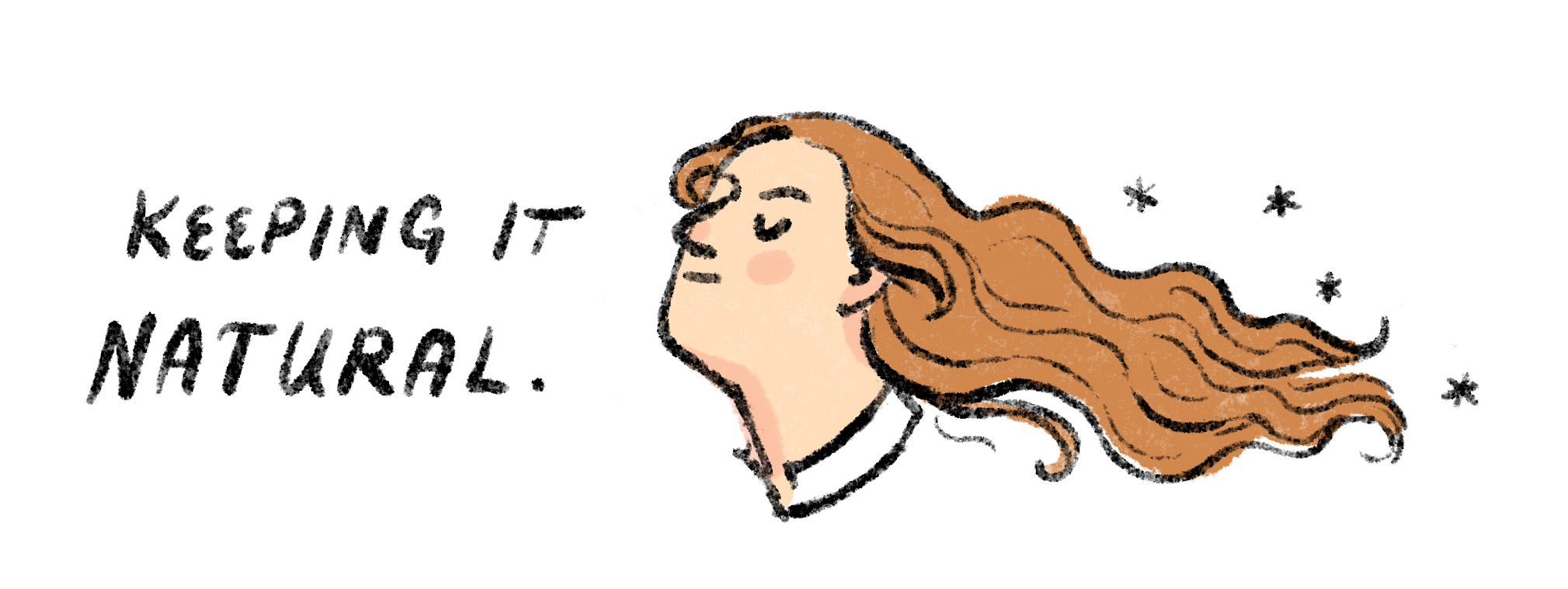
Lastly, there is an eminently identifiable piece of George’s image that I chose to change: his hair. In almost every portrait of George he appears with white hair. This was the fashion back then, and men in the 18th century would wear powdered wigs to achieve the look. George, however, never wore a wig and instead kept his own hair long. And he was a redhead. After consulting with Beth’s historical expert we decided to keep his hair red throughout the book. George would have powdered it to be white for formal events, but for a random day on the battlefield? No, even a man as invested in fashion as George wouldn’t have had time to powder his hair then.
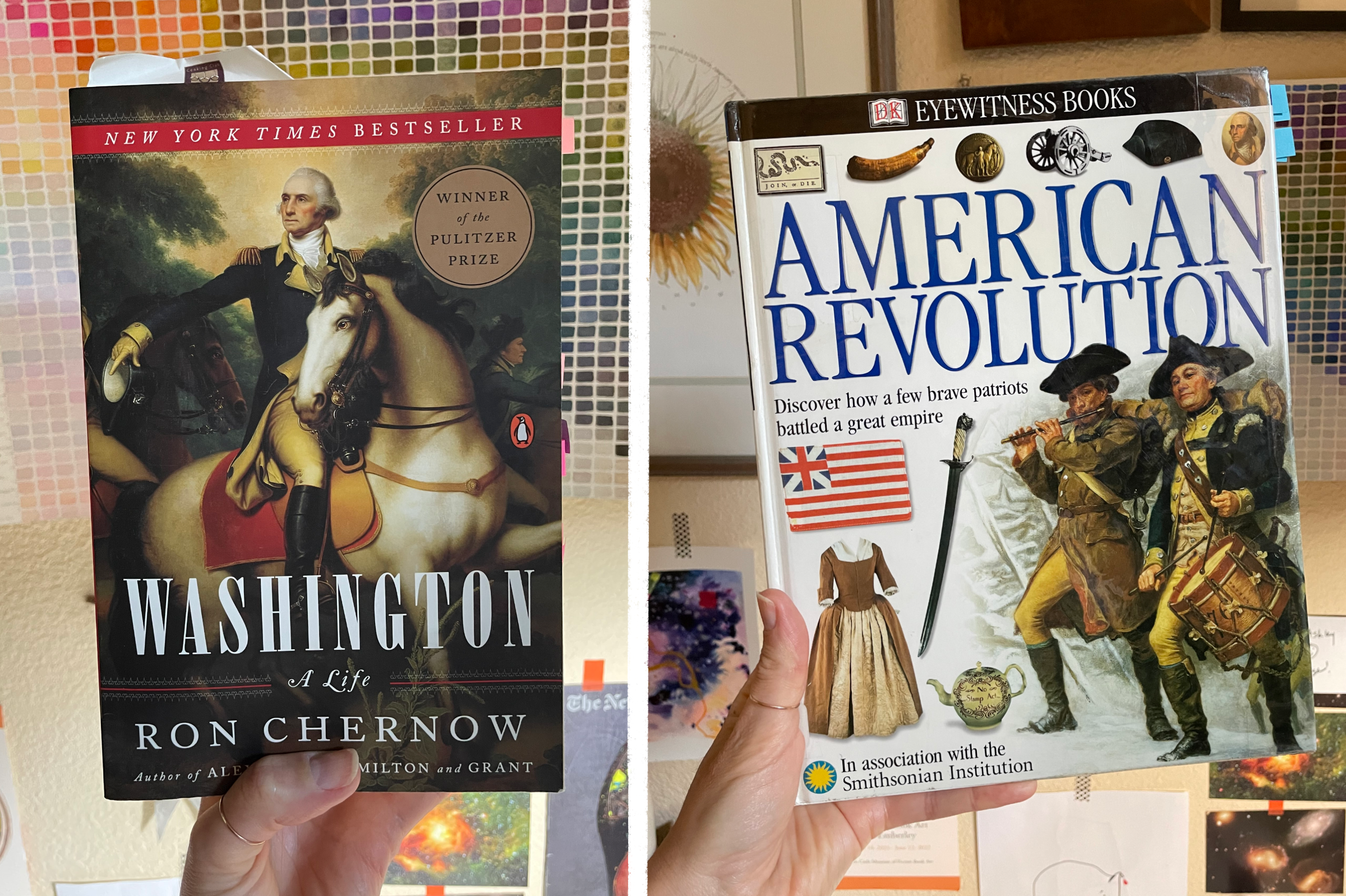
The George Washington that appears in The Patriots and The Pox exists thanks to several museums and the images they have shared online. The Morgan Library & Museum shared his life cast, while Mount Vernon shared both his terracotta bust and information about his cast. When it came time to flesh out his likeness with clothing and accessories, I turned to Mount Vernon again, which supplied information about his sword and other military equipment. The Smithsonian provided excellent views of a uniform he wore after the war, a garment similar enough to uniforms featured in his war-time portraits that it was still extremely useful, even if it was off by a few years. Lastly, the Museum of the American Revolution shared images of numerous objects from the war, belonging to both Washington and Revolutionary soldiers in general. Thank you, museums, for making the work of historical illustrators much easier! The book Washington: A Life by Ron Chernow helped me to better understand Washington’s character and mood, and of course I have to mention an old favorite from my own childhood: DK Books, whose American Revolution Eyewitness Book helped to furnish many additional details for The Patriots and the Pox.
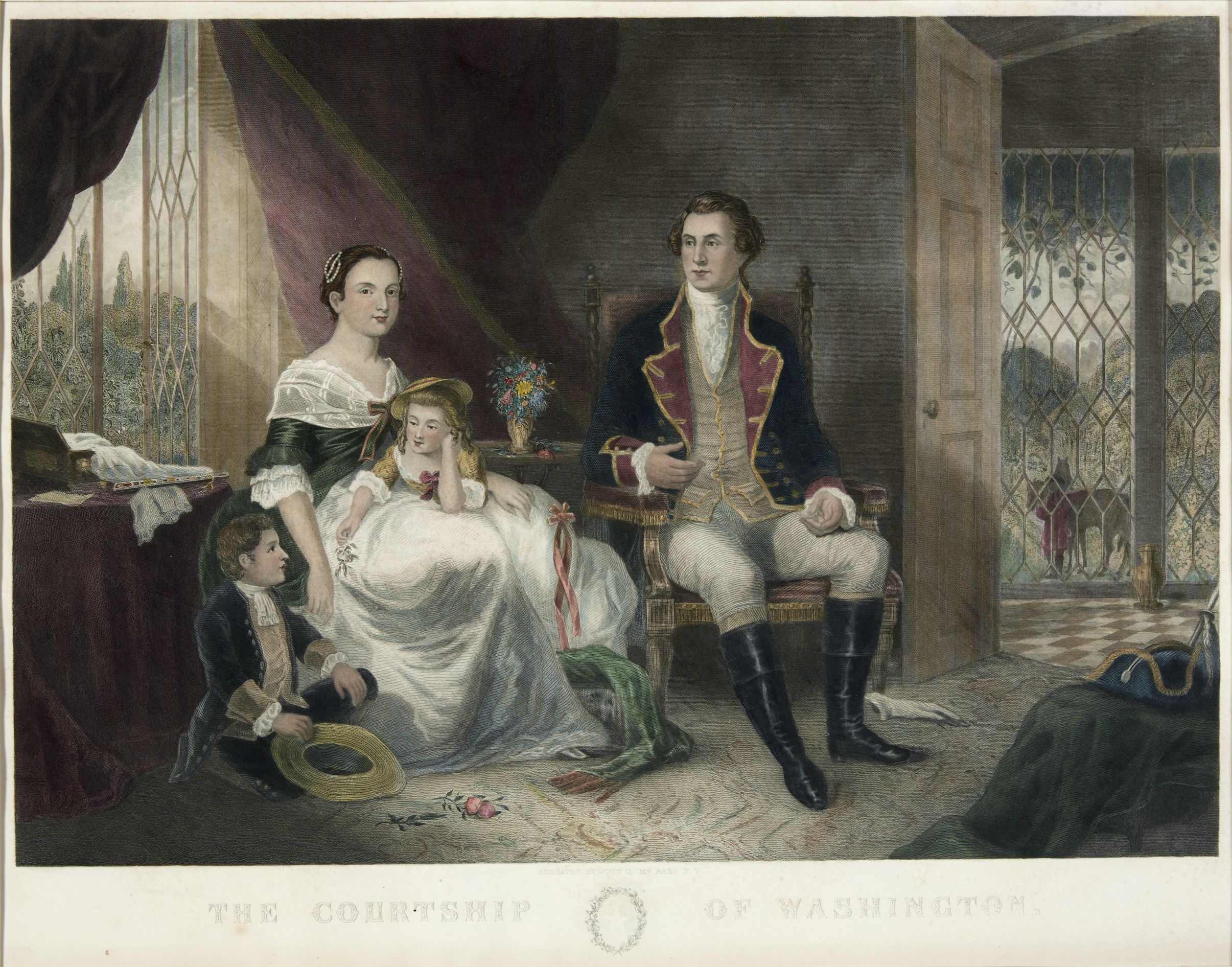
In the end the portrait that I looked to the most, after the life cast, was this one: The Courtship of Washington, by John C. McRae, c.1860. It communicates something that I think doesn’t always come through in the grand, stately portraits of our first president: casual humanity. Here he is, a young man. He’s in love, and hoping to make a good impression on Martha, who is looking at the viewer instead of George. He’s fine and fancy, and he’s ok spending time with children, even as he’s trying to woo their mother. There are flowers on the table (maybe he brought them for Martha), and on the floor (perhaps he also brought nosegays for her children). His hat and sword rest on an ottoman, and his horse can be seen out the window. He dropped a glove.
I love this picture. The humanity shines brightly, and the storytelling is in the details. These are goals I always aim for in my own work, and they were on my mind throughout The Patriots and the Pox. Give it a look and you’ll find an important and wonderfully told story by Beth, plenty of historical details in the illustrations, and my own version of George: a complicated figure, a strong general, a man who looms larger than life, dealing with a problem he knows to be much larger than himself.
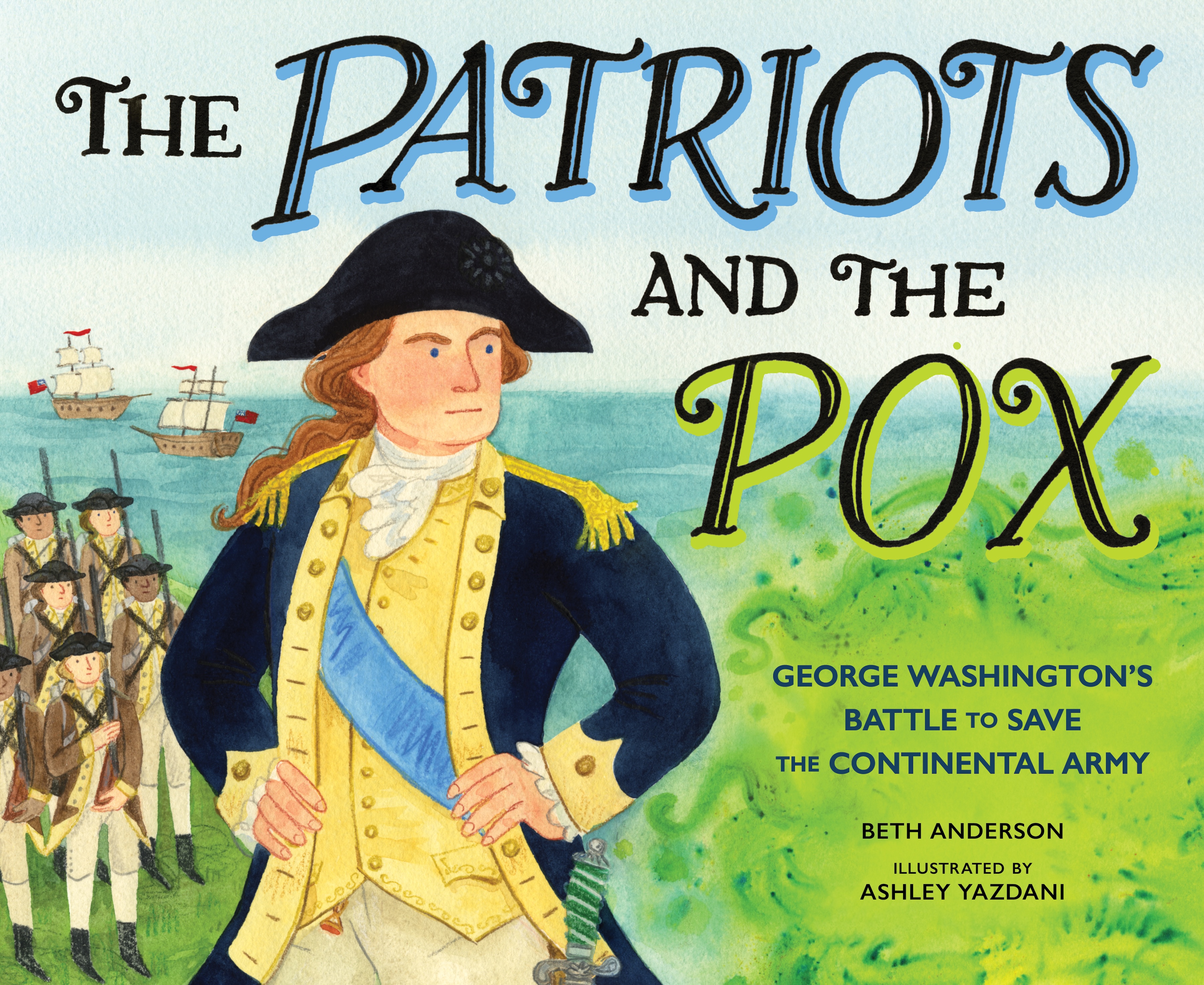
Don’t forget to leave a comment below to get in the drawing for a copy of THE PATRIOTS AND THE POX! (US addresses only, please. Winner announced 10/9/26.)
AND If you enjoy this book, we would be ever so grateful for your support by sharing it with others and leaving online reviews. 😍


As someone trying to break into illustration, I, too, am fascinated by how illustrators make choices that inform their final art for a book. And Ashley’s illustrations are as wonderful as your words, Beth!
LikeLiked by 3 people
This was so interesting! And I love everything about your book, Beth!
LikeLiked by 2 people
Great post, and so interesting!
LikeLiked by 2 people
Wow! Thanks for the invitation into your work process, Ashley! I am especially fond of your solution in conveying this dangerous virus as a misty, mobile, bright-green contagion!
LikeLiked by 2 people
I think it’s fun to learn that Washington was a red head like my dad. Thank you for sharing today and for the chance to win a copy of your book to read and review.
LikeLiked by 1 person
Thanks for sharing your process, Ashley! I never questioned Washington’s hair color, and now I’m taking another look. Also, really cool that you could work from a life casting of his face. Cool…and a wee bit eerie. It’s details like these that make history even more fascinating.
LikeLiked by 1 person