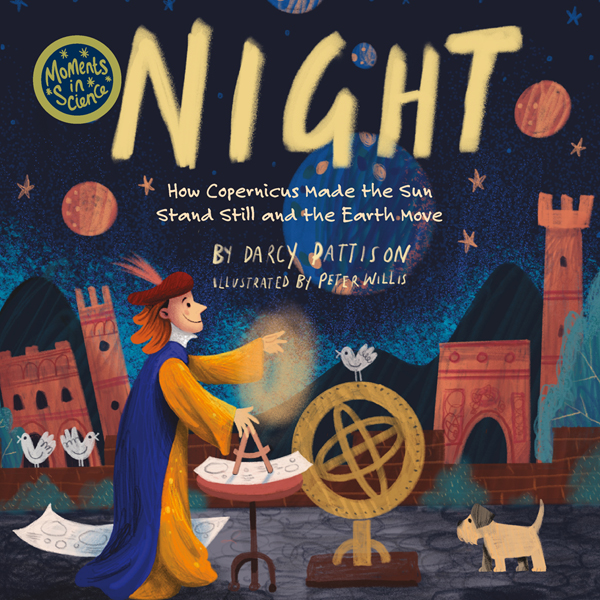
This post from author Darcy Pattison is a perfect sequel to Colleen Paeff’s post last week. Both authors experienced the power of place as they approached a story. A trip to Poland helped Darcy visualize the life of Copernicus so very long ago to create NIGHT: HOW COPERNICUS MADE THE SUN STAND STILL AND THE EARTH MOVE.
Congrats to Julie Rowan-Zoch, the winner of PUFFLINGS FLY FREE from Colleen Paeff!
The Power of Place to Find Story
By Darcy Pattison
The car was dead! We stood on a busy street in Torun, Poland, birthplace of Nicholas Copernicus, and wondered what was next. While we discussed the situation, we kicked around the hairy chestnuts on the ground. (You know you’re not in America when you encounter chestnut trees, because they were decimated in the U.S. by a blight over a hundred years ago.)
Magda and her husband Marcin had to make a difficult decision. Would we return to Krakow, or finish our trip of sites related to the Polish scientist, Copernicus?
In September 2024, my husband Dwight and I visited Poland with the idea of researching one of the most famous scientist’s historical sites. Magda is a former exchange student who lived with us for a year while in high school, and over the years, we’ve kept close contact. When she asked if we might come visit, I replied, “Yes. If I can use it as a research trip.”
In response, Magda arranged visits to 1) Torun, Copernicus’ birthplace, 2) Krakow, where he attended university, and 3) Frombork, the cathedral where Copernicus lived and worked for over thirty years. This was going to be an amazing trip!
Krakow University, Krakow, Poland—Copernicus’s University
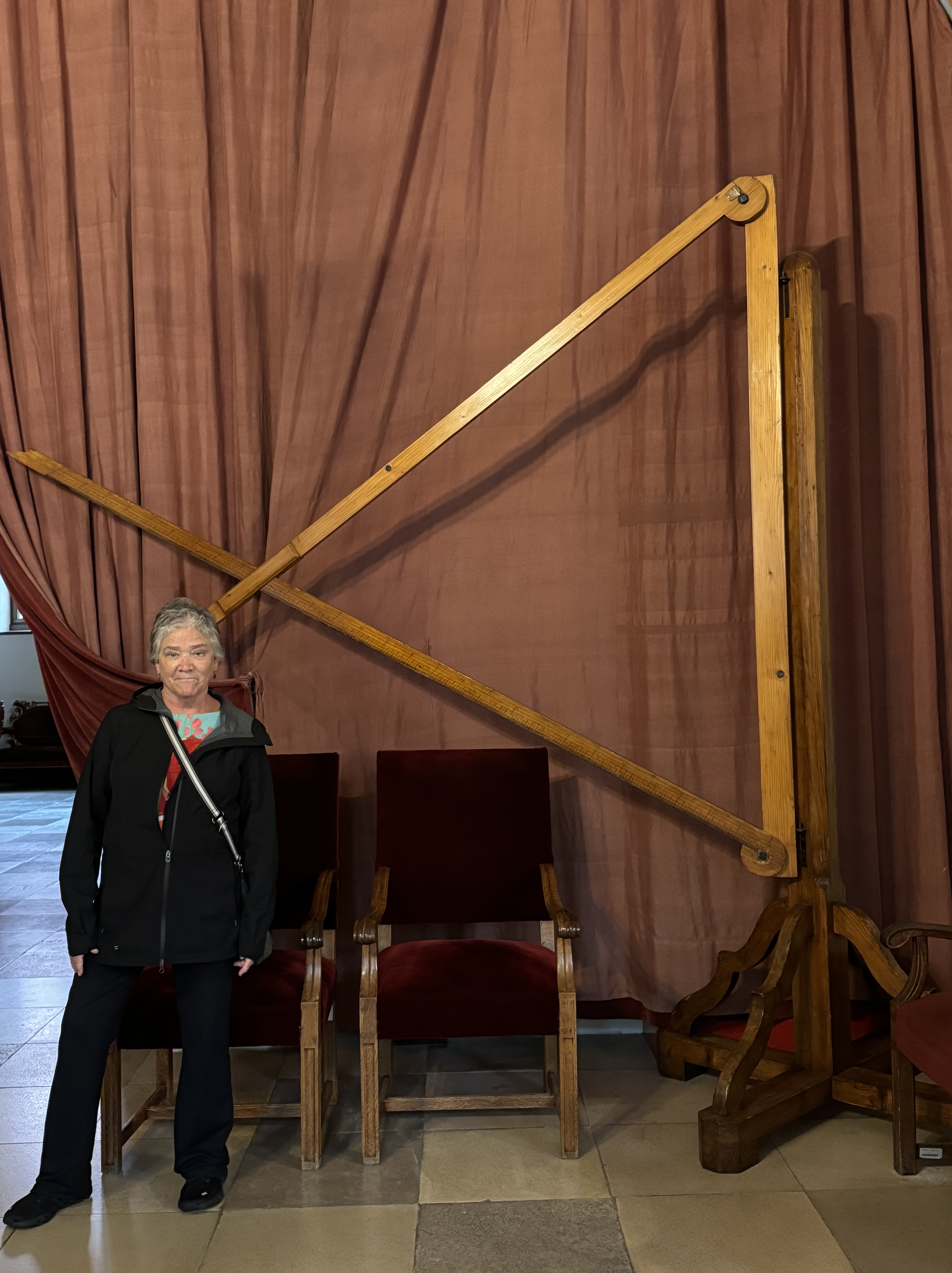
We started at Krakow University, founded in 1364, and saw astronomical instruments and museum exhibits. Telescopes were invented in about 1608 and improved by Galileo. Copernicus, however, lived 1473-1543, before the telescope, which mean his astronomy work was done by just observing the stars. While his instruments were crude, he was able to measure the positions of stars with enough accuracy to do his complicated calculations.
Torun, Poland—Copernicus’ Birthplace
Next, we drove to Torun, Copernicus’ birthplace, where his ancestral home is a museum. We learned that during Copernicus’ lifetime, the boundaries of Poland were fluid. His loyalty lay with the Catholic Church for whom he worked most of his life as an administrative cleric.
Torun is known for its gingerbread, which was soft and mildly flavored. Here, our host’s car broke down. Eventually, they hired a truck to take their car back to Krakow, which I rented a car to travel on.
Frombork Cathedral—Copernicus’ Workplace
As we drove north, I was constantly thinking about Copernicus’ travels 500 years ago. Likely, he traveled by foot or horse-drawn carts. We were out in the boondocks, as we say here in Arkansas. Frombork lies on the Vistula Lagoon, a narrow lagoon that separates Frombork from the Baltic Sea. This far north, the countryside is still rural. We got caught in road construction, so the trip seemed exceptionally long—and lonely. We finally arrived at our B&B about 10 pm.

The next morning, we stepped outside and saw the cathedral rising above us just two blocks away. The B&B owner said that still today, in the winter, they hear wolves howling. So remote!
Touring the cathedral was a thrill. Over the last 500 years, the size has doubled, so I kept imagining the smaller cathedral and what it would be like to live and work here. A couple rooms were set up with Copernicus-like mannequins to help visitors envision the scene. The museum was full of historical documents, art, instruments, and information.

Travel to Write
I wish I could travel to write every time I work on a project. When I wrote, Wisdom, the Midway Albatross, I wished I could go to Midway Island and see the flocks of Laysan albatrosses. But the island is a national sanctuary, and you must apply to visit; only credentialed scientists with legitimate research projects are allowed.
Here in Poland, though, because of the amazing hospitality of Magda’s family, we could visit the sites, see the landscape and hear local stories. They affected my story, NIGHT: How Copernicus Made the Sun Stand Still and the Earth Move. I keep telling people about the wolves howling around Frombork, but that’s just a shortcut way of saying the trip to Poland helped me write Copernicus’ story. It’s not always possible to travel for a project, but when I can, it affects the story I write, and the way I talk about the story. In the end, I hope it will affect how kids understand this amazing scientist.
—

About Darcy Pattison
Children’s book author and indie publisher DARCY PATTISON has written over seventy-five fiction and nonfiction award-winning books for children. Five books have received starred PW, Kirkus, or BCCB reviews. Awards include the Irma Black Honor award, six NSTA Outstanding Science Trade Books, six Eureka! Nonfiction Honor book (CA Reading Assn.), three Best STEM Book, two Junior Library Guild selections, two CLA Notable Children’s Book in Language Arts, two Notable Social Studies Trade Book, a Green Earth Book Award Long List, an Arkansiana Award, and the Susannah DeBlack Arkansas Children’s History Book award. She’s the 2007 recipient of the Arkansas Governor’s Arts Award for Individual Artist for her work in children’s literature. Her books have been translated into eleven languages.
When you enjoy a book, please support authors and illustrators by leaving online reviews! 😍


Thanks for sharing your travels with us! I can’t wait to read the book to learn how you translated your observations and knowledge to the page. The cover art is beautiful. I’m excited to see more.
LikeLiked by 1 person
Having been an amateur astronomer for 46 years now, I’m intimately familiar with all the big historical astronomer names, so I definitely want to check out this book. Love this behind the scenes look and I envy Darcy being able to go to his birthplace and more!
LikeLiked by 1 person
Thanks for sharing your adventure with us! So cool you got to visit those sites. I’m a huge fan of your books, Darcy, and I’m excited to check out this new one.
LikeLiked by 1 person
I love this book!! Kudos!
LikeLiked by 1 person
Interesting post. I’m not sure why we learned/taught so much about Copernicus but I feel like it might be related to the large Polish population in Chicago; at the time it was the largest outside of Poland. Also, I thought there were chestnut trees growing in the area where I am now living – Bergen County, NJ. I will have to research this later. Congratulations on the new book, Darcy!
LikeLiked by 1 person
A very nice essay on the power of place! I have been to Krakow and Torun so I felt like I was there with you. I look forward to checking out this book.
LikeLiked by 1 person
What a gorgeous cover! I love the story behind your research, Darcy. And knowing that the place is so remote you can hear wolves howl at night. How even more remote it must have been centuries ago.
LikeLiked by 2 people