In this year of the 250th anniversary of the American Revolution, it’s truly an honor to share a little-known piece of history in THE PATRIOTS AND THE POX: GEORGE WASHINGTON’S BATTLE TO SAVE THE CONTINENTAL ARMY, releasing 9/29/26. Here’s a peek behind the scenes of the writing and how I wrestled with TOO MUCH INFORMATION—an ongoing challenge in my writing journey. While I’m sure I haven’t defeated the issue entirely, I’ve found some strategies to carry with me.
🥳 GIVEAWAY!! Leave a comment below for a chance to win a copy of THE PATRIOTS AND THE POX! 🥳
Congratulations to Cynthia Grady, winner of MONSTER MANNERS A-Z from Heidi Yates!
THE PATRIOTS AND THE POX: An Author’s Battle with TMI—Too Much Information!
by Beth Anderson
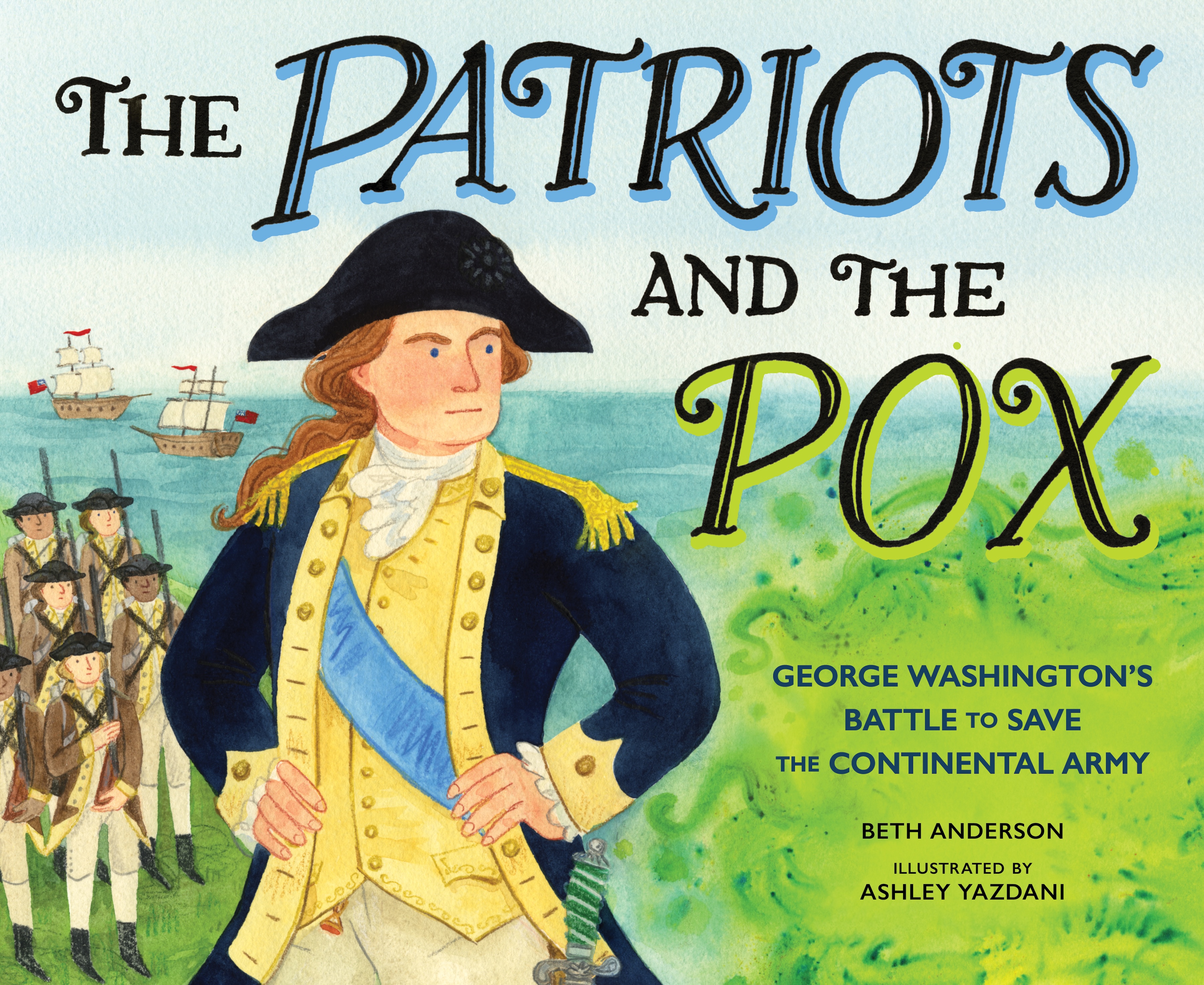
Every manuscript has its challenges. The toughest one with this book was TMI—too much information. This post shares a bit of that struggle and some strategies I used to battle that beast. If you’re interested in more, I’m doing a webinar for Rate Your Story on September 23. [interview and more info here]
Just as George Washington had to weigh options, consequences, and HOW to accomplish a task, so did I. Thankfully, I wasn’t dealing with life and death and the fate of a nation!
In this POST about THE PATRIOTS AND THE POX, I share some of the many topics I researched from military to medical to George Washington. His battle against smallpox involved the interconnection of so many concepts and so much (fascinating) context that it became overwhelming at times. (example: Did you know they had to burn the uniforms and blankets contaminated with smallpox? That certainly didn’t help an already under-supplied army!)
I needed to aim my sights as narrowly as possible while making complex concepts clear and bringing the emotion of Washington’s agonizing decision. Here are a few of my strategies that developed through the revision process.
Focus: What are you doing here?
Interrogate each scene. What is its purpose? How many “degrees of separation” is the content from the throughline and main topic?
Example 1: Say goodbye to your “darlings”!
I loved what I learned about the reading of the hot-off-the-press Declaration of Independence to the troops in New York City. It helped restore hope amidst losses and began to nurture much needed unity. BUT…While military losses were impacted by the disease, the document wasn’t directly related to the fight against smallpox.
(Did you know that Thomas Paine inspired the troops prior to their attack on Trenton with The American Crisis? Sigh. Another darling cut.)
If a scene is not directly related to your main story question, say good-bye. Then proceed with your “essentials.”
Flow: Making the most of Essential pieces
Once a scene or information piece has passed the purpose test, there are more questions to ask. Here are a few.
Essential Scene: but HOW?
Oftentimes, essential information becomes information dumps, boring spots that feel unrelated to the action and characters.
Example 2: Threading through the main character
Another piece that gave me lots of trouble was the military debacle and medical disaster in Canada. This directly impacted Washington’s decisions about how to defeat smallpox. He wasn’t there, but this “meanwhile up north” piece was vital to motivation, risk, and stakes. I could state that it happened and his reaction. But…as a scene, it was dramatic and could SHOW perfectly all his fears playing out. The question became:
How can I include this scene without disconnecting from the main character and the emotional plot?
The task here was placement, trimming, and connecting. My solution was to transition into the scene with Washington sending orders, and exit with the terrible news he receives. (all factual) I cut some of the drama, and the brief diversion stayed relevant, active, and didn’t break the flow as readers experience it through Washington.

Essential Context: Where do you belong?
There’s a tendency to want to prepare the reader by putting essential pieces of context up front. This can easily evolve into the dreaded info dump. Moving the paragraph doesn’t help. But…what if we look at it NOT as a paragraph, but as separate pieces of information and concepts?
For essential pieces of context, another question during revision became where. As I tried to amp up the narrative arc, I broke chunks of information into separate pieces and asked….
Where does the reader need to know this? Where is this key piece of context most impactful?
Example 3: Amp it up.
In the opening, I wanted the reader to get Washington’s emotional hit as he discovered his unruly troops. I wanted to share this essential context connecting lack of discipline with disease, though when you really consider it, it begs the question HOW and isn’t all that helpful.
“His undisciplined men with unsanitary habits made easy targets for contagion.”
As I revised, I found that “unruly” was more impactful four spreads later after readers witnessed the consequences of the chaos in Canada. In this turning point, lack of discipline isn’t background, it’s contributing to the arc with motivation, risk, and stakes. I’ve already SHOWed readers what happened with a scene, so now this pulls multiple ideas together concisely into Washington’s hard-hitting realization that allows the reader to understand not only his actions, but also how unruly soldiers related to disease. This revision was more specific and meaningful.
“The tragedy up north was proof he couldn’t risk inoculating soldiers who didn’t obey orders. Hundreds had died.“
The reference in the opening became more focused on one aspect of that unruliness, making that idea more concrete and contributing to the concept of quarantine coming next.
“His men roaming around made easy targets.” (Which was enhanced by Ashley Yazdani’s detailed illustration of an unorganized, undisciplined camp.)

Summing up here makes it sound easier than it was. It’s a process. It’s slow. And challenging. But each manuscript I attempt pushes me further along. I’ve learned so much from my peers and am grateful to editor Carolyn Yoder for drilling into me the motivation, risk, stakes mantra. Eventually, I won my battle against TMI in THE PATRIOTS AND THE POX with interrogation, torture (mine), and many discarded “darlings” in my wake. TMI requires a ruthless offensive! HUZZAH!

If you want to dig deeper, you can register here for the webinar. We’ll look at more examples and strategies, read the book, do Q&A, and have door prizes!
Registration includes a pre-order of the book!
Don’t forget to leave a comment below to get in the drawing for a copy of THE PATRIOTS AND THE POX! (US addresses only, please. Winner announced 9/25/26.)


Looove this line: How many “degrees of separation” is the content from the throughline and main topic? I need to keep that in mind for my own writing!
Also, this whole post is really enlightening. I may have to print it out and consider the advice side by side with the book to fully absorb how you revised it to work so well!
LikeLiked by 2 people
That “degrees of separation” was the only way my mind could distinguish between essential and connected but not essential. Gotta be ruthless! 😉
LikeLiked by 2 people
Congratulations again, Beth! This is such a great book. I loved reading the ARC!
LikeLiked by 2 people
Thanks so much, Kim!
LikeLiked by 1 person
Terrific, informative post! Agree about the “degrees of separation” idea, and think “threading through the main character” is very wise advice. I love Ashley’s tombstones so much!
LikeLiked by 1 person
Thanks, Lynn!
LikeLiked by 1 person
This is such a great book! You managed the info struggle well. There’s so much to think about when distilling the key elements into a few pages.
LikeLiked by 2 people
It’s not just so much information, but that I see so many important pieces that are hard to give up. 🙂
LikeLiked by 2 people
Thanks Beth for this insight into how you tackeled TMI. So very helpful. And congratulations!
LikeLiked by 2 people
Thank you, Lisa!
LikeLiked by 1 person
Such a great subject! And love how you became one with your subject in the TMI battle, ha!
LikeLiked by 2 people
Hard to let go of a good metaphor!
LikeLiked by 1 person
Congratulations on this amazing book! I love the mantra “Motivation, risk, stakes.” I’m going to write that and post it somewhere I can see it from my desk. 🙂
LikeLiked by 2 people
Thanks, Ann! Yep, that mantra ensures we build the emotional arc. 🙂
LikeLiked by 1 person
It’s so hard to “kill our darlings” when there’s so much great info we want to share! I’ve had that same problem! I’ve added some extras to back matter and some to educational resources for teachers and parents so it didn’t all feel wasted. Can’t wait to read your book!
LikeLiked by 2 people
I agree – back matter and the educator guide are great places to share a few of those extra darlings!
LikeLiked by 1 person
Thank you for sharing about how you consider the facts you find during research. With so much information, it’s a difficult decision what to include and what needs to be cut. I’m excited to read this book as I never heard about this life-threatening issue before and I’m always interested to learn how disease was treated/viewed in the past.
LikeLiked by 2 people
There’s just SO much info on the revolution and so much we never hear about. I really find this to be a fascinating period of history as minds were opening, critically thinking, and breaking traditions to blaze new paths in so many areas of life.
LikeLiked by 1 person
Thanks for sharing this! I am guilty of TMI.
LikeLiked by 2 people
I think TMI is a pitfall for most NF writers. But…I never consider the gathering of it wasted as that wider understanding always helps inform every word choice even when the info is not directly on the page. Still the focusing and framing challenge is tough. 🙂
LikeLiked by 1 person
I am counting the days to be able to read your latest book. Thanks for sharing how you handled the challenge of TMI. I will be thinking about the information you shared when I read the book.
LikeLiked by 2 people