Any kids who fill their pockets with rocks definitely need this book! In this post, Melissa Koch shares the spark that started STONE BY STONE: A ROCK’S JOURNEY THROUGH TIME and how she revised for the heart in this engaging approach.
GIVEAWAY! Leave a comment below for a chance to win a copy of STONE BY STONE from Melissa!
Congratulations to Ann McCallum Staats, winner of ANSWERING THE CRY FOR FREEDOM from Gretchen Woelfle!
The Heart of a Story Starts with a Spark by Melissa Koch
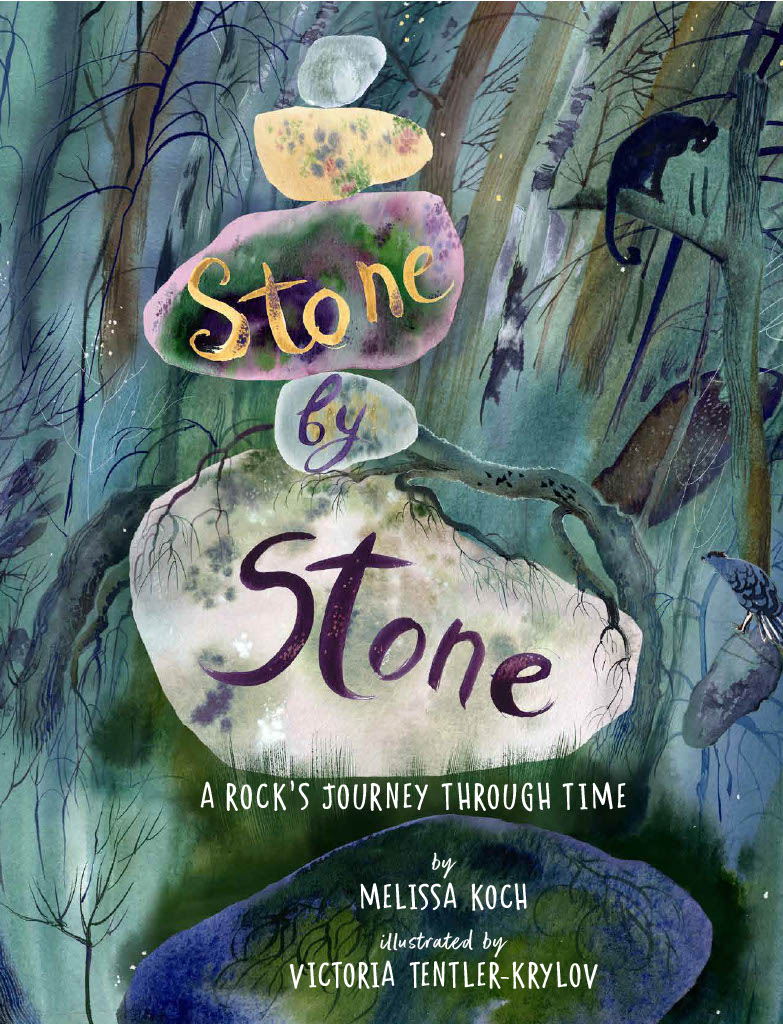
Sometimes a story spark appears when you notice something in the world. It’s like a hidden gem just waiting for you to find it. Other times you may be brainstorming (or daydreaming) story ideas when a story seems to come to you out of thin air. And sometimes—maybe most times—it’s both. For my debut picture book, STONE BY STONE, it started with a rock.
When I was a kid, I found rocks fascinating: their colors, textures, and shapes seemed infinite. In fourth grade when I learned that there are only three types of rocks—metamorphic, sedimentary, and igneous— and that each can become the other over time, changed by wind, water, heat and/or pressure, it blew my mind. This interconnectedness made me wonder about Earth’s cycles and where humans fit.
Plus, there’s something about the feel of a special rock that fits perfectly in your hand. Its warmth a grounding, a connection with the Earth.
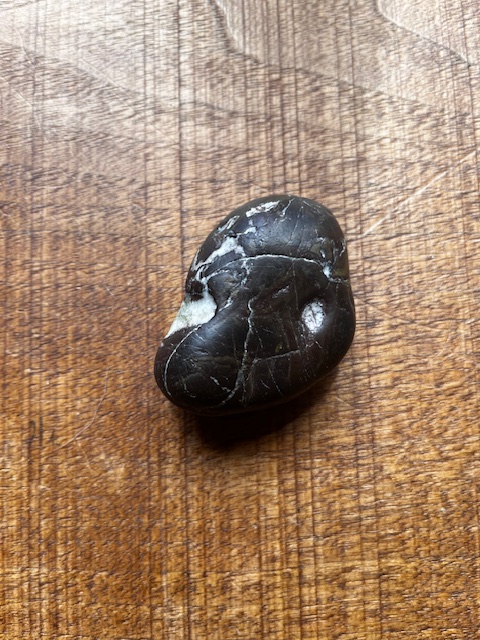
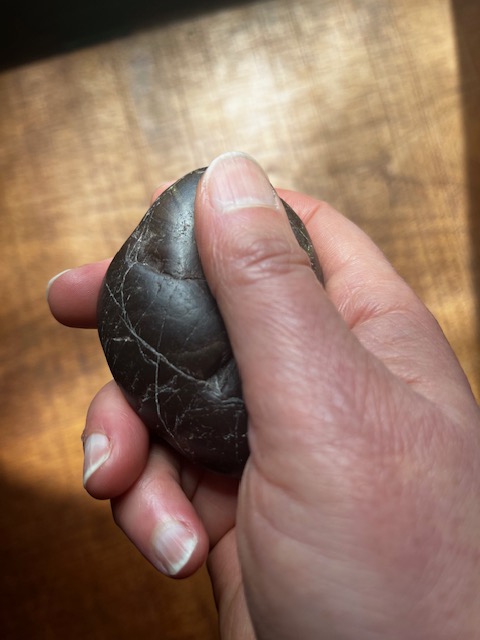
It wasn’t until many years later in an annual Storystorm (a January brainstorming of 30 story ideas in 31 days) that rocks re-emerged for me. For day #24, I wrote:
Rock walls. Our neighbors built a rock wall in the late 1800s. Not to keep anyone in or anything out, but to showcase the interesting rocks all around us. Kids (and adults too) put coins and messages between the rocks.
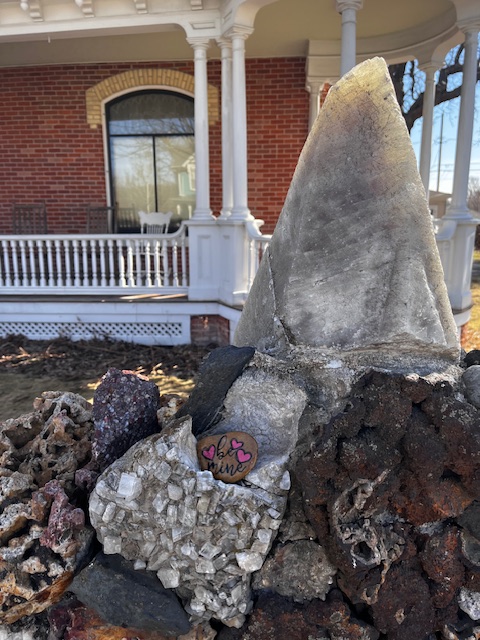
I realized that in all my travels, I gravitate towards rocks, rock formations, and stone structures: the monkey-shaped rock on a beach in Greece, the dry-stack stone walls that weave through the hillsides of Ireland, or the eerily inviting stones of the Karlov Bridge in Prague. On family trips, we explore rock formations, admire stone structures, and talk with stone masons about their craft. The many mysterious stone structures around the world beg to be explored!
From the first spark of a story, my heart has to be in the idea of the story in some way. That’s what inspires me to research and read to see what else emerges. Reading about ancient stone structures around the world, who built them, why they were built, how they were built, and what stones they used was pure joy for me. Having conversations with local stonemasons and geologists gave me more than the science, engineering and history of rocks and stone structures, it showed me these experts’ passion and heart for these often overlooked bits of Earth.
A story began to emerge from my readings, conversations, and personal experience visiting stone structures around the world. When thinking about a story, I think about the heart—the emotional arc—from the beginning. Why do I care? Why would kids care? What’s important to understand, to feel about this topic? Why is it important now?
I think about four main things when I write:
- Narrative arc.
- What’s the beginning, middle, and end of the story?
- What’s the structure?
- What belongs in the back matter vs. the story, and what’s the role of the back matter?
- Word choice. I love word banks. Word banks provide a place to play with individual words, their meaning and sound, associated with a theme or topic (e.g. rocks and stone) as well as phrases and ideas.
- Tone. What do I want readers to feel? What do I want to inspire them to think about?
- Emotional arc (aka the heart). The previous three—tone, words, and narrative arc—have to work in concert with each other and the emotional arc to achieve the heart of the story.
All of the above doesn’t just happen in the first draft of the story. I THINK about these four things and TRY to get them on the page, but it’s when I receive feedback and REVISE that I get at the heart of the story.
The narrative arc that emerged from my research revealed how we’ve built stone walls, castles and fortresses to separate us; and we’ve built bridges, homes, cities, and even small walls to bring us closer together. The story structure was naturally circular given the rock cycle and the fact that building anything starts with one stone. The editor saw the potential of having the rock cycle be the pre-story to the stone’s story, which definitely contributes to the story’s heart.
A part of the word choice came from a list of ‘re’ words I had kept that focused on transformation and connection (e.g rebuild, reclaimed). The prefix ‘re’ means to go back, to do again, anew. The mentor text, Undefeated by Kwame Alexander, showed the power of using words with the same prefix to tell a story.
I knew the tone of the story needed to be iambic (heart beat rhythm) and lyrical, mimicking the rhythm of stone work. Two-syllable words with the prefix re worked well. Breaking this rhythm also revealed the heart of the story.
The heart of STONE BY STONE: We are connected to the Earth and to each other. What we build together matters; it impacts us and the Earth. We, just like the stones, are unique, the same, and a part of something bigger: Earth’s cycles.
I can see the heart of the story—our interconnectedness—reflected in the illustrations for STONE BY STONE: A ROCK’S JOURNEY THROUGH TIME.
~~~~~~~~~~
“A book that’s as tactile as its subject, at once intimate and epic.” – Publishers Weekly, starred review
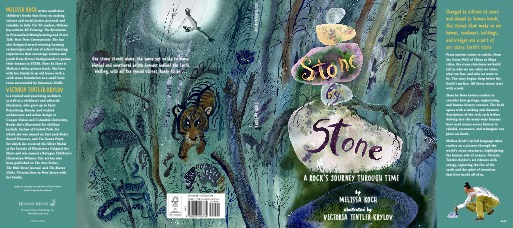
Melissa Koch writes nonfiction books for children and their teachers. Her nonfiction children’s books (picture books, middle grade, and young adult) focus on making science and social justice personal and valuable to readers. She lived in Silicon Valley for 27 years where she designed award-winning learning technologies and out-of-school learning experiences that encourage youth and young women from diverse backgrounds to pursue their dreams in science, technology, engineering, and mathematics. Her background in STEM informs her writing, teaching, and exploring of the natural world. Stone by Stone: A Rock’s Journey Through Time (Holiday House, August 4, 2026) is her debut picture book.
Don’t forget to leave a comment below to get in the drawing for a copy of STONE BY STONE! (US addresses only, please. Winner announced 5/22/26)
When you enjoy a book, please leave online reviews to support authors and illustrators. 😃


I can’t wait to read this exclamation mark. My twins are huge rock collectors. They’re 11 years old and I still have to check their pockets when I do laundry because they pick up interesting rocks everywhere they go!
LikeLiked by 2 people
Thanks, Destiny! My son’s idea of rock collecting overwhelmed me. Bags and bags of rocks. We had a return-to-nature day when he was around 11.
LikeLiked by 1 person
Thanks for sharing one, Beth. I’m going to look for it. There’s a bag of rocks on my dining room table as I type this. And when I moved from Colorado, I had to leave my own special collection behind.
LikeLiked by 2 people
Yay for rocks!
LikeLiked by 1 person
Melissa’s book is absolutely captivating! I, too, find rocks to be captivating out in the wild, as it were. But I took Geology 101 at university and found it dreadfully dull so I had to drop it 😆
(no need to include me in the drawing, thanks!)
LikeLiked by 2 people
Thanks, Teresa. That’s why we have the power of picture books: to take a dull topic and show all the amazing possibilities.
LikeLiked by 1 person
Yay! Stone By Stone is already an obvious mentor text for my own WIP — lyrical, theme of interconnectedness, NF!! Thank you for spotlighting it!
LikeLiked by 2 people
Thank you, Patricia! I hope STONE BY STONE serves you well as a mentor text. Good luck with your writing.
LikeLiked by 1 person
Melissa Koch: a monkey?? I shall have to control my urge to revisit those delightful pictures instead of working on my manuscript.
“…at once intimate and epic.” Wow — not too shoddy. This sounds a gorgeous book, and I can’t wait to read it.
LikeLiked by 2 people
That’s exactly what my son and husband said “a monkey??”. I think individual rocks speak to us in unique ways. That’s why we want to pick them up. I hope you enjoy the book!
LikeLiked by 1 person
Excellent, thought-provoking post, can’t wait to read the book!
LikeLiked by 2 people
I love the message of this book and can’t wait to read it. I enjoy geology and took classes in college.
LikeLiked by 2 people
I’ve always loved rocks too. Thanks for sharing how this book came to be, from your spark of an idea, Melissa, through to its bigger message. I’m excited to check it out!
LikeLiked by 1 person
I love this idea! Can’t wait to read it! We have many rocks on our shelves!
LikeLiked by 1 person