Educators! Here’s a terrific science activity using carnivorous plants and a new book from author and science educator Jessica Fries-Gaither!
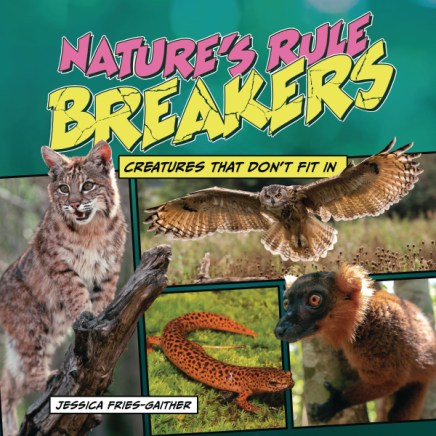
AND Jessica is offering a GIVEAWAY! A copy of NATURE’S RULE BREAKERS: CREATURES THAT DON’T FIT IN! Just leave a comment after the post to be entered in the drawing.
Congratulations to ejdthomasville winner of Kelly Rice Schmitt’s giveaway of a copy of I SHIP or a 30-minute brainstorming session on backmatter! 
Investigating the Structure and Function of Rule-Breaking Plants
by Jessica Fries-Gaither
While we teach students to organize living things into neat (and often binary) categories, there are always exceptions that just don’t quite fit. My latest picture book, Nature’s Rule Breakers: Creatures That Don’t Fit In, explores eight common categories used in science and the animals that don’t play along. Sharing this book with students is a great way to engage in a conversation about biodiversity. And even though animals are the focus of the book, there are plenty of plants that break the rules, too.
Carnivorous plants such as Venus flytraps, pitcher plants, and sundews are rule-breakers: they digest other living things (insects and small animals) for nutrition. While they still perform photosynthesis like other plants, they live in nutrient-poor soil and thus need to supplement what they can get through their roots. These plants have evolved a variety of physical parts for attracting and trapping prey, making them a great way to introduce students to the concept of structure and function. Structure and function, or the idea that the way an object or living thing is shaped and its substructure determine many of its properties and functions, is one of seven cross-cutting concepts in the Next Generation Science Standards and an idea that weaves its way throughout many scientific concepts.


Here’s a simple instructional sequence to help students identify the concept of structure and function in carnivorous plants.
- Read and discuss Nature’s Rule Breakers.
- Direct student attention to the back matter which introduces pitcher plants as an additional rule-breaker. Read this section and explain that pitcher plants belong to a larger group of carnivorous plants. If needed, review the word carnivorous to ensure that all students understand that carnivorous plants use other living things for energy and nutrients.
- Display (or distribute printed copies) pictures of various carnivorous plants and allow students to browse them. This article from National Geographic Kids presents a nice variety, although you’ll need to show students the pictures without the captions which could give away the answers.
- Ask students to select one type of carnivorous plant to focus on. Invite them to examine the picture closely with this question in mind: “How do the structures (parts) of this plant help it eat insects?” You can deepen students’ observational skills by having them draw a sketch of their plant rather than just look at a photograph, and you can integrate literacy into the task by asking them to respond to the question in writing.
- Provide time for students to share their individual plants and ideas with the rest of the class. This might look like a gallery walk to view sketches and read written responses, partner sharing, or even a whole class conversation. You might choose to track student thinking on chart paper in a two-column t-chart labeled “Plant Structures” and “Functions (Jobs).”
- If students need more exploration of this topic, you might choose to let them read nonfiction picture books about carnivorous plants, including Pretty Tricky: The Sneaky Way That Plants Survive by Etta Kaner and Ashley Barron.
- If you’d like to assess students’ understanding of structure and function with respect to carnivorous plants, you could invite them to compare a carnivorous plant with another type of (non-carnivorous) plant. Ask students: What structures does the [carnivorous] plant have that the other does not? Why might the [carnivorous] plant need those additional structures? Why doesn’t the other plant need them?
 Enjoy exploring the fascinating world of rule-breaking plants!
Don’t forget to leave a comment below for a chance to win your very own copy of NATURE’S RULE BREAKERS! (US addresses only, please. Winner announced 12/15/23)
If you enjoy a book, please share a review online. Authors are very grateful!
Bio: Jessica Fries-Gaither is an award-winning author of books for children and teachers. Her writing introduces readers to the wonder of the natural world and the work of scientists, past and present. Her first children’s book, Notable Notebooks: Scientists and Their Writings, was named an Outstanding Science Trade Book for Students K-12 by NSTA and the Children’s Book Council and was read aboard the International Space Station by astronaut Joseph Acaba as part of the Story Time From Space program. Exemplary Evidence: Scientists and Their Data, her second title, was also named an Outstanding Science Trade Book for Students K-12. Her third picture book, Nature’s Rule Breakers: Creatures That Don’t Fit In, was published by Millbrook Press in October 2023 and is a School Library Guild Gold Standard Selection. Learn more at her website, www.jessicafriesgaither.com and follow her on Facebook at https://www.facebook.com/jfriesgaither, on Twitter and Instagram at @JessicaFGWrites, and on Blue Sky at @jessicafgwrites.bsky.social.
Photo credits:
Venus Flytrap. Photo by Elizaveta Mitenkova: https://www.pexels.com/photo/exotic-plant-growing-in-garden-12463886/.
Pitcher Plant. Photo by Najman Husaini: https://www.pexels.com/photo/close-up-photograph-of-a-pitcher-plant-11144486/.
Sundew. Photo by eveli rammul: https://www.pexels.com/photo/roundleaf-sundew-18187685/.
 Beth Anderson, Children's Writer
Congratulations to Jessica and Millbrook Press on a fantastically delicious looking book. I can’t wait to read it and also evaluate the back matter for future use. I like a lot of the books that Jessica has already written and I am a big fan of just about anything that Millbrook Press puts out. The suggestions and lesson plan that went along with this blog are fantastic and fun and interesting. Please enter me in this drawing. Thanks for the consideration and wishing everyone happy holidays and good health. Stay creative friends.✌️💙🎵🎨📚
LikeLiked by 1 person
I enjoy reading books like this one and learning new facts about nature. The photographs are amazing.
LikeLiked by 1 person
I tried posting before, so I apologize if this is a duplicate! But, I wanted to say that this book sounds like fun for both kids and adults…I look forward to reading it!
LikeLiked by 1 person
Congratulations Jessica! I had an idea to write about this very topic. Great minds think alike but your mind got to work and wrote it! I look forward to reading your book. 🙂
LikeLiked by 1 person
This looks fascinating! I know I have readers at my school who’d grab this one up right away.
LikeLiked by 1 person
Rule breakers? I am intrigued by the title and excited to share the book with my readers.
LikeLiked by 2 people