Welcome to Keila Dawson, a fellow member of Kid Lit For Growing Minds, a group of kid lit creators whose books cross curricular areas and support educators. Keila’s got a delicious activity to use with her latest release, YUMBO GUMBO, that brings math into the kitchen in the best way, merging learning, culture, and food!
Keila’s offering a GIVEAWAY, too—a copy of YUMBO GUMBO to one lucky person who comments below.
Congratulations to Cindy Boyll, winner of Kirsten Larson’s giveaway! A copy of Reimagining Your Nonfiction Picture Book or half off an annual membership to the Reimagine Insiders community
 Using Storytelling to Teach Math in the Primary Classroom
By Keila V. Dawson
Thanks for having me on your blog, Beth! I’m so excited about sharing an idea with primary teachers for using YUMBO GUMBO in the classroom. It’s part of the Charlesbridge Storytelling Math series spearheaded by editor Alyssa Pusey. I also worked with Marlene Kliman, at TERC, an organization of math experts, researchers, and leaders in K-12 STEM education. The intent of books in this series is to expose children to solutions to problems using math. And for them to see authentic storytelling from the lens of different cultures.
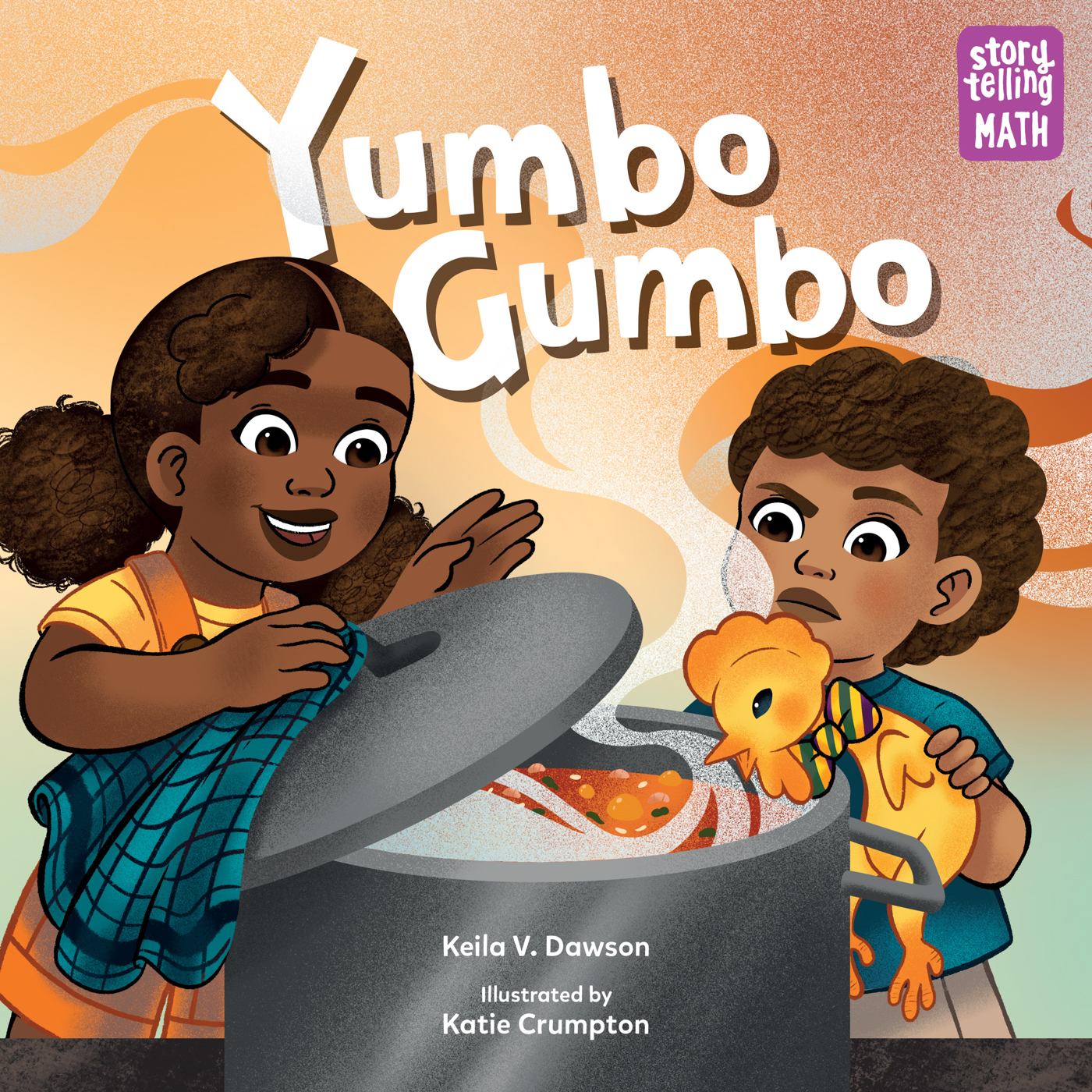
In YUMBO GUMBO, a young girl in Louisiana is excited about her first gumbo cooking lesson. But her family of six can’t decide what kind of gumbo to cook for dinner. The main character, Annabelle, wants okra gumbo and her little brother Beau wants chicken. So they try to resolve their conflict fairly through voting. When their first vote ends in a tie, she adds a third choice, hoping okra will be the winner. Mais là! I can’t believe it! That vote ends in a tie, too! Annabelle really wants gumbo for dinner and must come up with a clever solution—voting for their unyumbo gumbo. When she changes the vote to their least favorite, there’s a clear winner. But the story doesn’t end there because her little brother is still upset that he didn’t get his way. And Annabelle finds a YUMBO way to solve that problem.

The target audience for books in this series are 3-6-year-olds, so it’s important that these young children can follow the math. For example, a 3-year-old can only hold a small amount of information in mind at one time, so the characters stand next to their favorite of the two gumbos in the first vote. They can see the results of the tied vote in the illustrations. How is it possible to break the tie? Annabelle’s reasoning is to add a third gumbo. Now children see the six of them voting on three gumbos. But that didn’t work, either. The illustrations show how the characters move to vote because a 3 or 4-year-old wouldn’t have had the same exposure to pictures, tallies or graphs like a kindergartner or first grader.
Also, in this series, the main character should solve the story problem through mathematical reasoning. And the young children should be able to follow their reasoning as it develops over the course of the story. Besides math, the Storytelling Math books incorporate an emotional element, and show math in real-life situations.
I designed this comparing data activity for 5 to 6-year-olds who have had experience with concrete to representational math instruction.
Comparing Data Using Yumbo Gumbo Activity
- Before Reading
Discuss mathematical vocabulary and concepts needed to understand Annabelle’s thinking. Definitions are from the Merriam-Webster dictionary:
- more: “resulting in an increase in amount or number”
- least: “lowest in importance or position”
- tie: “to make or have an equal score with in a contest”
- During reading
Copy these bar graphs on chart paper, a whiteboard or download the worksheets from my website. As the teacher reads YUMBO GUMBO, have students record the data from each vote using a different color for each gumbo.

- After reading
Have students complete the True or False worksheets. Download here.
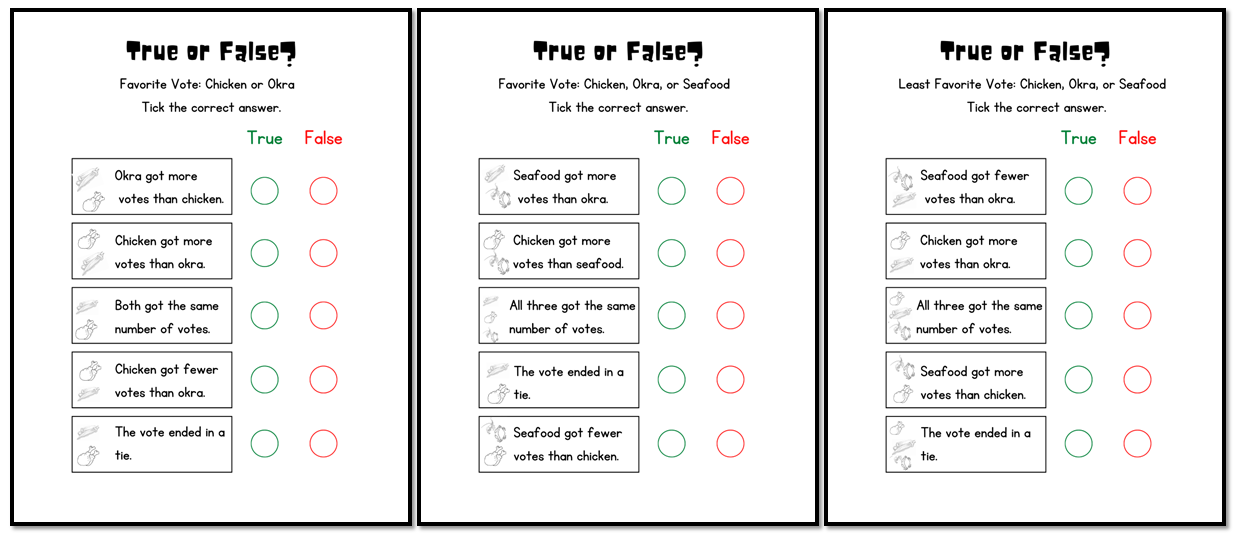
Download the two-page activity kit, get the grocery list, watch instructional videos, and follow the recipeto make your own Yumbo Gumbo!

Don’t forget to leave a comment below if you’d like to be entered in the giveaway for a copy of YUMBO GUMBO. (ships to US addresses only. Winner announced 2/16/24.)

Keila V. Dawson is a two-time Ohioana finalist and former educator who writes fiction and nonfiction picture books. Her books have been featured on numerous best books lists, state reading lists, and nominated for various awards. She is a coeditor of No World Too Big: Young People Fighting Global Climate Change, a companion title to the International Reading Association Children’s Book Award-winning title, No Voice Too Small: Fourteen Young Americans Making History, and the forthcoming No Brain the Same: Young Neurodivergent Activists Shaping Our Future. She is the author of Opening the Road: Victor Hugo Green and His Green Book, The King Cake Baby and Yumbo Gumbo. A New Orleans native, Dawson has also lived and worked in different states, and abroad in the Philippines, Japan, and Egypt. She lives in Cincinnati, Ohio.
Find out more about her and her books at www.keiladawson.com . Follow her on Facebook, Instagram, Twitter/X, and Bluesky.
If you love a book, please take a moment to leave reviews online. Authors appreciate your support!
 To learn more about Kid Lit for Growing Minds, subscribe to our free newsletter featuring articles from authors and illustrators, mini’s for the classroom, book news, events, BOOK BUNDLE GIVEAWAYS, and more! To see our books, visit our website here. For a variety of mini’s for the classroom, visit our YOU TUBE CHANNEL here.
 Beth Anderson, Children's Writer
You have so many fun resources! Looking forward to reading this next week and adding to my storytelling math collection. I love this series.
LikeLiked by 1 person
Thanks, Stacy! I wish there were books like this when I was a kid struggling to learn math concepts.
LikeLiked by 1 person
What a great idea! Kids respond to concrete examples better than abstract concepts at first and this looks like a YUMBO GUMBO way to help them along!
LikeLiked by 1 person
Thanks, Chris. These were fun to create!
LikeLiked by 1 person
You are so great at coming up with helpful extension activities. Love this book and this post!
LikeLiked by 1 person
Aww, thanks, Lindsay. Once a teacher, always a teacher. LOL!
LikeLiked by 1 person
What fun! Such a gift!
LikeLiked by 1 person
Thanks, Donna!
LikeLiked by 1 person
I second what everyone else said! 🙂
LikeLiked by 1 person
Thanks, Teresa!
LikeLiked by 1 person
I’ve always loved the idea of using recipes to teach math–thank you for the wonderful activity ideas and chance to win a copy of this yummy and fun book. So many readers will relate to this family.
LikeLiked by 1 person
Thanks for reading, Danielle!
LikeLiked by 1 person
Keila, Congrats on your latest book! I’m so luck to have a copy now. I just want to say, it’s a wonderful story–I love how it combines the food and culture of New Orleans, the sibling/family element, AND math!
LikeLiked by 1 person