It’s a nonfiction writer’s worst nightmare! All your research, meticulous questioning, and writing suddenly hit with a sledgehammer of doubt…YIKES! It’s stressful just to think about it! But fortunately author Patricia Newman and her editor found their way through, and even added another layer of “interesting” to a gorgeous book!
Fake News?
by Patricia Newman
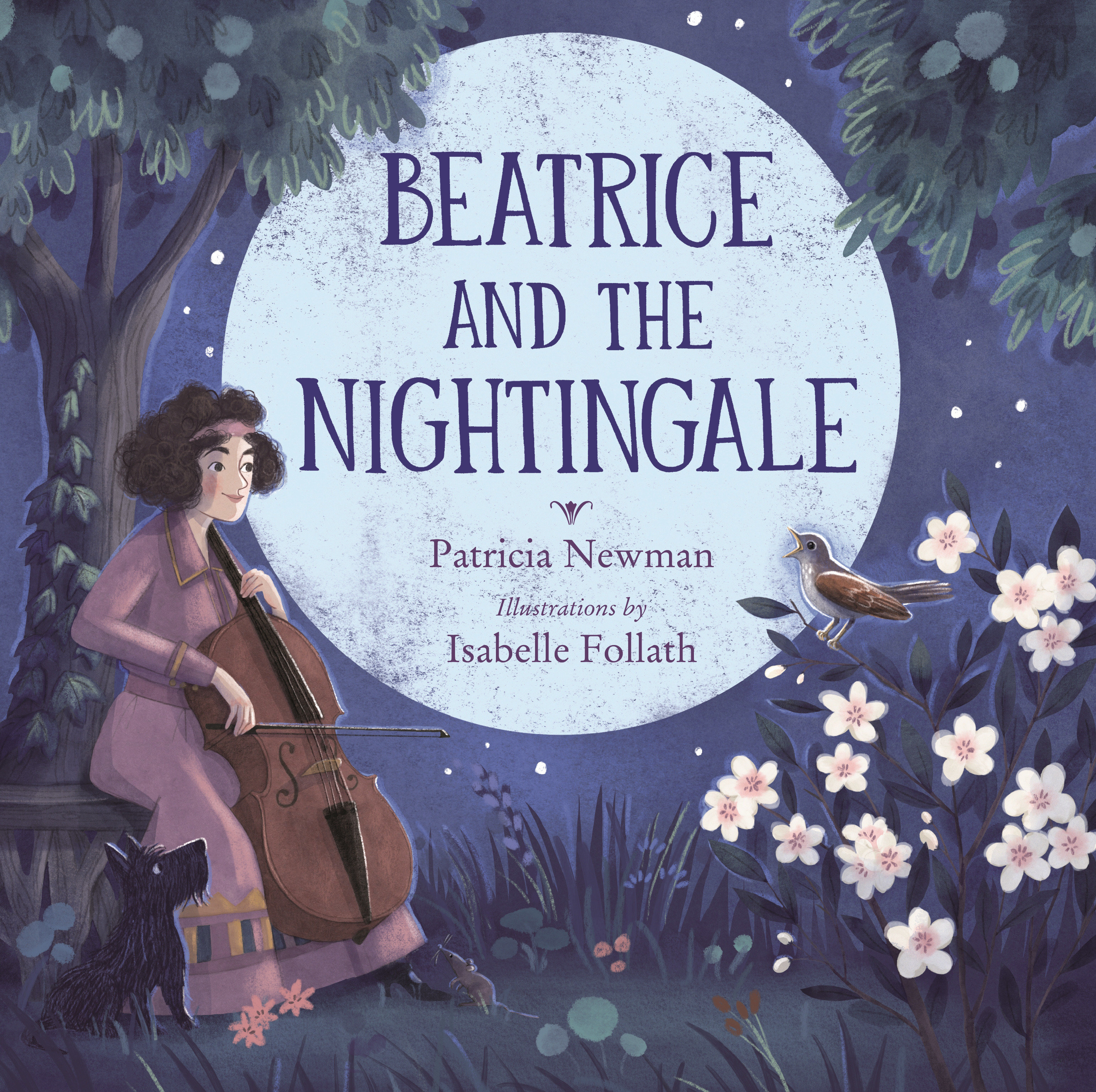
Imagine this scenario. You write a nonfiction book about a famous young cellist who, while practicing in her garden in 1924, hears a nightingale sing along. Our young cellist, Beatrice Harrison, convinces the fledgling BBC to come to her garden and broadcast the duet to their listeners.
Millions of listeners tune in to hear birdsong broadcast over the airwaves for the first time. Beatrice receives thousands of letters from people all over the world. Listeners’ backyard nightingales sing when they hear the broadcast. People without radios listen to friends’ radios via telephone. People who live in places without nightingales hear one sing for the first time. The broadcast is a triumph!
In July of 2022, a wonderful editor sees magic in Beatrice’s story, but before you sign your contract, the “BBC reveals that famous nightingale and cello duet was faked” (Discover Wildlife, 12 April 2022)
This exact sequence of events happened to me before I signed my contract for Beatrice and the Nightingale (Margaret Quinlin Books/Peachtree Press, 2026). I still remember the panic I felt then.
After writing a score of nonfiction books, I’d become an excellent researcher digging into primary sources, articles, studies, videos, and more. For Beatrice and the Nightingale, I read an annotated copy of Beatrice Harrison’s diary. I listened to recordings of her cello concerts. I read articles about how the BBC engineers visited Beatrice’s garden to place “a microphone in a thicket of oak leaves and connected it to amplifiers stacked in the summerhouse” (p. 30, Beatrice and the Nightingale). I had dates, details, and Beatrice’s own writings. Beatrice herself secured the permission of Sir John Reith, director of the BBC. When King George V of England met Beatrice, he said, “Nightingale, nightingale, you have done what I have not yet been able to do. You have encircled the Empire with the song of the nightingale with your cello” (p. 38, Beatrice and the Nightingale).
How could the duet be fake?
Luckily my editor said, “I would like to get to the bottom of what we know. I don’t think it kills the book. In fact, it makes it more interesting” (July 2022 email). So, I went to work!
In April 2022, a bird expert appeared on a podcast called Private Passions. He claimed the nightingale in Beatrice’s garden never sang at all and a bird mimic hired by the BBC had filled in. As I listened to the podcast, he played a supposed 1924 recording of Beatrice playing cello while a nightingale sang. But how was that possible? The 1924 broadcast was never recorded.
Then I turned to Patricia Cleveland-Peck, the editor who annotated Beatrice’s diary. Boy, did she have a few words to say! Would BBC boss Sir John Reith have “countenanced such a deception?” Would Beatrice with her musician’s ear have been so entirely duped? Would she have allowed such a scandal to tarnish her integrity? Did no one see the bird mimic? The garden wasn’t that large.
Throughout the editing process, we opted to keep my original manuscript intact, as I researched it from Beatrice’s diary, with only the usual editorial revisions for clarity, and addressed the alleged hoax in the back matter. As we worked with illustrator Isabelle Follath, a May 2024 BBC article proclaimed, “There is no way it was fake” (“New evidence uncovered on cello and nightingale,” 19 May 2024).
Phew! We sent the final files to the printer at the end of July 2025.
Nonfiction authors are often confronted with conflicting facts, and we do our best to make sense of them. The back matter of Beatrice and the Nightingale goes into the so-called fake in more detail. As I say in my author’s note at the end of the book, “I love this meeting of music, nature, and science.” I hope you pick up a copy of Beatrice and the Nightingale and judge for yourself.
😃 When you enjoy a book, please support authors and illustrators by leaving online reviews.
Sibert Honor author Patricia Newman empowers us to find our own connections to nature and encourages us to use our imaginations to make the world a better place. Patricia’s love of nature and her own efforts to play piano seemed the ideal background for Beatrice and the Nightingale, a true story about the intersection between nature, music, and technology. Patricia’s titles have received multiple starred reviews, two Orbis Pictus Recommended Awards (NCTE), two Green Earth Book Awards, and several Eureka! Awards (CRA). All her nonfiction titles are Junior Library Guild Selections, and most have been included in the Bank Street College’s Best Books of the Year lists. To learn more about her books and her Teach the Hope initiative, visit her website at patriciamnewman.com or connect with her on Bluesky, Instagram, X/Twitter, and Facebook.
 Beth Anderson, Children's Writer
Fascinating, Patricia. I will definitely pick up a copy of your book. I want to know more! I mostly write fiction, but have a few nonfiction books and also a few inspired by nonfiction. I always promise myself in the middle of the writing that I will never write another nonfiction story again. Ha. Congratulations to you for being such a good researcher and persevering through.
LikeLiked by 1 person
Wow. What a story behind the story. Can’t wait to read this one!
LikeLiked by 1 person
Wow, the story behind the writing of this book is as gripping as any novel! Poor Patricia…her panic at the initial “fraud” news is palpable. The is one of our big fears as NF writers for sure.
LikeLiked by 1 person
Congratulations Patricia on not giving up and your approach. What a fascinating story!
LikeLiked by 1 person
absolutely fascinating! Thanks for sharing.
LikeLiked by 1 person
What an interesting backstory! Congratulations, Patricia!
LikeLiked by 1 person
Wow, you must have been so disappointed and frustrated for a while there. I’m very glad there was such a happy ending. The book looks beautiful, congratulations!
LikeLike
Oh, this would have given me a heart attack! I remember feeling panicked at finding a “breaking” research article that suggests the dust that finally reaches the Amazon doesn’t come from the Sahel but from much farther west in the Sahara. But no one knows for sure. So I felt compelled to include and post the uncertainty in the back matter. But when the possible “fake news” is at the core of the story, well, sheesh! I’m glad it turned out that all was well. It does add to the interesting backstory for the book! Congrats, Patricia!
LikeLike
Never have I read a more nail-biting account of writing, editing, and (potentially) revising a picture book! Whew! indeed!
LikeLike