It’s so exciting to see budding authors I met at a retreat in 2016 releasing books like this! The title of this post by author Elizabeth Brown is a question I’ve heard often from writers. I was surprised by the length of this amazing book, but I have to say, the pace never faltered. Such a tremendous story! And so beautifully and effectively told!
Should I Write This as a Picture Book or a Middle Grade?
by Elizabeth Brown
The World Entire: A True Story of an Extraordinary World War II Rescue by Elizabeth Brown, illustrated by Melissa Castrillon (Chronicle 2025)
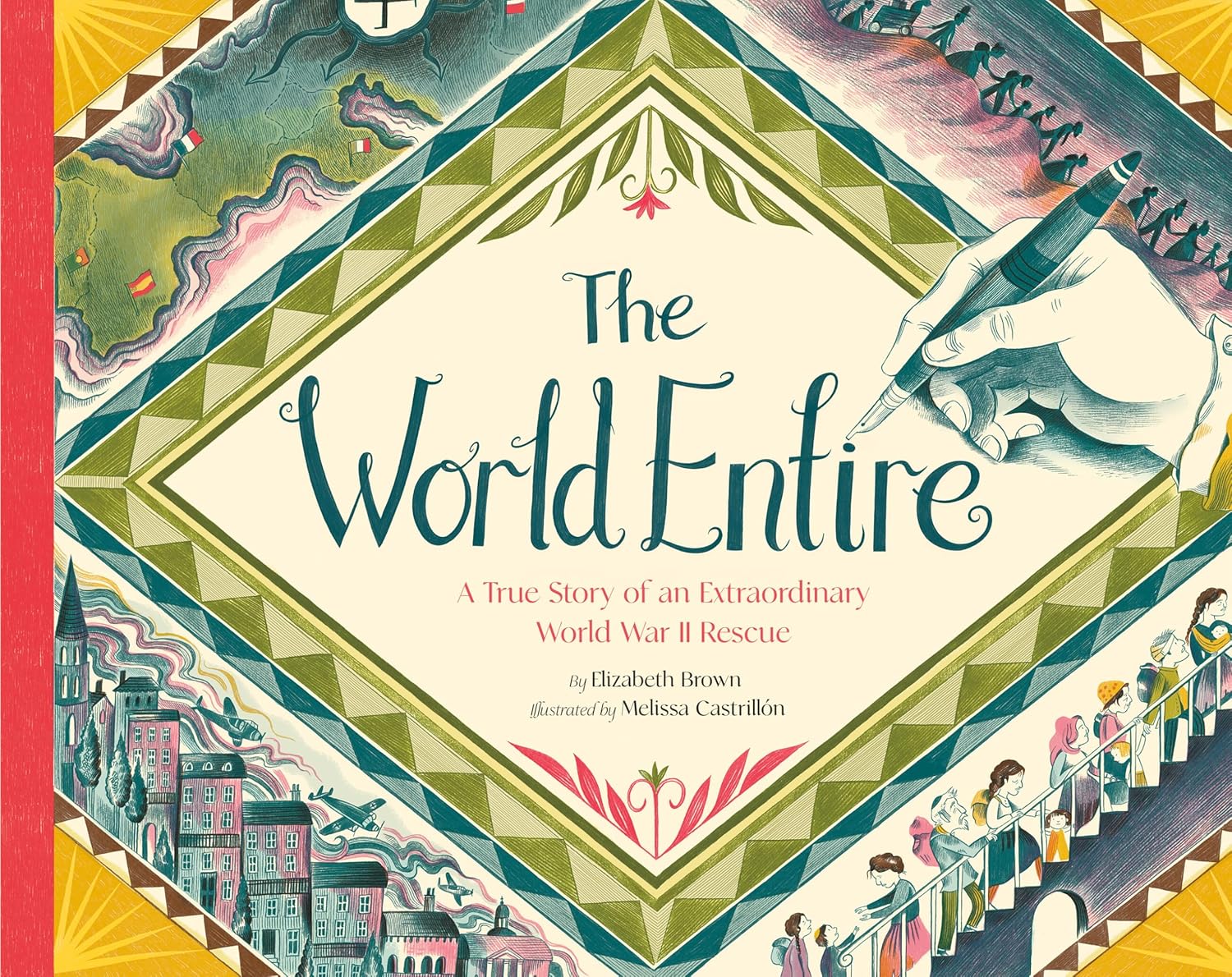
The World Entire: A True Story of an Extraordinary World War II Rescue tells the story of Aristides de Sousa Mendes, a Portuguese diplomat in France, who must decide whether to disobey his government or offer visas to the thousands of refugees fleeing France during World War II. He ultimately sides with his conscience and signs visas, saving countless lives, a choice that costs him but that he never regrets.
When I first started writing this book, I wondered: Is this a nonfiction picture book or a nonfiction middle-grade book? I wrestled with this for many months. I tried it as a middle-grade novel, due to the subject matter and how it would fit within the standard curriculum subjects and grade levels. I worked on developing the flow and a strong narrative style, but I could not get the story to gel. I finally realized that I wasn’t paying attention to the voice in my head shouting…this needs to be a picture book!
I’m glad I listened to that voice.
Once I started working on it as a picture book, the writing process soared, but it still took a long time to get everything right. Writing it as a picture book allowed me to reach readers of all ages, from elementary through even young adult readers, who could learn about Aristides de Sousa Mendes and his heroic actions. A picture book possesses the power to touch readers, no matter their age.
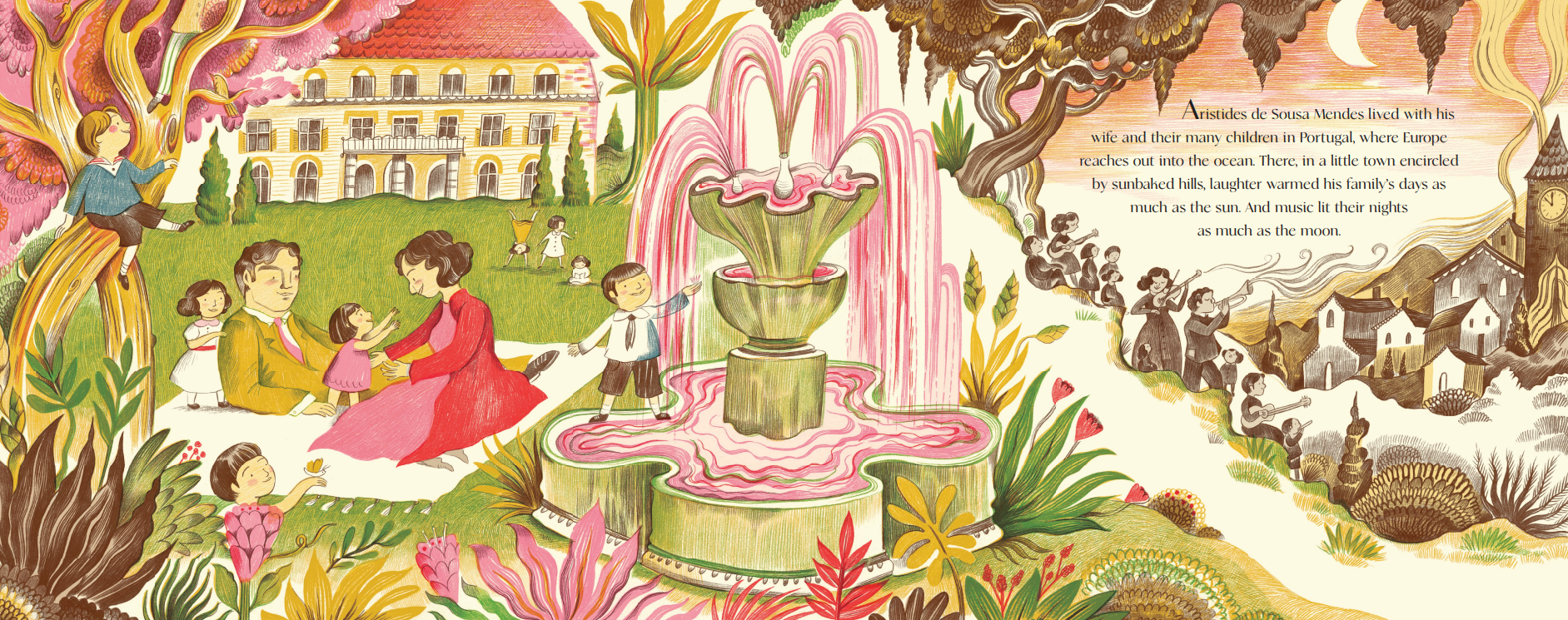
As a picture book, the subject matter required planning, pondering, and revising for word choice, phrasing, and how to tell the story in a way that the youngest of readers might understand. This is where the challenge really started, but it also provided the greatest joy and discovery. My favorite part of creating the book was exploring ways to make this story accessible and also lyrical. I also did not want to water down any of the historical facts about this time in history. As the story developed over many drafts, here were two of the most challenging aspects of writing this story as a picture book, and how I solved them:
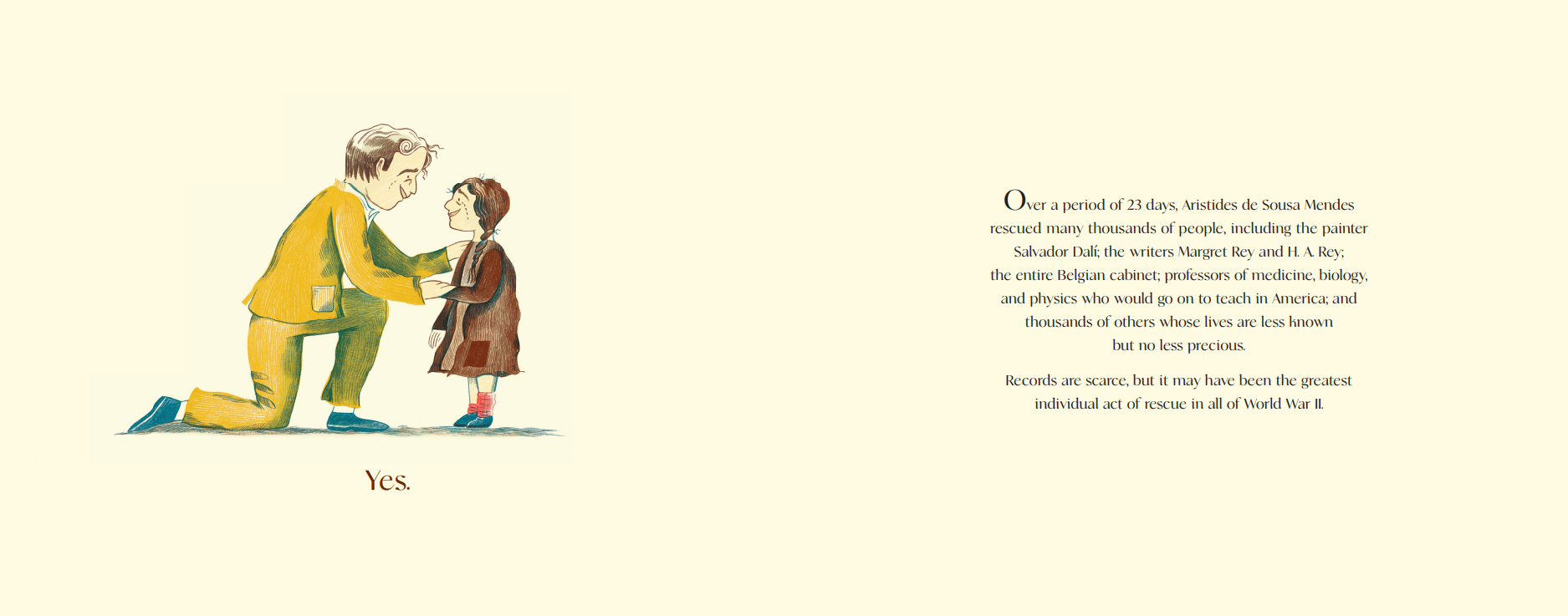
- How will I tell the story, but also emphasize the message that every life is equally important and deserving? It is definitely built into the story through the actual events and deeds that Aristides performed, but I wanted it to be understood by the youngest of readers. I wanted the message to come through without saying it or being too “on the nose.” After working on this aspect in draft form, the solution came by having a recurring element of naming various refugees from all backgrounds, ages, and jobs who received visas with a call-and-response style of writing, which happens three times, in the beginning, middle, and again at the end of the book. Here is an example from the one in the middle:
A family of musicians? Yes.
An engineer? Yes.
A professor? An artist? Yes. Yes.
A mother? A carpenter? A child? Yes, yes, yes.
This allowed me to showcase the refugees themselves, emphasize that all refugees were important, and provide a compelling way to explain the events for younger readers. Once I did this, the rest of the text flowed more easily.
- All along, I worried about the length of the story. Would I be able to tell this story as a picture book and make it work in terms of the content? I tried to tell the story in scenes as much as possible, planning it on index cards like scenes in a movie script. I wanted the book to have a cinematic quality to it, and with the illustrations, I hoped that readers would feel an expansive experience as they read the weighty subject matter, but also be inspired by Aristides’ deeds. I finally got it to the point where the length seemed to work, even though it is a longer picture book. It has extensive back matter that includes an author’s note and timeline, as well as quotes and sources to make sure all the necessary context is accounted for in the book.
Overall, the greatest aspect of writing this book has been sharing it with young readers everywhere. I hope children will get to know who Aristides de Sousa Mendes is and realize that one person can make a difference.
😃 When you enjoy a book, please support authors and illustrators by leaving online reviews.
 Beth Anderson, Children's Writer
Yes, I’ve definitely struggled with the question myself many times! And recently, I also struggled with “Should I write this as prose, poetry, or graphic format?” Congratulations to Elizabeth on her new beautiful book! Love the title, too.
LikeLiked by 1 person
Thank you for pin-pointing and showing how you solved the problems, Elizabeth. Can’t wait to read it myself.
LikeLiked by 1 person
I love the solution to the first issue! Says so much more than the words!
LikeLiked by 1 person
I found this book in our library and loved it! I felt the same way; despite its length, the pacing never lagged. And Chronicle never falters when it comes to releasing a long picture book. I’m glad they’re in the publishing ecosystem. And it’s interesting to hear about Elizabeth’s quandary, her final decision to write it as a PB, and how to make it approachable for even the youngest reader.
LikeLiked by 1 person
I always appreciate learning how an author finds solutions to the problems. 🙂
LikeLiked by 1 person
Fascinating, Elizabeth…both the story and how you managed to bring it to life in a picture book. I’m looking forward to reading it 🙂
LikeLiked by 1 person
So good!
LikeLike
What a challenge to write this story for a wide swath including “the youngest of readers.” In addition to the subject matter itself, the story necessitates explanations of geography, borders, and occupation. I agree with everyone that the pacing is great — the tension and timing of the emotional beats keeps me in! I immediately looked up more information on Aristides de Sousa Mendes, as I’m sure many young readers will, too. Beautiful book about a beautiful man.
LikeLiked by 1 person
I mentioned The World Entire during a program with homeschool students this week. We were talking about different types of picture books and their structures. I’m grateful you found the right publisher for The World Entire. I’ve struggled with a manuscript that several have said is a MG. Sigh. I’ll figure it out.
LikeLiked by 1 person
Seems what I heard at our last conference from multiple people was the value of playing with a story by using varied forms as each brings out something special. Good luck!
LikeLike
That’s for a great post Beth and Elizabeth. It was very enlightening to read how you solved some of the issues in making this story a PB. I am excited from my hold to come in at my library.
LikeLiked by 1 person
and YOU were one of those incredible kid lit people that was at that 2016 retreat too! So glad I met you both!
LikeLike
Congratulations on your book! I’m so happy I stumbled on your blog. I just started writing children’s books and am so fascinated by other authors’ writing processes. 🙂
Wow, your book is beautiful! I love books about history, especially books for young people, that don’t shy away from heavier subject matter. I think you did this beautifully!
LikeLiked by 1 person
I’m so glad you found the blog too! That’s why I started it – we can learn so much from each other!
LikeLike
Looks like a beautiful book!
LikeLike