Here’s another fantastic book from one of the Kid Lit for Growing Minds members! In this post for educators and librarians, author Lisa Rogers, a former library teacher, shares how WOODY’S WORDS: WOODROW WILSON RAWLS AND WHERE THE RED FERN GROWS can be used as a springboard for students to practice a growth mindset.
GIVEAWAY! 🥳📕 Just leave a comment below to be entered to win a copy of WOODY’S WORDS!
Congratulation to Heidi Chupp, the winner of BEFORE I LIVED HERE by Stacy Jensen!
Who Helps You Shine? Embracing a Growth Mindset to Reach Your Dreams
By Lisa Rogers
Have you ever wondered what life would be like if your favorite piece of music, art, or book didn’t exist? What if the person who was making it never finished — or didn’t even start?
I have, especially after learning about the life of Wilson Rawls, the author of the classic novel Where the Red Fern Grows.Rawls gave up on a long-held dream to become a published author, but when he told his wife his dream, she wanted to help.
Rawls, nicknamed Woody, accepted that help. It worked: Woody published Red Fern in 1961 and another novel, Summer of the Monkeys, in 1976. “She made him shine,” Sophie’s niece told me.
Without Sophie, it’s unlikely that those two books would have been published.
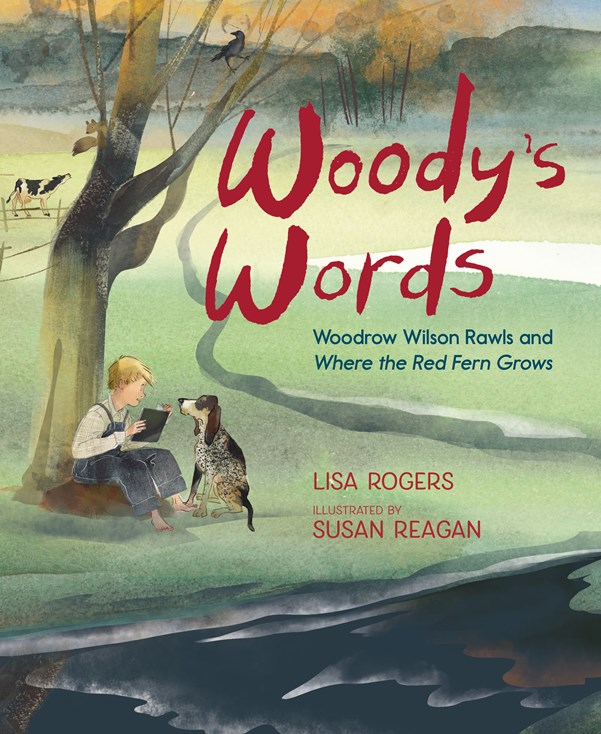
Learning that Woody burned his writing moved me to research and write the picture book biography Woody’s Words: Woodrow Wilson Rawls and Where the Red Fern Grows, illustrated by Susan Reagan (Calkins Creek/Astra, 2025).
One reason why Woody’s story resonated was because I almost gave up my writing dream. As a child, I didn’t have Woody’s struggles, but I lacked confidence. I didn’t know anyone who was a writer and could not imagine how to become one. Later, I dedicated myself to my goal, but good wasn’t good enough, and I almost gave up.
So I created a growth mindset—the strategy originated by Stanford psychologist Carol Dweck. I pushed myself further, embracing mistakes as a way to learn more. I accepted help and encouragement from writer friends, continued to improve,
and I reached my goal.
Educators can help students build a growth mindset by sharing Woody’s story. It might seem to students like success comes easily, but success most often requires lots of practice, trial and error, persistence, and help.
After reading and discussing Woody’s Words: Woodrow Wilson Rawls and Where the Red Fern Grows, students can practice embracing a growth mindset in their writing.
Here are six ways that Woody exemplified a growth mindset, with takeaways and writing prompts:
1. Woody practiced.
Woody taught himself how to write by listening to the world around him. His spelling wasn’t perfect, but he learned how to express emotion in his words.
Takeaway: Practice can be tedious, but it builds skills. The foundation built through practice can lead to breakthroughs. As Caldecott Honoree author-illustrator Brian Lies says, “Practice makes better.”
Writing prompt: When have you practiced something? What difference did practice make in what you were trying to achieve?
2. Woody made mistakes but kept writing.
Woody did not always do the right thing in his life. Times were hard and he sometimes stole. But he continued to write.
Takeaway: By accepting that mistakes are part of the process, students can find new paths to improve their writing. Trying a new opening for a story, changing a rhyming piece to prose or prose to verse, adding dialogue to show how characters’ feelings, or writing from a different character’s perspective all can open up possibilities.
Writing prompt: Have you ever rebounded from a mistake or choice that didn’t feel right? How can you transform a mistake or choice into something that feels right?
3. Woody became discouraged and gave up.
Woody was ashamed of his writing. He didn’t think he would ever be published. He destroyed all of his novels and short stories.
Takeaway: Each one of has something important to say that can resonate with others. Giving up means a writer’s voice will never reach others.
Writing prompt: How can you use your own important voice? What will you write? How might what you say and write affect others in a meaningful way?
4. Woody accepted help.
Woody admitted to his wife that he had a dream of becoming an author. She offered to help him, and he agreed.
Takeaway: Asking for and accepting help can be difficult. Most people, though, feel good about being asked, and are happy to help.
Writing prompt: Can you think of a time when someone asked you for help? How did that you make you feel? How did it feel to help? What do you need help with? Who could you ask?
5. Woody started over and published his first book.
Woody reached his goal when Where the Red Fern Grows was published. He dedicated the book to Sophie because her help was so essential.
Takeaway: Realizing a goal means you put in the work, learned through practice and mistakes, and most likely asked for and received help.
Writing prompt: When you reach your goal, who will you thank for helping you? Who has helped you shine?
6. Woody encouraged others.
In a letter to young writers, Woody wrote: “Do not get discouraged. If you keep trying and don’t give up, you will make it someday.” The letter appears in the anniversary edition of Where the Red Fern Grows (Delacorte Press, 1996).
Takeaway: Receiving encouragement helps you notice when others need encouragement, too.
Writing prompt: What have you learned about the importance of encouragement? How might you reach out to others who need help?
I hope that Woody’s story will inspire students to express themselves in whatever creative endeavor that is meaningful to them—and not give up until they reach their goal.
Here’s a download of the READER’S GUIDE FOR WOODY’S WORDS!
To see a video intro to the book with author Lisa Rogers, click HERE.
Don’t forget to leave a comment below to get in on the GIVEAWAY for a copy of WOODY’S WORDS! (US addresses only, please. Winner announced 9/26/25.)
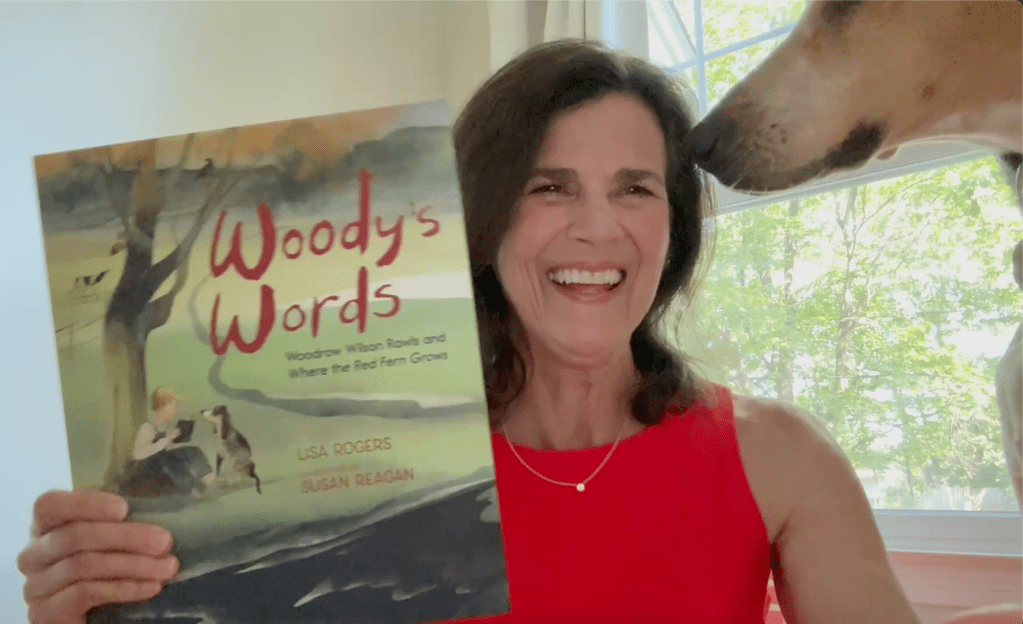
Lisa Rogers’ career as an elementary library teacher inspired her to write for children. She’s the award-winning author of Beautiful Noise: The Music of John Cage, 16 Words: William Carlos Williams and “The Red Wheelbarrow,” Joan Mitchell Paints a Symphony, and the brand-new Woody’s Words: Woodrow Wilson Rawls and Where the Red Fern Grows.A former news reporter and editor, Lisa received degrees in English Literature from William & Mary and Boston College and a master’s in Library Science from Southern Connecticut State University. A four-time runner of the Boston Marathon, she daydreams, runs, paints, and has adventures with her hound near Boston.
And when you enjoy a book, please support authors and illustrators with online reviews. 😍
Lisa Rogers is one of the new members of KID LIT FOR GROWING MINDS, a group of children’s book creators with books that cross curricular areas and which is dedicated to providing resources and support for educators. You’ll find our free newsletters HERE. (And September’s newsletter has a 3-book GIVEAWAY!)
 Beth Anderson, Children's Writer
Congratulations, Lisa! Sounds like a wonderful book and I love the teaching element you shared.
LikeLiked by 2 people
Thanks, Kim! Hope you love the book.
LikeLiked by 1 person
Thank you for the writing prompts based on your research of your subject. They will be very useful in the classroom.
LikeLiked by 2 people
I am so glad, Danielle! Thank you!
LikeLiked by 1 person
Congratulations Lisa! What a wonderful way to share the importance of perserverence with young readers.
LikeLiked by 2 people
Thank you! Woody was an amazing person and a beautiful writer, too. I am so glad he overcame his struggles.
LikeLiked by 2 people
This post is so inspiring. I can’t wait to read the book! Congratulations, Lisa!
LikeLiked by 2 people
Thanks so much, Heidi! Woody wanted to inspire others so that too is my hope for this book.
LikeLiked by 1 person
This is a wonderful book, Lisa, and a great post. Congratulations!
LikeLiked by 1 person
Thank you, Cathy! I can’t wait for young readers to discover this book!
LikeLiked by 1 person
This resonates with me, too. Writing is often a lonely task and there can be (and IS) self-doubt! I love this inspiration to keep going!
LikeLiked by 1 person
Ann, I totally agree–writing is tough in many ways and it is hard to know when something is good or not. I love that Woody wanted to inspire young writers and I hope writers of any age feel inspired, too! Definitely keep going!
LikeLiked by 1 person
Gotta keep going because we love it!!
LikeLiked by 1 person
Great post, Lisa! I love how you apply it to our writing lives.
LikeLiked by 1 person
Thanks so much, Tina! I really believe that being able to change and grow through what we learn from others is a vital part of reaching our goals.
LikeLiked by 1 person
Congrats to Lisa! This books speaks to everyone!
LikeLiked by 1 person
Thanks so much, Jilanne! I hope it encourages readers to reach for their goals!
LikeLiked by 2 people
Great interview! Fabulous activity! This ties in beautiful with NCRA’s Young Author theme this year!
LikeLiked by 1 person
Thank you! That’s amazing that the activity ties in with the NCRA theme! Let me know if you use it and how it’s received!!
LikeLiked by 1 person
That last comment was mine, Lisa and Beth. Tonnye Fletcher. No idea why it recorded that as my identity.
LikeLiked by 2 people
Thanks for letting me know, Tonnye – something strange happening in cyberspace. The comment did come through with your email. 🙂
LikeLike
Tonnye, I thought so! I would love to know more.
LikeLike
I love Woody’s Words and I relate to the need for asking for help and think we need to make this a normal function of all academic activities. My students were all below grade level readers so their norm was asking for help but some of them were gifted artist and had other talents. It’s important to normalize asking for help, remembering how good it feels to be able to help, and to share growth and overcoming obstacles with students.
Thanks for sharing this Beth and Lisa. An obstacle that I think I overcame (if you are reading this, it worked) is WordPress locking me out of my account last week and unfollowing a bunch of accounts I had previously been following. – Laura
LikeLiked by 1 person
Thank you, Laura. I agree that supporting students in asking for help should be the norm. I appreciate your perseverance with WordPress–I am able to write to you because I asked for help with WordPress, which somehow doesn’t allow me to comment…it’s a roadblock for me but I have a workaround now.
LikeLiked by 1 person
Glad you didn’t give up, Lisa. Imagine how happy and proud Woody would be that his life story would be shared with such skill and care to kids everywhere. Great job!
LikeLiked by 1 person
Thanks so much, DG. I do hope that Woody would be proud and I also hope that this book extends his legacy.
LikeLike
I love the writing prompts, not just for students, but for myself. Thanks for giving children a mentor to believe in themselves. Congratulations, Lisa!
LikeLiked by 1 person
Thanks so much, Kathryn!! I think these prompts are for everyone so I hope you give them a try! I so appreciate you reading and finding value in my words.
LikeLike