Ah yes, the conundrum of TMI (too much information). I know it well. It’s like you’re a kid in a candy store and can only choose one of the many varieties tempting you. Here’s a wonderful post from Julie Winterbottom on how she drilled down for her focus in MAGIC IN A DROP OF WATER: HOW RUTH PATRICK TAUGHT THE WORLD ABOUT WATER POLLUTION.
GIVEAWAY! You just might win a copy of MAGIC IN A DROP OF WATER if you leave a comment below!
Congratulations to Jilanne Hoffmann, winner of MUD TO THE RESCUE from Tanya Konerman!
Using Poetry to Get Unstuck by Julie Winterbottom
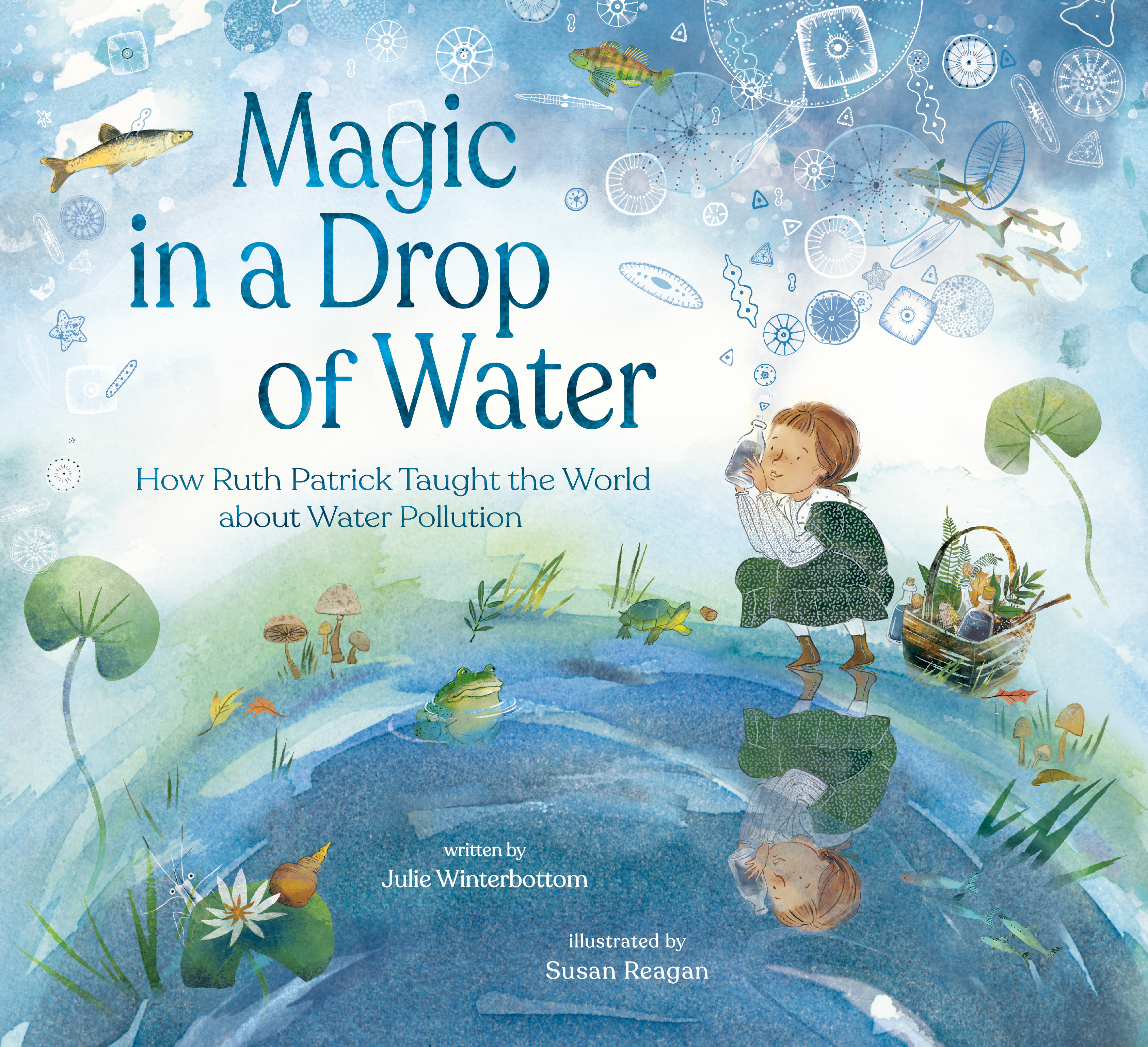
When I first read about ecology pioneer Ruth Patrick in a book of essays about women in science, I immediately thought, picture book biography! Her story had all the right the ingredients. She was only five years old when she fell in love with science. She studied diatoms, jewel-like, microscope algae that would make gorgeous illustrations. Best of all, she used her scientific knowledge to fight water pollution. A quick search told me that even though Patrick is considered on a par with Rachel Carson, no one had written a book about her. Here was the overlooked STEM hero I had been looking for!
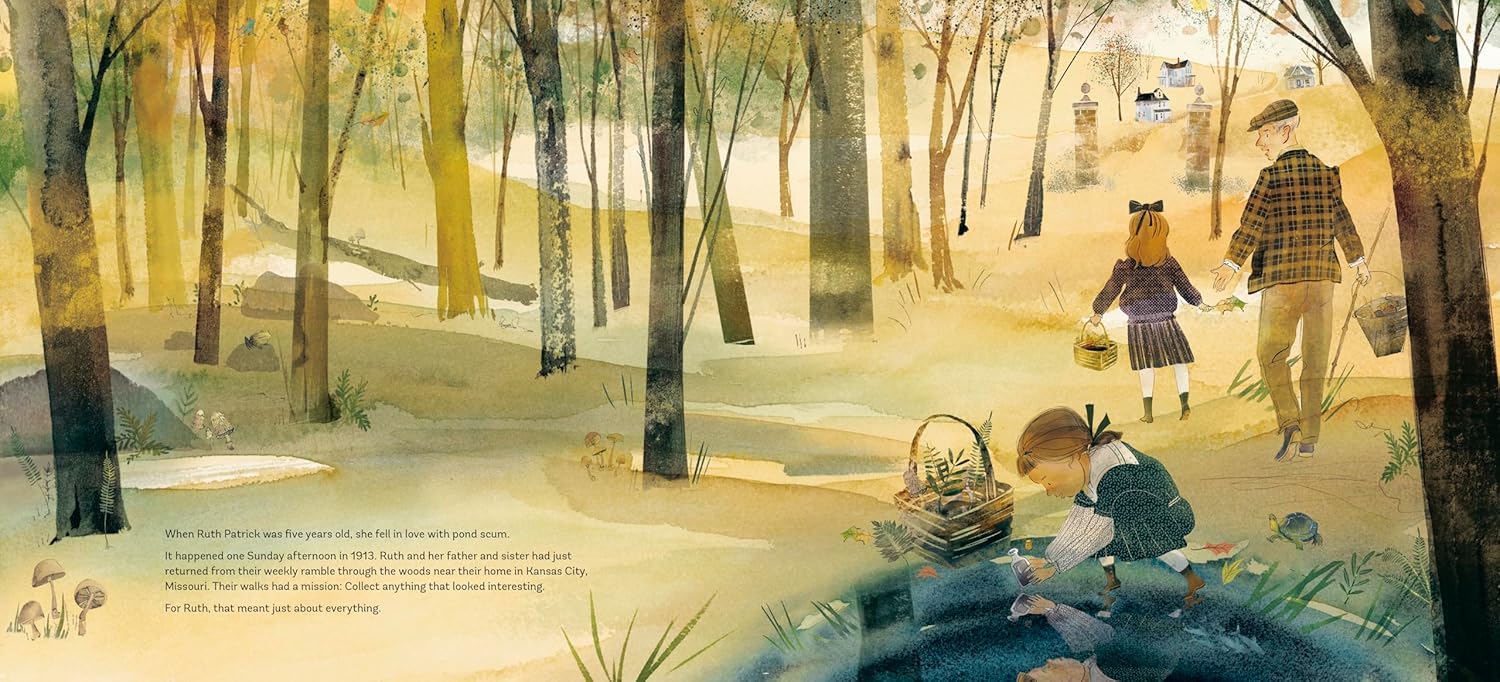
My agent at the time asked me to write the first few spreads. I had no trouble coming up with a catchy opening line: “When Ruth Patrick was five years old, she fell in love with pond scum.” The pages that followed about Patrick’s childhood practically wrote themselves.
Great, I thought. Now I’ll just do a bunch of research and finish the draft.
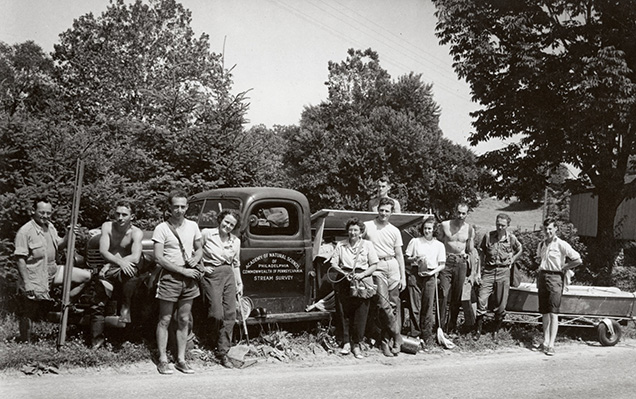
Six months later, I was drowning in information. I had read every article I could find about Patrick. I had pored over her scientific papers. I had interviewed scientists who worked with her and historians of science who studied her. I knew enough to write 20 picture books. But I couldn’t write one. The problem was, I couldn’t choose just one slice of Patrick’s life to focus on. It didn’t help that she lived to 105 and accomplished a prodigious amount. The real problem, though, was that I didn’t have a gut feeling about what part of her work was most important—and best for a picture book.
I tried making a list of the events and themes and quotes that I thought absolutely had to be in the book. That “list” quickly grew to 4,000 words. I tried to write streamlined drafts…but kept shoehorning in all my favorite anecdotes. I was so deep in the weeds of my research, I couldn’t extricate myself.
Then my friend Agatha threw me a lifeline.
“What if you try writing the book as a poem?” she said. “Just as an experiment. You don’t have to use any of it.” I had never written poetry before. In hindsight, that was probably a good thing because I had no expectations that my poem should be any good. That freed me in just the way I needed. I wrote fast and recklessly, following nothing but my own excitement. I instinctively skipped over some events, telegraphed others, and dug deep into just a few, letting scenes play out in my head like a movie. When I was finished, I had an 1800-word “poem” that centered on Patrick’s pioneering study of stream pollution. I had found my “slice of life” story. The poetry experiment had helped me to write from my gut.
I still had to cut a lot of text, but that was easy now that I had my focus.
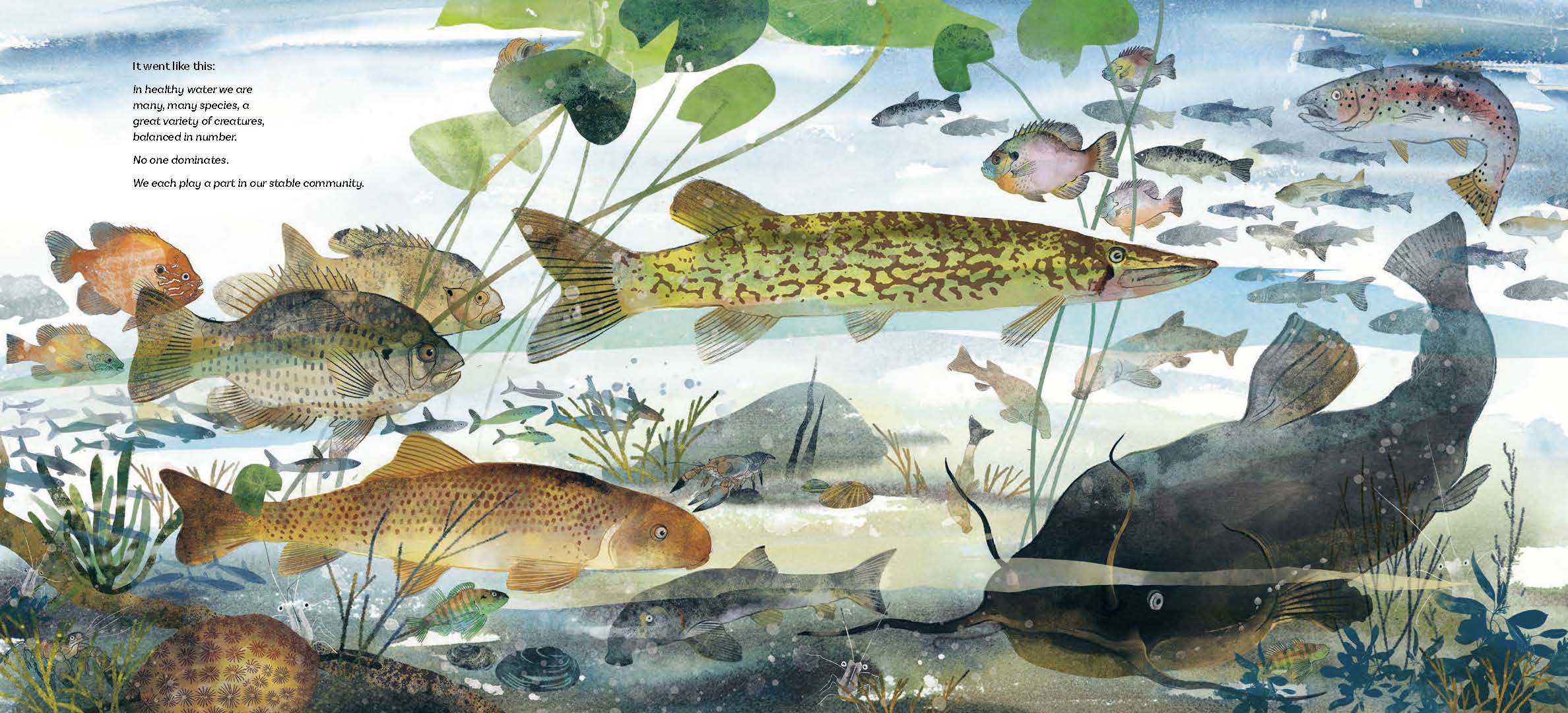
The poetry experiment paid off in other ways. I had thought it would be impossible to write about Patrick’s breakthrough finding that biodiversity is a good indicator of pollution without sounding like a textbook. To my surprise, in the poem, I solved the problem by playing with voice. I let the community of plants and animals in the stream speak. Their words, excerpted below, made the difficult science concept more accessible.
“In healthy water
we are many, many species,
a great variety of creatures,
balanced in number.
No one dominates.”
Another unexpected dividend of the poetry experiment was that it freed me up to try using lyrical language and imagery, much of which I mined for my next draft. This description of a diatom hardly changed between the poem and the final manuscript:
“A single cell
Protected by a glassy shell.
Old as the dinosaurs.
Provider of food and oxygen
to water dwellers everywhere.”
Just how instrumental was my friend’s poetry suggestion in helping me get unstuck? The answer is on the book’s dedication page: “To Agatha.”
Don’t forget to leave a comment below to be entered in the drawing for a copy of MAGIC IN A DROP OF WATER! (US addresses only, please. Winner announced 6/20/25.)
And if you enjoy a book, please support authors and illustrators by leaving online reviews. 😍
 Beth Anderson, Children's Writer
Oh my goodness…I felt like I wrote this one myself! I’ve been grappling with the exact issue for a recent bio, AND I did end up writing the ms as poetry. Unfortunately for me, the editor who expressed an interest wanted a R&R as…prose. *palm-face* She thought that the poetry form was a bit too sophisticated. Back to the drawing board.
Congratulations to Julie on getting this beautiful book published!
LikeLiked by 2 people
I love that you tried the same thing, Teresa! In the end, I reverted mostly to prose, but just kept snippets of the poem. Sort of a hybrid–maybe your editor will go for that? Good luck with it!
LikeLiked by 1 person
I am so looking forward to reading about Ruth Patrick – I love learning about unsung heroes, especially those related to science. And, the idea to write the book as a poem is brilliant. It may just be the fix one of my own WIPs needs. Thank you!
LikeLiked by 2 people
Congratulations Julie. This sounds like a wonderful book. Thank you sharing your process! I am a volunteer water sampler of benthic macro invertebrates. Can’t wait to read your book.
LikeLiked by 2 people
So cool that you are doing that as a volunteer. Right down in the stream like Ruth Patrick!
LikeLiked by 1 person
I absolutely loved reading about your process that produced a lyrical, poetic book about science! Perfect!
LikeLiked by 2 people
Super fascinating and inspiring, Julie! I love learning stories like this (yours and Ruth Patrick’s). I can’t wait to read this book. Congrats!
LikeLiked by 2 people
What a wonderful article! I can’t wait to share this with my Writing! students at UCLA extensions. During week-six for new picture book writers, we look at poetry and I ask them to take their existing work in process and try it using some poetic elements. I love what Agatha says, nobody has to keep it. It’s just a new vehicle to get into your writing. Thank you for sharing your revelations!
LikeLiked by 2 people
Thank you, Kim. I am honored that you want to share this with you students. Hope it inspires some interesting writing!
LikeLiked by 1 person
Congratulations, Julie! I loved reading about your process, and I’m excited my library carries your book. It’s on hold and I can’t wait to read it!
LikeLiked by 2 people
Such an interesting intervention! I am a poet and have never tried this with my TMI nonfiction manuscripts! But I will now. Thank you!
LikeLiked by 2 people
I loved this! Who would have thought that poetry would be the key to revealing your main theme! I thinkI’ll try if on one of my manuscripts that isn’t sure what it wants to be. Thank you!
LikeLiked by 2 people
Such a perfect example of how poetry can be used to distill complex concepts down to accessible nuggets. I love the examples you used in this post, and the book looks wonderful! Congrats!!
LikeLiked by 2 people
“I knew enough to write 20 picture books. But I couldn’t write one. The problem was, I couldn’t choose just one slice of Patrick’s life to focus on.” Well, now, that’s something I’ve NEVER felt! — HA! I love that element of surprise you mention when nature’s voices emerged. Great exercise. Thank you, Julie and Beth. Really looking forward to reading this!
LikeLiked by 2 people
Ha! That made me laugh. I guess I am not the only one who has experienced this. Actually, I am in the beginning stages of a new book and I see this situation coming on already.
LikeLike
Yessss! I am such a fan of using poetry to “unclog” the drain filled with facts and other detritus. Congrats on the success!!!
LikeLiked by 2 people
Thanks you, Jilanne (who writes with so much poetic voice). I love that image of unclogging the drain. I am going to hold onto that.
LikeLiked by 1 person
I’m circling the drain on a new story right now, LOL.
LikeLiked by 1 person
Some of my favorite manuscripts are ones that started as 50 words (Vivian Kirkfield’s contest) or 200 words (Sun.Write.Fun contest). And I sometimes write a haiku about a subject to get the ideas flowing.
Thank you for a terrific post! I look forward to reading this important PB biography.
LikeLiked by 2 people
So inspiring to read how poetry/lyrical language got you out of the weeds and find your focus. Thanks for sharing–I will ask for Magic In a Drop of Water at my library!
LikeLiked by 2 people
What a wonderful story to share with my family and students! I live very close to this area and it is so inspiring to learn about Ruth Patrick and her water pollution experiments. Thank you for sharing your process of finding a way to become “unstuck” in writing your book and transforming with the use of lyrical language.
LikeLiked by 2 people
That’s so cool that you live near where Ruth Patrick worked!
LikeLike
I love this example of how to enjoy the research process yet be able to distill all of that fascinating info into what really matters–engaging readers with a compelling true text that informs & delights! Congratulations on your beautiful book!
LikeLiked by 1 person