Ah, the fun of mud! But how does one create a viable manuscript with this topic and a pile of information? Like a mudpie, it takes some squishing and slopping and playing around. Here’s a post from author Tanya Konerman detailing her path to MUD TO THE RESCUE!
And don’t miss the GIVEAWAY! Leave a comment below for a chance to win your own copy of MUD TO THE RESCUE! HOW ANIMALS USE MUD TO THRIVE AND SURVIVE.
Congratulations to Barbara Kimmel, winner of BUILD A SANDCASTLE by Eileen Rajala Meyer!
Organizing Facts for the Audience and Current Market by Tanya Konerman

In 2017, I was brainstorming nature-related things kids love in order to find my next picture book topic. Mud was near the top of my list, and as I began trying to weave that topic into a nonfiction story, I realized kids aren’t the only ones who can like or use mud, that animals do too. After months of research, I wasn’t sure how to pull it all together. My first go at a story on this topic featured a narrator named Cordelia who traveled around the world to find animals who use mud in their lives. Here’s an excerpt from 2017/2018:
Cordelia knows that many animals in AFRICA and ASIA love mud. The sun is hot and high in the sky. But some of the animals can’t sweat to keep cool because they don’t have sweat glands. And very small, itchy critters like to live on their bodies.
[Cordelia to animals]: Why do you like mud?
Elephant: I don’t have much hair at all. This mud on my body helps to keep me from getting too hot when I can’t find shade.

But after helpful critiques from other writers and editors, I realized a few things: this story form was unwieldy for this age group, with it jumping from continent to continent; the tone was a bit too didactic; and overall it was way too long at the 960 words I needed in order to give two to three examples of animals who used mud in each part of the world! So despite my love for Cordelia, I said goodbye to her and rewrote the text. My goals were to make the story more lively, shorten each example to cut words, and focus on a bigger variety of animals. To help with this, I also decided to use free verse instead of prose.
In this version, I first began organizing the animal examples in the story by how they used mud (to build homes, as sunscreen, etc.). But it was too long! Then I switched to looking at the general habitats they live in:
Drip.
Drop.
Splatter.
Splash.
As rain falls where it is
hot or cool, wet or dry,
up-high or down-low,
animals search for mud.
But it was too complicated! Feeling rudderless, I set the story aside, working on other books for a while.
Then, talking to my agent one day, we were discussing this manuscript and I mentioned how fun mud can be for kids. Bingo! I knew I needed to do an overhaul to make this story not only chock full of information in a shortened format, but fun too.
This time, I ramped up the alliteration and assonance to add more lyricism. I cut down on the numbers of animals I featured, focusing on the more well-known animals and a few of the more colorful ones so the illustrations were not all brown (goodbye Eld Deer and American Bison and hello Pink Flamingo and Green-winged Macaw).
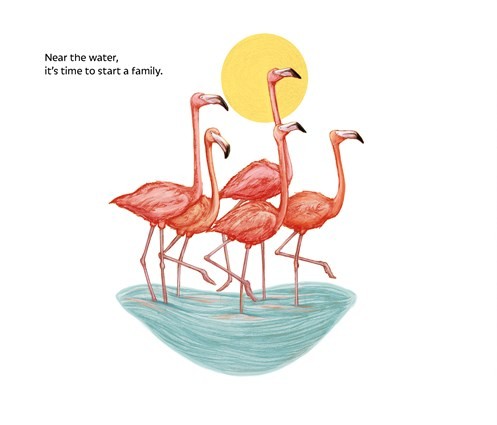
I also moved some of the informational text into back matter and added side bars to include cool facts. Then, knowing the importance of “read-aloud-ability” for today’s picture books, I decided to create a repetitive refrain that would encourage kids to join in the story, making it more interactive. To help it all work, there was something I needed to do first. You can probably guess what what it was, right? Yes…I reorganized the way I categorized the animals (again!), now focusing on how mud solves a problem for each pair of animals. One example:
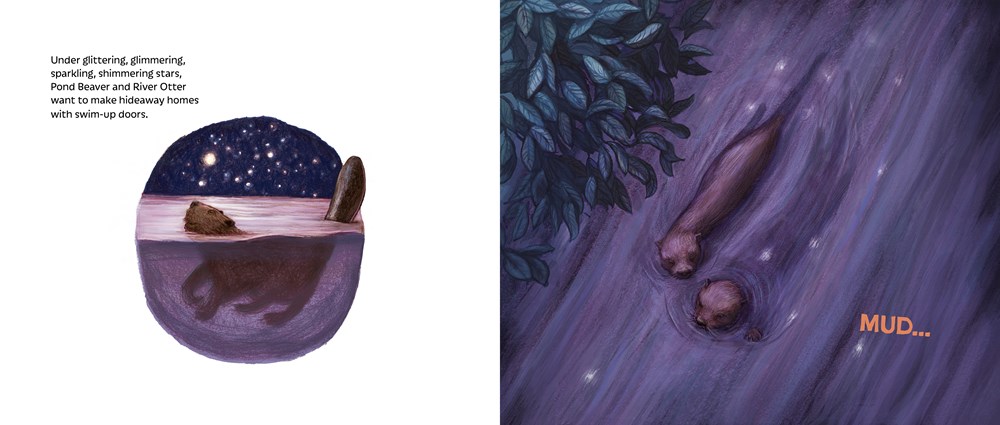
Under glittering, glimmering,
sparkling, shimmering stars,
Pond Beaver and River Otter
need to make hideaway homes
with swim-up doors.
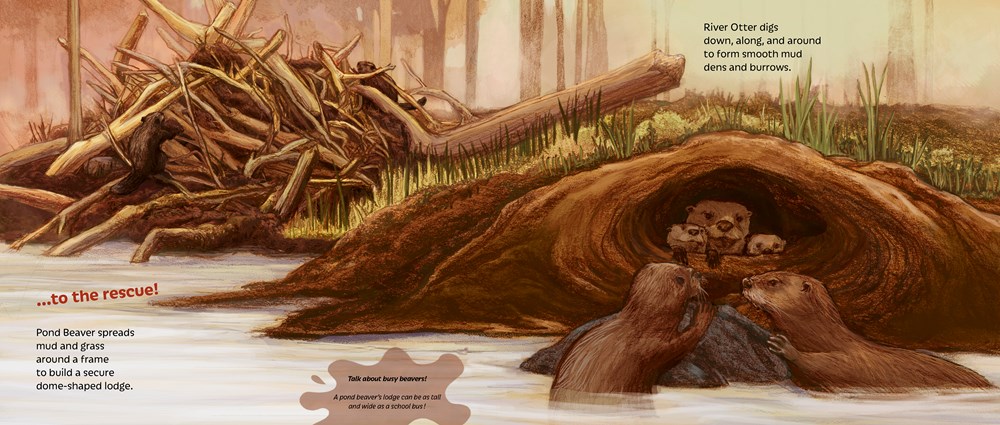
Mud…
…to the Rescue!
Pond Beaver spreads
mud and grass
around a frame
to shape a secure dome-shaped lodge.
River Otter digs
down, along, and around
to form smooth mud
dens and burrows.
This version felt fun, lyrical, and well-organized. It was sparse yet still provided plenty of examples and interesting information in a way kids could follow easily. And it better matched the current market for children’s nonfiction picture books in its voice, possibilities for colorful illustrations, and read-aloud qualities. The great news: an editor agreed in our next round of submissions, offering me a contract within two months!
Don’t forget to leave a comment below to get in on the GIVEAWAY – a copy of MUD TO THE RESCUE! (US addresses only, please. Winner announced 6/6/25)
And if you enjoy a book, please support authors and illustrators by leaving reviews online. 😄 Thanks!
 Beth Anderson, Children's Writer
I enjoyed hearing the back story for your beautiful new book. Congratulations!
LikeLiked by 1 person
I love the lyrical tone of the book! Congrats!
LikeLiked by 1 person
It’s always helpful to hear of other writers’ processes in revision. Factual information always has its challenges, so I appreciate the guidance. Thank you, Tanya.
LikeLiked by 1 person
Thank you for sharing how you developed your book idea from spark to finished product. The text samples are very helpful too. Congratulations on a book I’m sure readers will pull off the shelves based on the fun cover and topic.
LikeLiked by 1 person
Structure is the muddy elephant in the room, isn’t it, LOL. I’m glad Tanya figured out the way to tell this story effectively with humor.
LikeLiked by 1 person
Who doesn’t love mud? What a great idea for a story!
LikeLiked by 1 person
Thanks so much for sharing your writing and rewriting process. It’s a muddy job, but I’m excited to read the beautiful story you’ve created.
LikeLiked by 1 person