I’m a fan of Selene Castrovilla’s writing…and the ways she finds to tell stories. I know how hard it is to take a snippet of history, dig out the information, and create a story that’s engaging and meaningful! Her new book, GEORGE WASHINGTON’S SPECTACULAR SPECTACLES: THE GLASSES THAT SAVED AMERICA is fabulous! Here Selene shares how, after a VERY long time, she landed on a way to tell the story.
GIVEAWAY! Leave a comment after the post for a chance to win a copy of GEORGE WASHINGTON’S SPECTACULAR SPECTACLES.
Telling Your Story by Selene Castrovilla
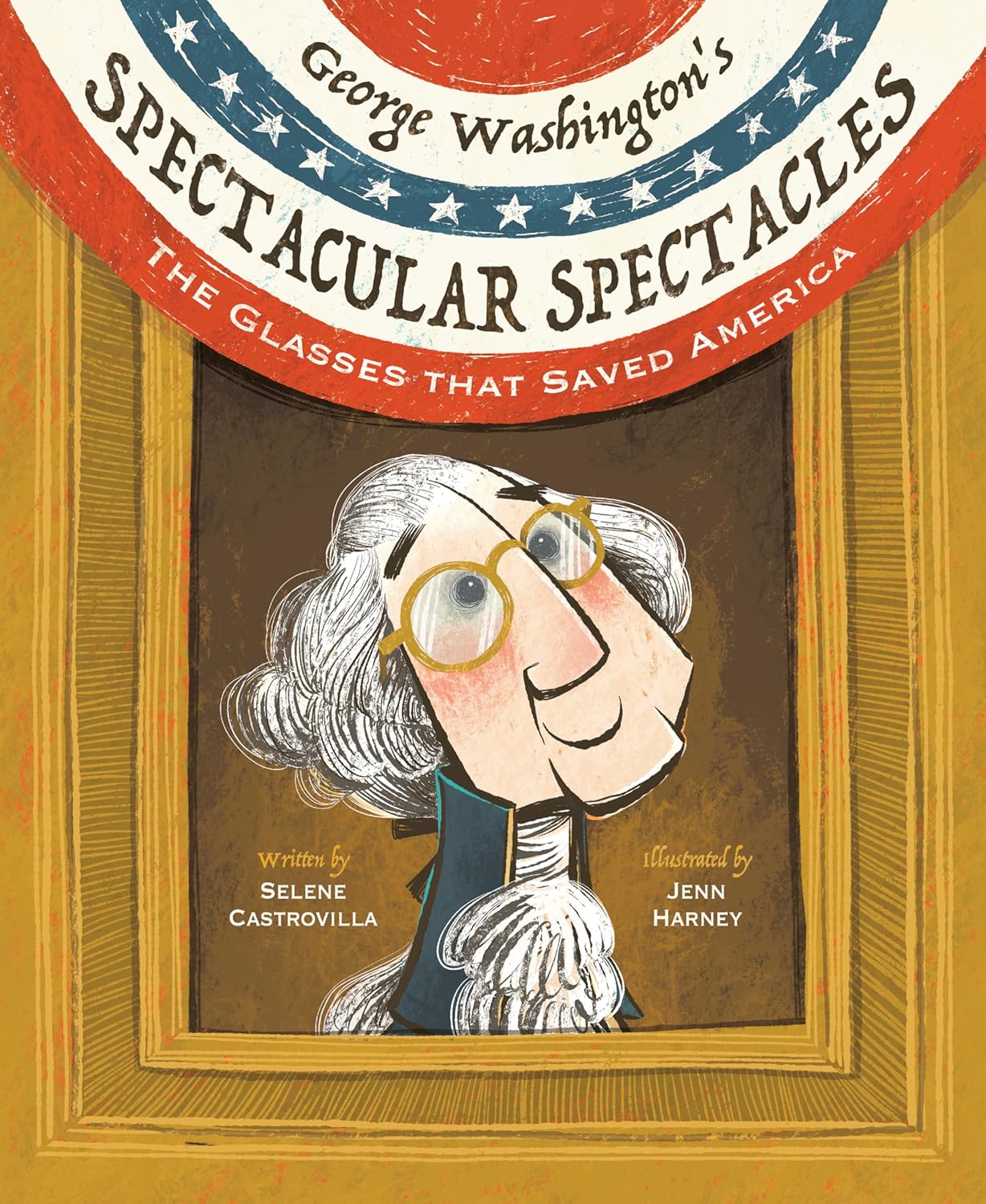
There’s a story. And then there’s how you tell it.
A funny thing happened on the way to writing a publishable manuscript about one of the darkest little-known moments in American history—the Newburgh Conspiracy. It turned into a comedy. But what is comedy except tragedy we laugh at? We laugh because we relate. And telling my story effectively hinged on making George Washington relatable.
Somewhere in my never-ending research on the American Revolution, I learned about an incident at the close of the war that almost ended our democracy before it even got started. Washington’s officers were disturbed (rightfully) that they had not been paid. Once the war ended, they would no longer be needed and sent back home penniless and in debt. Not only would they be unable to support their families, but there was also this place called “debtor’s prison” back then, and that was no joke. These desperate men were goaded into a plot to storm Congress, demand their money and take over the government if they didn’t get paid. The goading part was complex.
George Washington learned about the plot, and more stuff happened. Bottom line: he gave a heartfelt speech to his men asking them to remember what they had fought for, and how much freedom meant to them. Unmoved, they wanted Congress to show them the money—period. Washington had one thing left: a letter from a member of Congress promising to pay the men (albeit not at this time). To read it, Washington had to reveal a secret: he had gotten glasses. What’s the big deal, you might ask. At the time glasses (spectacles) were considered a sign of frailty, and he did not want to appear weak! He donned his spectacles as his men gawked, and said, “Gentlemen, you must pardon me. I have grown gray in your service and now find myself growing blind.” This simple statement struck the officers straight in their hearts, and they recalled how Washington had been beside them throughout the war. They wept and declared their loyalty to him. Coup averted. Mic drop for George.
The story struck me immediately. I wanted to tell how George Washington put on a pair of glasses and saved democracy. My problem was context. How could I explain the goading part, and the more stuff happening part? Then there was this Temple of Virtue, where Washington addressed his officers. What a name! Surely it could be a focal point of the manuscript. Maybe I could call it, “George Washington and the Temple of Virtue” ala Indiana Jones and the Temple of Doom.
I wove more words through the complexities, adding more explanation. Then more. Such a tangled tale. And so, so serious. I mean, we’re talking treason!
The Temple of Virtue remained so tantalizing, representing the “good” in humanity. A perfect offset to the heinous plot.
Years of complicating my story to provide context, only to have to provide more.
A story so mired in detail that it could not possibly be published for young readers. (Probably not for any readers.)
I put it in my digital drawer, but its crux stayed in my heart.
Then came one night before my monthly critique meeting with the Bank Street College Writers Lab. I needed something to share. Hmmm. Aha! What about George Washington and his glasses?
I started to pull up the Word doc, but the idea of carving through that dense story was too daunting. All I ever wanted to do was tell the story of George hiding his glasses, only for them to be the very thing that saved the day. I realized George’s perspective about his glasses was everything. I started writing from scratch:
“George Washington had to wear glasses. It was a secret.”
Boom! An explosion in my mind—George’s voice, the manuscript’s voice, was born! Like magic, everything followed. A funny tale about a not-at-all funny moment in our history, but the comedy was necessary to share George’s vulnerability.
The Temple of Virtue turned out to be wrong as a focal point, because Washington’s virtue was all the story needed. Realism beats symbolism.
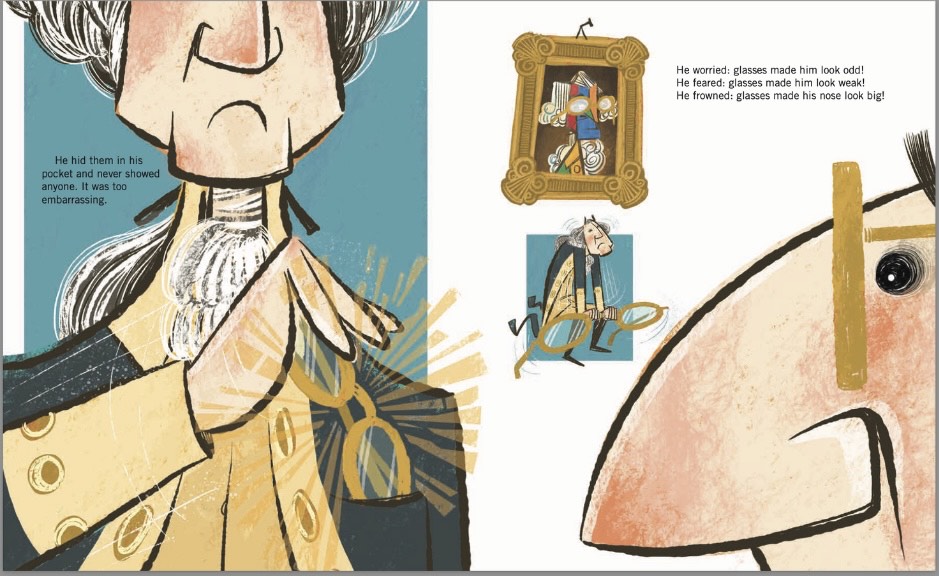
Finding a story is thrilling indeed, but it’s just the beginning of a writer’s task. The challenging part is finding out how to tell the story. Sometimes this eludes us for a long time. I learned an important lesson telling the story of George Washington’s Spectacular Spectacles: The Glasses That Saved America. I must keep my eyes open for all possibilities. So should we all.
Don’t forget to leave a comment below to be entered in the drawing for a copy of GEORGE WASHINGTON’S SPECTACULAR SPECTACLES! (US addresses only, please. Winner announced 2/7/25)
😍 And, if you enjoy a book, please support authors and illustrators by leaving reviews online.
BIO:
George Washington’s extraordinary character caught Selene Castrovilla’s eye years ago, as she set her sights on penning Revolutionary Friends: General George Washington and the Marquis de Lafayette. Her enthusiasm for the Father of Our Country never weakened. See what this revolutionary writer, native New Yorker and mother of two sons is all about: visit selenecastrovilla.com.
Selene has 2 podcasts you might want to check out: Life in Jest and Heartful of History
 Beth Anderson, Children's Writer
Finding the right nugget. That seems to be the path to finding story gold. Thanks for the inspiration.
LikeLiked by 1 person
I’m a fan of Selene’s stories so please, count me in! Sometimes we have to overwrite before we come back to the kernel of the story. I’m glad she returned to that kernel!
LikeLiked by 1 person
A really well-written and helpful post Selene. Thank you. And congratulations on getting that idea out in book form. It looks great!
LikeLiked by 1 person
I can totally see why you’re a fan of Selene’s writing! This was a riveting post and makes me eager to read the book. 🙂
LikeLiked by 1 person
“The Temple of Virtue turned out to be wrong as a focal point, because Washington’s virtue was all the story needed. Realism beats symbolism.“
What power in that summary! Thanks for sharing the process
LikeLiked by 1 person
This was one of the best blog posts on writing nonfiction PBs I’ve read. So useful. So well crafted. I struggle with these very issues myself and I’m excited to go back to my manuscripts with new glasses.
LikeLiked by 1 person
What an informative post. Thanks for sharing! The book is on order at our library and I’ve placed a hold. Can’t wait to reading it!
LikeLiked by 1 person
Just read the book, Selene! It is marvelous! Now I’m filled with questions about how the details were drawn from primary sources. I always wonder: What license do we have to imagine the scenes? For example, when he reads the letter to the men, do you have a source for all his little actions–holding the document different ways, smoothing out the wrinkles–or is that within the range of what you consider acceptable imagining of the moment? Also, is the text of the letter from the congressman the actual letter or is that yours? It doesn’t read to me like it’s from that time, but it seems presented as if it is. (I’m guessing it’s a paraphrase in the voice of the narrator.) These are things I really struggle with in my own writing, so I’d love anything you can share about these judgment calls. All the ways that you made the story immediate seem essential to me and yet also like some room for imagining is essential to accomplish that.
LikeLiked by 1 person
Priscilla, I agree, the book is fantastic! And reading your comments, I thought you would love Selene’s new podcast Heartful of History! These are the kinds of things Selene gets into with authors and illustrators. So if you haven’t checked it out, I think you would definitely enjoy it.
LikeLike
Thank you, Beth! I just today because of your blog discovered her podcast and have started listening. So excited to have a chance to hear Carolyn Yoder myself!
Also, thank you for your recent book-launch webinar! (So good!) Very similar theme to this blog post and both got me chewing on new possibilities for one of my beloved manuscripts.
LikeLiked by 1 person
This book looks wonderful on all levels -story, illustrations, etc. Bravo. I can’t wait to read it.
LikeLiked by 1 person
Thank you for the excellent post today. I loved the details about how the author found the heart of her book. I can’t wait to read this–the topic is fascinating and one I can’t wait to share with my family. I’m adding this to my Goodreads.
LikeLiked by 1 person
Wow! Such a great lesson about finding the heart of a story and how to tell it. I’ve had a manuscript in a drawer for a long time because I just couldn’t make the story work. Now I think I need to look at it with fresh eyes to find the heart and a new way to focus the story. Thank you for sharing your journey with this book. I’m excited to read it.
LikeLiked by 1 person
Crafty fellow, Washington. Looks like I will have to read the book to find out how the farmers finally got compensation!
LikeLiked by 1 person
I find it funny that George Washington had to go through so much to keep his spectacles secret for fear of what others would think. Nowadays, glasses have become a fashion statement. Thank you for sharing your writing journey through the revisions that brought you to this wonderful book. The illustrations are incredibly lively and kid-friendly, too. You must be so thrilled!
LikeLiked by 1 person
This is such a ‘wow!’ post! I felt excited by not only the discovery of the glasses in the first place, but the amazing journey you had to write the story you wanted to write. Brilliant!
LikeLiked by 1 person