Setting is a key piece of story. For me, it requires lots of research. For author Sarah Hovorka, writing a fictional story based on a childhood memory, it required an awareness of how times have changed. Sarah offers a few examples, and …
a GIVEAWAY! Just leave a comment below the post for a chance to win a copy of UNICYCLE DAD!
Congratulations to Laura Perdew, winner of BIRD GIRL: GENE STRATTON-PORTER SHARES HER LOVE OF NATURE WITH THE WORLD! from Jill Esbaum!
Writing Childhood Stories for the Modern Market
By Sarah Hovorka
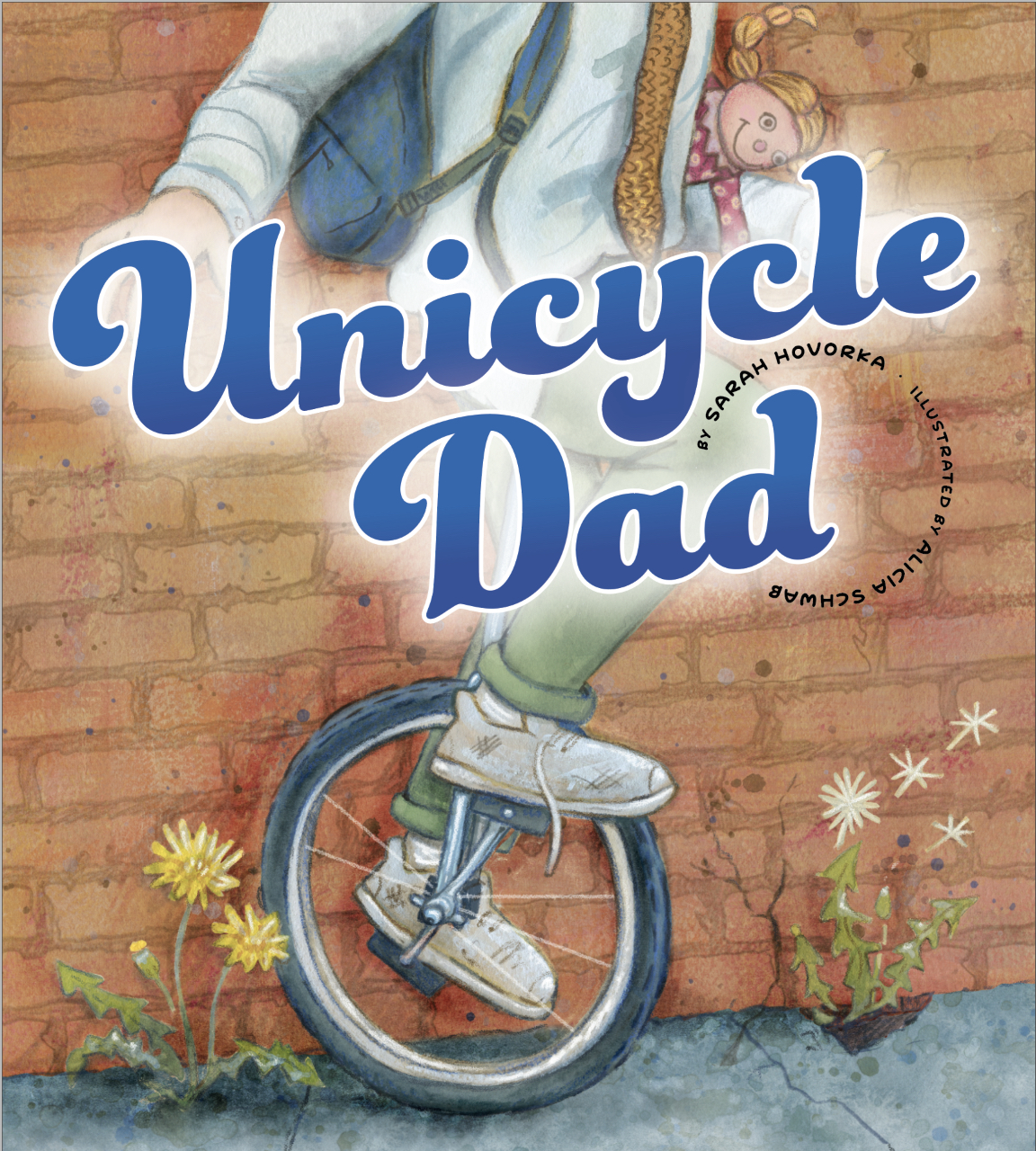 When I started writing my newly released picture book Unicycle Dad (Amicus Ink, March 2024), I was thinking about my childhood memories, the strong emotions I felt towards my family and myself, and what I hope for readers to take away from the story. In other words, I focused foremost on the heart of the story, a great thing for a writer to do. And everyone really seems to love all those things about this story.
But my childhood took place in the eighties. Yes, the 1980s… a different century, a different time, a different world. I didn’t necessarily want the story to take place in the past; I wanted modern readers to connect with the enduring qualities that are time (and place) immaterial. While remembering the world of my childhood, I also had to keep in mind the world of today and how modern children experience this world.
For example, in the story the main character, Sarah, declares she wants to go to college right after high school. Back in the eighties, I didn’t even know what college was. Educating children about college didn’t happen in my elementary school. But it happens at my kids’ schools now and more broadly across different socio-economic classes than in the past. Giving the Sarah character a desire to go to college increases her agency in the story as well as strengthens the theme of persevering towards goals.
I also tried to be careful about “parentifying” Sarah too much. A major part of this story is Sarah learning to do new things, including trying to ride the unicycle, but also things to help her father out. She learns to cook and, in an earlier version of the story, keeps an eye on her younger brother. These days some parents are more aware of putting too much adult responsibility on their children, even while trying to help them learn independence and a sense of family responsibility. So, in this case, I tried to create a balanced approach so that this issue wouldn’t detract from the main message of my story.
 There are a few things like that throughout the story and the illustrator, the amazing Alicia Schwab, added modern aspects as well, such as Sarah wearing a helmet (I usually didn’t) and adding in a diverse cast of background characters.
And there was something brought up during the editing process after the story was acquired by Amicus Ink. We had to add a babysitter for while the father was at his second job since many modern parents would not be pleased to see a couple of young kids without adult supervision. Everyone’s experiences, past and present, may differ on this point, but again, we didn’t want this issue to detract from the story. Careful judgement is needed on these types of issues, including what role they may play, if any, in your particular story.
Those are some of the ways I adjusted this story for the modern market while still maintaining the heart of my childhood experience. There are other things that we writers need to be aware of as well: boundaries; pet names; names for body parts; assumptions of a shared culture, religion, or lifestyle; being more open with kids (for example, talking about finances); pronoun usage; technology; self-esteem; education (for example, homeschooling is more common now). The list of ways life has changed for children today compared to writers’ childhoods goes on and on and will continue to evolve.
It’s something to be aware of as writers. But first, if you want to write a story based on a childhood experience, immerse yourself in your experience. Find why that experience still stands out to you today. Find the heart of your story then adjust the extra stuff to fit the modern market.
Don’t forget to leave a comment to enter the GIVEAWAY for your very own copy of UNICYCLE DAD , [U.S. addresses only, please. Winner announced 4/5/24]
AND if you enjoy a book, please support authors and illustrators by leaving online reviews. 😃
Bio:
Sarah Hovorka is the author of picture books, novels, and short stories for children. In addition to writing, Sarah works in the public sector and spends her free time reading, homeschooling, and playing video and board games with her husband and three sons in California. You can find out more about her, her books, and follow her blog at www.SarahHovorka.com or connect with her on:
X (formerly Twitter) https://twitter.com/HovorkaSarah
IG https://www.instagram.com/authorsarahhovorka/
 Beth Anderson, Children's Writer
This is such a great book! Congratulations, Sarah!
LikeLiked by 1 person
Thank you for sharing how you put so much heart and so much of yourself into your book. I’m excited to read it!
LikeLiked by 1 person
Great tips to modernize your story and keep it relevant for today’s readers. Love this story and love the illustrations! Congrats on another wonderful book!
LikeLiked by 1 person