Just in time for the start of a new school year! This post from author and teacher Zeena Pliska shares an activity for educators to help explore, examine, and evaluate classroom libraries. AND she’s offering a copy of her newest picture book, EGYPTIAN LULLABY.
GIVEAWAY! Leave a comment after the post to get in the drawing for a copy of Zeena’s EGYPTIAN LULLABY.
Congratulations to Maria Marshall, winner of ARMANDO’S ISLAND from Marsha Diane Arnold!
Recentering Diversity and Decentering White/Eurocentric Culture by Zeena M. Pliska
As an author/artist and a public-school kindergarten teacher in Los Angeles, my intentions more likely than not, intersect. Both roles are an act of social justice for me.
As a picture book author, my intention is to provoke discourse… not to impose an agenda but rather to encourage exploration and thinking. I believe that provoking discourse leads to more fully formed ideas and creates connections and communication that then leads to a more expansive understanding of humanity and the world we live in. I believe this is especially important for young children.
My most recent picture book, Egyptian Lullaby, is my love letter to Cairo, Egypt.

A young girl misses her homeland. When her father’s aunt comes to visit, Ametti Fatma brings the sights and sounds of Cairo in the form of a lullaby, soothing the young girl with the memories of the place she left. Egyptian Lullaby is an immigration story that’s the opposite of most. Rather than being a story of learning to belong and assimilate, it is a story of longing. Illustrated by Egyptian born Hatem Aly, this book places you on the streets of Cairo, giving you a visceral experience and up-close view of Egyptian culture.
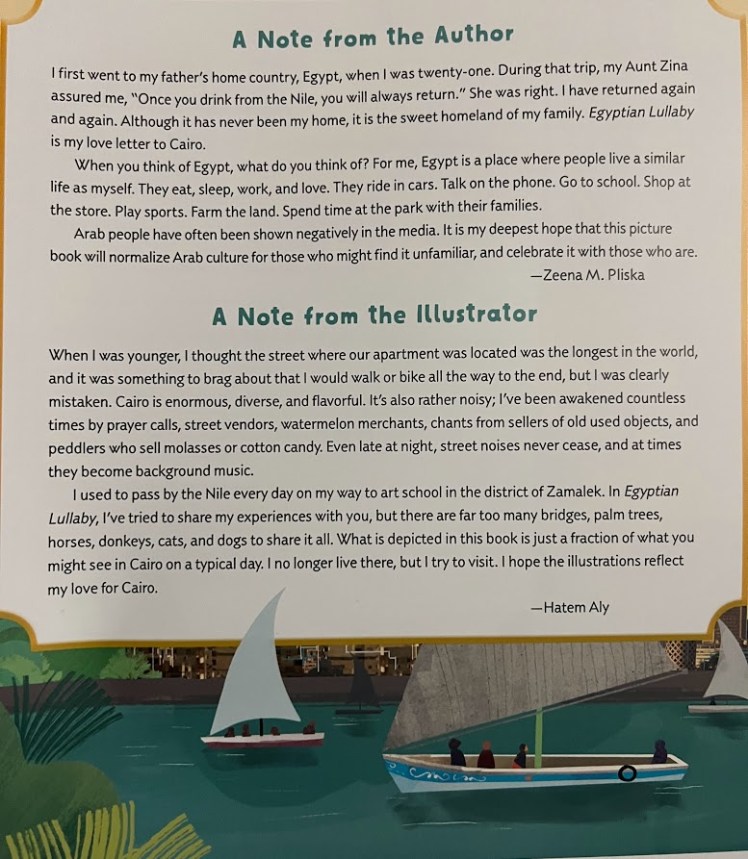
The media and Hollywood have done a very effective job of demonizing Arab culture. It is my hope that this book will help mitigate the damage. It is my hope that this book will normalize Arab culture for those who are unfamiliar and celebrate with those who are.
As a kindergarten teacher, I know that I provide a window to the outside world and can support and contextualize the ideas of my students. I can design an environment that reinforces the dominant paradigm, or I can challenge it.
Part of anti-racist teaching means that teachers must consciously and intentionally make subtle changes that shift who and what we value as humans. Teachers can use picture books to recenter diversity and decenter the white/Eurocentric dominant culture to create a balanced vision of equity.
One way that we control this is by the literature that we choose in our classrooms, especially for young children. I am painfully aware that as teachers we come with our own internal bias. It is impossible to claim that one is free of these socially conditioned biases despite the work we have personally done. And yet, it is imperative that we constantly do this work to ensure that we do not subtly pass bias on to our students.
If we examine the picture books that we read to young children, we have a better chance of not reinforcing stereotypes and assumptions. We can consciously shift the way we present picture books in a balanced way by equally representing Black, Indigenous, or People of Color (BIPOC) cultures so that we don’t reinforce the white dominant culture only. We have the power to normalize true diversity. We can create a lens in which children see a world where many different peoples and cultures live equitably. Then, we can begin to value all people and bring the marginalized out of the margins.
TEACHER ACTIVITY:
I would encourage educators to make a list of their favorite 10 picture books that they use every year in their classrooms. Then, focus on the protagonists of the picture books selected. Ask yourself: What percentage of the protagonists are Black, Indigenous, or People of Color (BIPOC)? What percentage of the protagonists are white? What percentage of the protagonists are animals whose viewpoint is through a white/dominant culture lens?
What did you discover? Does the literature you use, mirror a world where all are valued equally?
Now, list the stories of BIPOC protagonists in your classroom library. What percentage of the stories are about universal themes i.e., human experiences, friendships, or family relationships? What percentage of the stories are about resistance, oppression, or trauma? What percentage of the stories are about culturally specific experiences such as food, traditions, religion or cultural rituals?
What did you discover? Do your stories with BIPOC protagonists reflect a holistic view of the human experience or do the stories only reflect an experience of struggle and trauma or do the stories make white culture the default? How can you make sure the books you choose are a balanced representation of our world?
All it takes are slight shifts, modifications, and changes to the literature we use to expand our student’s world. All it takes are slight shifts, modifications, and changes to create connections and communication that lead to a more expansive understanding of humanity and the world in which we live.
As an author/artist and educator, I truly believe this is critically important for our children now and in the generations to come…
Don’t forget to leave a comment below for a chance to win a copy of EGYPTIAN LULLABY! (US addresses only, please. Winner announced 8/18/23)

Zeena M. Pliska spends her days immersed in the joy of 5-year-olds. She is a kindergarten teacher by day and a children’s book author by night in Los Angeles, California. A progressive public-school educator, she believes that the most important aspect of teaching is listening to children. A social justice activist and organizer for over 30 years, she brings race, class, and gender analysis to everything she does. She is half Egyptian and half Filipino. A lifetime storyteller, she has facilitated stories as a theater director, visual artist, photographer and journalist. Zeena is the author of Hello, Little One: A Monarch Butterfly Story from Page Street Kids and Egyptian Lullaby from Roaring Brook Press.
You can find Zeena at www.teachingauthors.com and on social media: Instagram @zeenamar, Twitter @zeenamar1013, and on Facebook @Zeena M. Pliska or @Zeena Mar. Of visit her at www.zeenamar.com
 Beth Anderson, Children's Writer
Thank you for sharing your beautiful story with the world!
LikeLiked by 1 person
So excited to read this book — I have ordered it into my library! Best of luck with it! I would love to add it to my personal library which includes books of many world cultures!
LikeLiked by 1 person
A beautiful post! Over the past ten years, my world has expanded to include many books written by diverse authors, both for adults and children. It has enriched my world immensely, and I am grateful. I find it exciting to see books on the shelves that reflect many cultures, races, gender, neuro, and physical differences. And I can only hope that both adult and children’s literature becomes even more inclusive. Thank you for writing this lovely book about your family’s homeland! And thank you for sharing this thoughtful library exploration activity.
LikeLiked by 1 person
It’s high time the world we live in is portrayed authentically! Thank you Zeena, for your contribution to shedding more light on the rich tapestry that is humankind. I’m adding “Egyptian Lullaby” to my baby/children’s gift list. Keep ’em comin’ Zeena 🙂
LikeLiked by 1 person
Great post, Zeena & Beth. I would love to win your book for my classroom!
LikeLiked by 1 person
YES! I love your activity for teachers, Zeena! And I hope that not only teachers, but parents as well will take a look at the picture books they have in the house…what are they reading with their children. Thank you for this powerful post…and for the beautiful book that you wrote and Haytem illustrated and the amazing YouTube video of Cairo from your eyes – and window.
LikeLiked by 2 people
Forgive me, I misspelled Hatem’s name.
LikeLiked by 1 person