While every historical rabbit hole offers interesting tidbits and discoveries, there’s always the challenge of accuracy. It takes time and perseverance to sort it all out, but somehow, for me, it’s nerd-ily fascinating. In this post, Cathy Ogren shares how she searched out the facts for PEW! THE STINKY AND LEGEN-DAIRY GIFT FROM COLONEL THOMAS S. MEACHAM.
GIVEAWAY! Just leave a comment below for a chance to win a copy of PEW! THE STINKY AND LEGEN-DAIRY GIFT FROM COLONEL THOMAS S. MEACHAM.
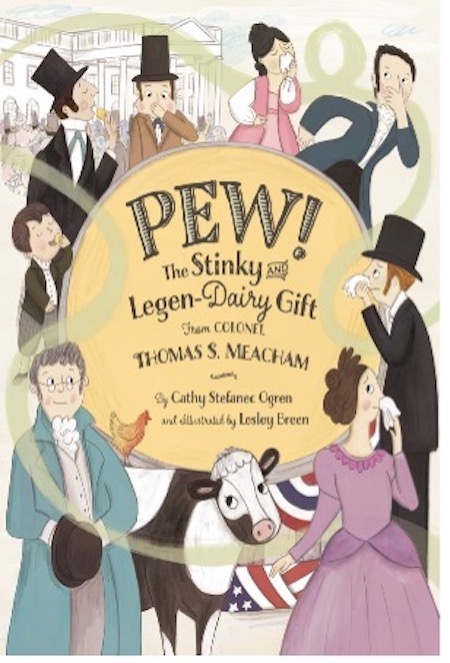
Separating the Curds from the Whey in Search of Accurate Information by Cathy Ogren
From the moment I learned about an enormous cheese made in 1835 by Colonel Thomas S. Meacham as a gift for the president of the United States, I was hooked. My first thought was this would make a perfect picture book. After I did my first round of research, I began writing what I thought was a clever fiction manuscript. The main character was a mouse who was a tour guide for White House visitors. The manuscript was filled with cheesy wordplay woven in with the historical information I had found. My agent submitted it to several editors. Rejections came back. The consensus was that the information was interesting, but the mouse narrator was a no-go.
I didn’t want to let my cheese story go. I took a deeper dive into my research and requested more books from libraries, searched the internet, looked at websites, and archived books and newspaper articles. When my new research began to repeat information, it was time to stop and begin writing.
This time, I took a different approach – write a nonfiction picture book about Thomas S. Meacham’s colossal cheese creation for the president. My focus for the manuscript was the cheese – how it was made, how it was transported to the White House, and what happened to it after it was delivered. I considered the elements of nonfiction, the historical facts, the structure, the word choice, rhythm and pacing, and some wordplay.
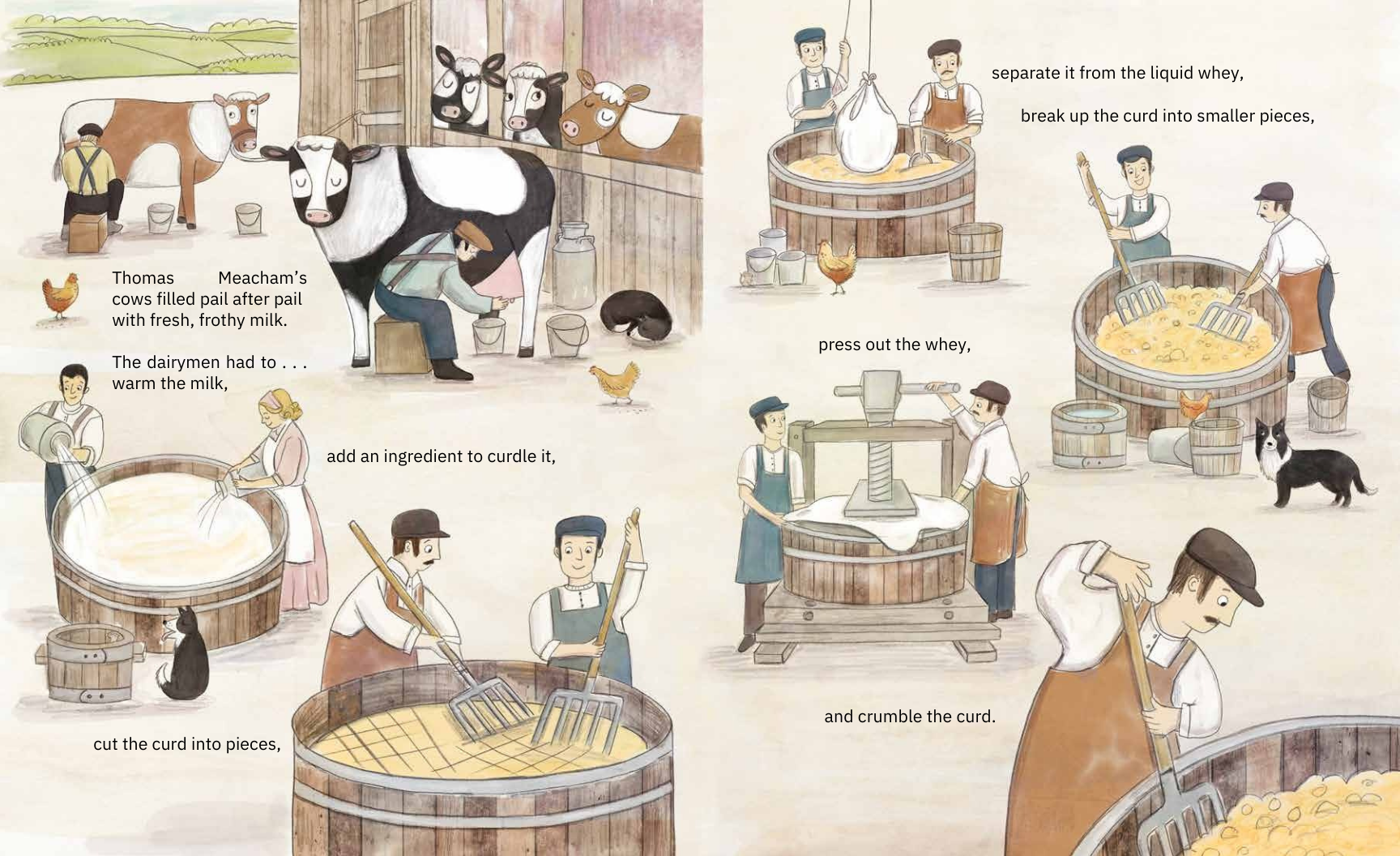
As in the cheesemaking process, it was time to separate the cheese curds from the whey. Information that fit into the book’s focus was separated from unnecessary information.

For any facts that had questionable accuracy, I contacted Peggy Rice, the historian for the Sandy Creek, NY History Center. She helped confirm dates and sent photos of Thomas Meacham’s property and what houses and buildings looked like during the 1830s.
After working on several drafts to create a solid, cheese-worthy manuscript, my agent put her stamp of approval on my last revision and submitted it. When Sleeping Bear Press offered me a contract, I was thrilled. The research and numerous rewrites and drafts were worth all the work.
My editor had a great vision for the book. She included me in the entire process from editing the text for clarity to the approval of Lesley Breen’s wonderful illustrations. When my text received a thumbs-up, I thought I was done. Not so!
A stickler for accuracy, my editor had questions about the details of the illustrations before everything was finalized. Going back over my research, I found several places where the illustrations needed a tweak such as the terrain of the Meacham farm, the number of horses that pulled the cheese wagon, and the White House entrance where the cheese was delivered. Lesley Breen skillfully made the corrections.


Probably the hardest spread we worked on was the cheesemaking one. Lesley and I found information on how cheese was made in the 1830s and viewed YouTube videos, but there was very little detailed information on how Thomas Meacham managed to make such a huge cheese and transport it to the White House. It was a scientific and engineering feat!
We went round and round about how the cheesemaking spread should look until we reached a consensus. While Lesley worked on the final illustrations, my editor gave me one last task. It was to find out the population of African Americans, enslaved and free, who were living in Washington, D.C. in the 1830s. A bit more research into the government census in the 1800s revealed the population in Washington, D.C. in 1830 was 30,261. Of that number, the African American population was 9,109, and half of those counted were free citizens. That information was used in the final illustrations.
 With so much research material to sift through, I learned it’s important to keep your eye on the “prize cheese.” In other words, keep focused on the main idea of your story. Once you have a solid structure, you can add pizzaz with interesting word choices, pacing, and page turns. If you’ve done a good job separating the curds from the whey, you’ll end up with a delicious product. It’s all about the cheese!
Don’t forget to leave a comment for a chance to win a copy of PEW! THE STINKY AND LEGEN-DAIRY GIFT FROM COLONEL THOMAS S. MEACHAM.
Connect with Cathy here: Website Facebook Twitter Instagram
 Beth Anderson, Children's Writer
As a member of the LegenDAIRYwriters critique group in the Dairy State, I simply must read this book. 🧀 I appreciate reading about your fact-checking. Thank you!
LikeLiked by 2 people
Thanks, Joyce! Make sure to have a slice of cheese as you PEW!
LikeLiked by 2 people
What is not to appreciate about this book’s process from concept to print? Particularly, I like how discerning and persevering the team was in the historic details. It appears this is not a stink book at all.
LikeLiked by 3 people
I’m glad you agree! 🙂
LikeLiked by 1 person
After reading this post about the research and careful attention to historical details by everyone involved, I know this book will make an exciting read about an event I’d never heard of before. Congratulations on all your hard work bring this cheesy story to life!
LikeLiked by 2 people
Thank you, Danielle!
LikeLiked by 1 person
I gouda say, what a FANtastic story!
LikeLiked by 2 people
I love your cheesy puns! Thanks!
LikeLiked by 2 people
Love this dive into your process of making this book, Cathy! Research is such a tricky thing. And your dedication to getting things right is so important for kids. Congrats!
LikeLiked by 2 people
Thank you, Jilanne!
LikeLiked by 2 people
Enjoyed learningabout your journey. Sounds like a really fun book. Can’t imagine what you’d do with that much smelly cheese. Pass it around to the less fortunate, I hope.
LikeLiked by 2 people
When you read the book, you’ll be surprised how the president got rid of the 1,400-pound cheese. In the back matter, you’ll also find that the incoming president discovered another huge cheese stored in the White House and how he got rid of it. (Charity wins!)
LikeLiked by 2 people
Congratulations on creating a fascinating nonfiction book AND sharing your research process! Will request my local library to order a copy.
LikeLiked by 1 person
What a fun and fascinating historical event! I loved reading your research process and how the facts were updated in the illustrations. Congratulations on your new picture book. It sounds delightful.
LikeLiked by 1 person