We’ve got another revolutionary true story for you! Another example of how children’s books widen understanding, engage all ages, and invite us to consider the range of people who contributed to the American Revolutions and the challenges they faced.
GIVEAWAY! For a chance to win a copy of GEORGE WASHINGTON’S ENGINEER: HOW RUFUS PUTNAM WON THE SIEGE OF BOSTON WITHOUT FIRING A SHOT from Darcy, just leave a comment after the post.
How George Washington’s Engineer Won a Battle without Firing a Shot
By Darcy Pattison
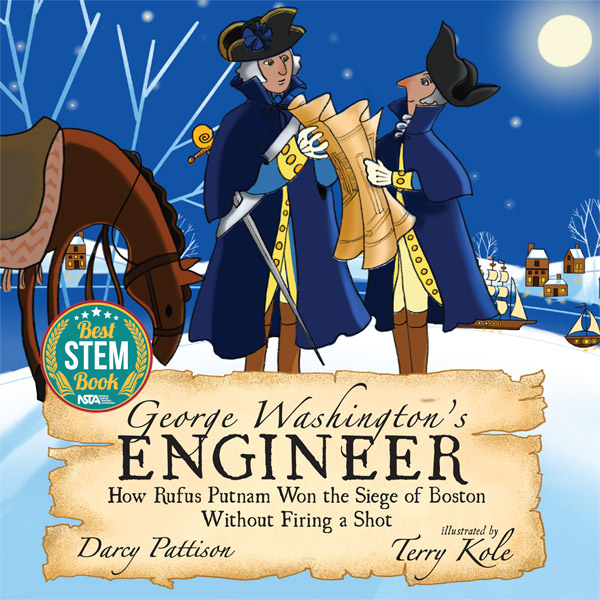
In January 1776, George Washington had a problem: the British army controlled the city of Boston. The colonial army needed to force the British to leave. But how?
The Battle of Bunker Hill, on June 17, 1775, was fought over who would control the high ground to the north of Charlestown. The British won that battle. The Colonials needed a big win.
But they needed a couple things or they would lose the war for independence before it even started. First, the Colonial army needed cannons and ammunition. Colonel Knox took care of this in a historic effort, traipsing through a frigid winter To Fort Ticonderoga, where he captured cannons. 59 cannons! It took 48 days to travel the 300 miles back to Boston. Most stories about the Siege of Boston end there. They Colonials had cannons, end of story.
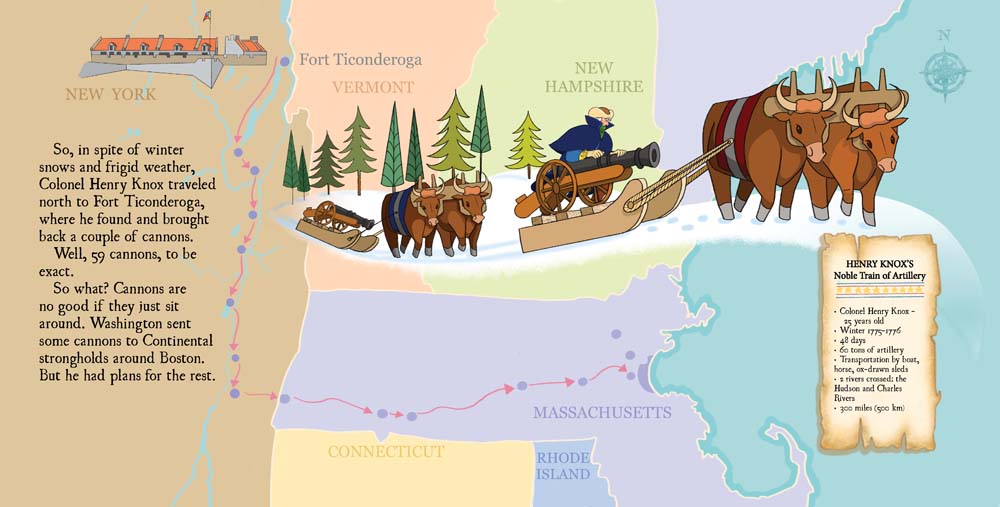
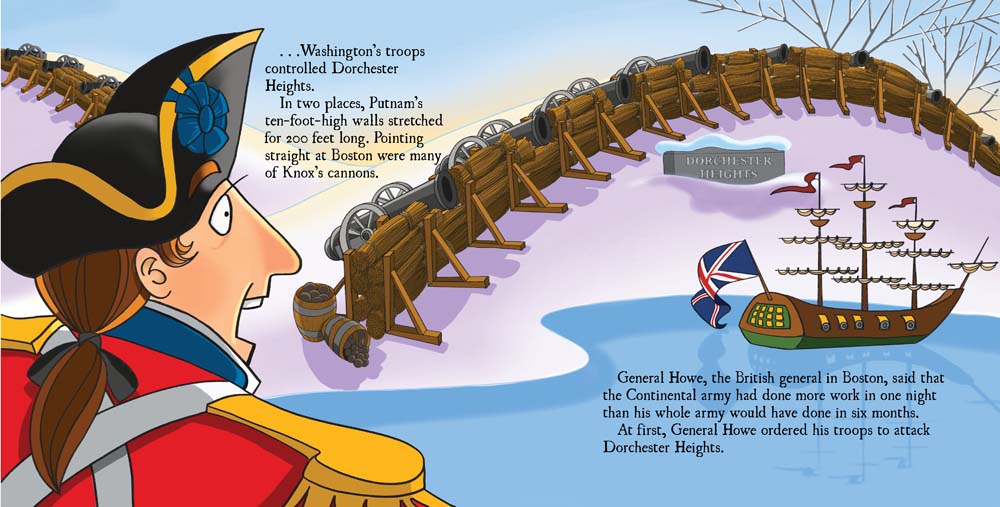
But I’ve always been fascinated with the second part of the Colonial strategy. They needed to bring the cannons to high ground—Dorchester Heights—and aim those cannons straight at the British.
It was a cold winter, though. No one could drag cannons up Dorchester Heights without being seen. Washington asked Rufus Putnam, his army engineer, to create a temporary wall to protect the army as they moved the cannons into place. New England, though, was frozen solid and no one could dig in the ground till spring. Putnam had to figure out how to protect the troops without digging anything.
Military engineers have long been important in winning battles as they figured out how an army could quickly cross a river, digging trenches and bunkers, destroying obstacles, map battlegrounds, and so on. Putnam searched for ways to build a wall without a foundation and found a surprising inspiration military engineering book, The Attack and Defense of Fortified Places by British engineer John Muller.
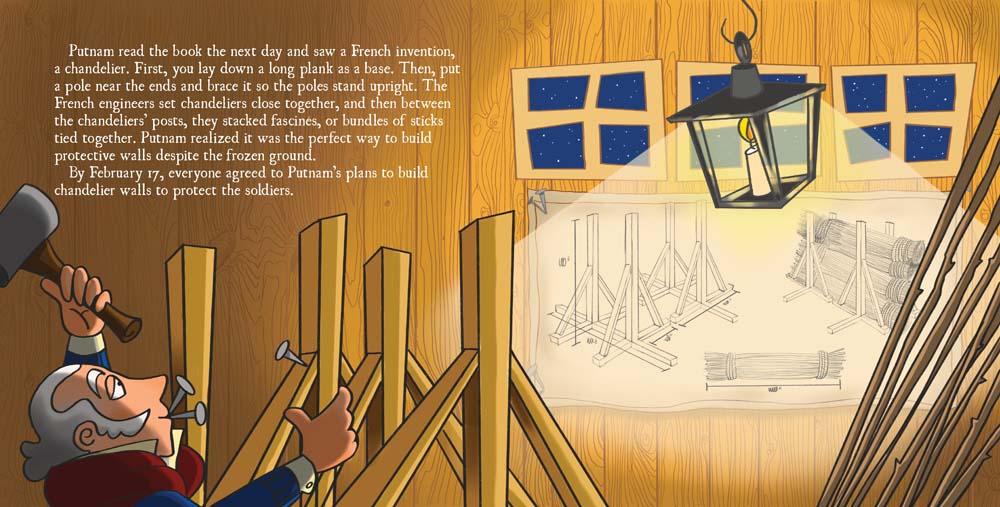
Putnam created “chandeliers,” structures that could hold a “facine,” or a bundle of sticks. Best of all the structures could be prefabricated and moved into place when they were ready.
Putnam relied on quartermaster Thomas Mifflin to find the materials, oversee building the portable structures, and manage the personnel. Truly, it was a massive operation requiring organization and coordination: 300 wagons, 1200 men, and sections of the defensive wall that weighed 700 to 800 pounds.
Kirkus Reviews said the book is “…a case study in how logistics can sometimes accomplish more in war than battles do…”
General Washington would eventually be credited with a win, but it was the army of people behind him who made it work.
Don’t forget to leave a comment below for a chance to win a copy of GEORGE WASHINGTON’S ENGINEER: HOW RUFUS PUTNAM WONT THE SIEGE OF BOSTON WITHOUT FIRING A SHOT. (US addresses only. Winner announced 3/6/2026.)
Coloring pages, free download: https://cdn.shopify.com/s/files/1/0066/3679/8009/files/GWColoringPages.pdf?v=1690816070
😍 If you enjoy a book, please support authors and illustrators by leaving online reviews!

Children’s book author and indie publisher DARCY PATTISON has written over seventy fiction and nonfiction award-winning books for children. Five books have received starred PW, Kirkus, or BCCB reviews. Awards include the Irma Black Honor award, six NSTA Outstanding Science Trade Books, six Eureka! Nonfiction Honor book (CA Reading Assn.), three Best STEM Book, two Junior Library Guild selections, two CLA Notable Children’s Book in Language Arts, two Notable Social Studies Trade Book, an Arkansiana Award, and the Susannah DeBlack Arkansas Children’s History Book award. She’s the 2007 recipient of the Arkansas Governor’s Arts Award for Individual Artist for her work in children’s literature. Her books have been translated into eleven languages. You can information and links at: https://mimshousebooks.com/products/engineer.
 Beth Anderson, Children's Writer
Teachers are going to love reading this aloud to highlight the importance of engineering. I can just see them developing wall-building STEM challenges to go along with the book. I can’t wait to share it with my boys to show how smart strategy can overcome strength!
LikeLiked by 1 person
I’ve been so fascinated every time I dig into this period of time! SO many people beyond the soldiers were essential to the Continental Army.
LikeLike
I’ve been thrilled with all the picture books about American history that are being published. This one adds gloriously to the growing collection. But even more, it takes a little known aspect of a fairly well-known early American Revolution patriot success and shows young readers that there is more to history than wins. Important as those are, the behind the scenes ingenuity, creativity, and teamwork meaningfully demonstrate how important it is to know our true history.
LikeLiked by 1 person
Exactly! Well said!
LikeLike
This is a fascinating story with many lessons to be learned. So rewarding to see the unsung hero is finally revealed in a ‘brains vs. brawn’ history lesson. Children and adults alike will marvel at the ingenuity and strategy of Rufus Putnam!
LikeLiked by 1 person
I love books about about American history. I find them fascinating. This one sounds like another winner!
LikeLiked by 1 person
I remember reading an account of this with my son when he was in 4th or 5th grade. Yes, it ended right where Darcy said. I love that she went beyond that “ending” to discover a really cool STEM moment in history!
LikeLiked by 1 person
I am so happy to have this title on my radar. The timing is perfect! My district has selected a new literacy curriculum for next year and one of the units I will be teaching is the Revolutionary War. I currently have a few titles in my collection focusing on this time period in history, but I am in need of many more. This title would be a wonderful addition. I can’t wait to read it.
LikeLiked by 1 person
I hope you’ll stay tuned as we share more great books for kids about the American Revolution!! I’m so excited to hear one of your LITERACY units is focused on history! You are nurturing critical thinkers!
LikeLike