Are you considering writing an early reader? Wondering where to start? Here’s an informative post from author Kim Larson on how she took what she learned from a webinar, did her research on the form, and worked her way to a published book.
Leave a comment below to get in on the GIVEAWAY for a copy of Kim’s debut book, GOAT’S BOAT WON’T FLOAT!
Congratulations to Danielle Hammelef, winner of TINY TERN TAKES FLIGHT from Donna McKinney!!
The Ins and Outs of Writing Early Readers
by Kim Larson 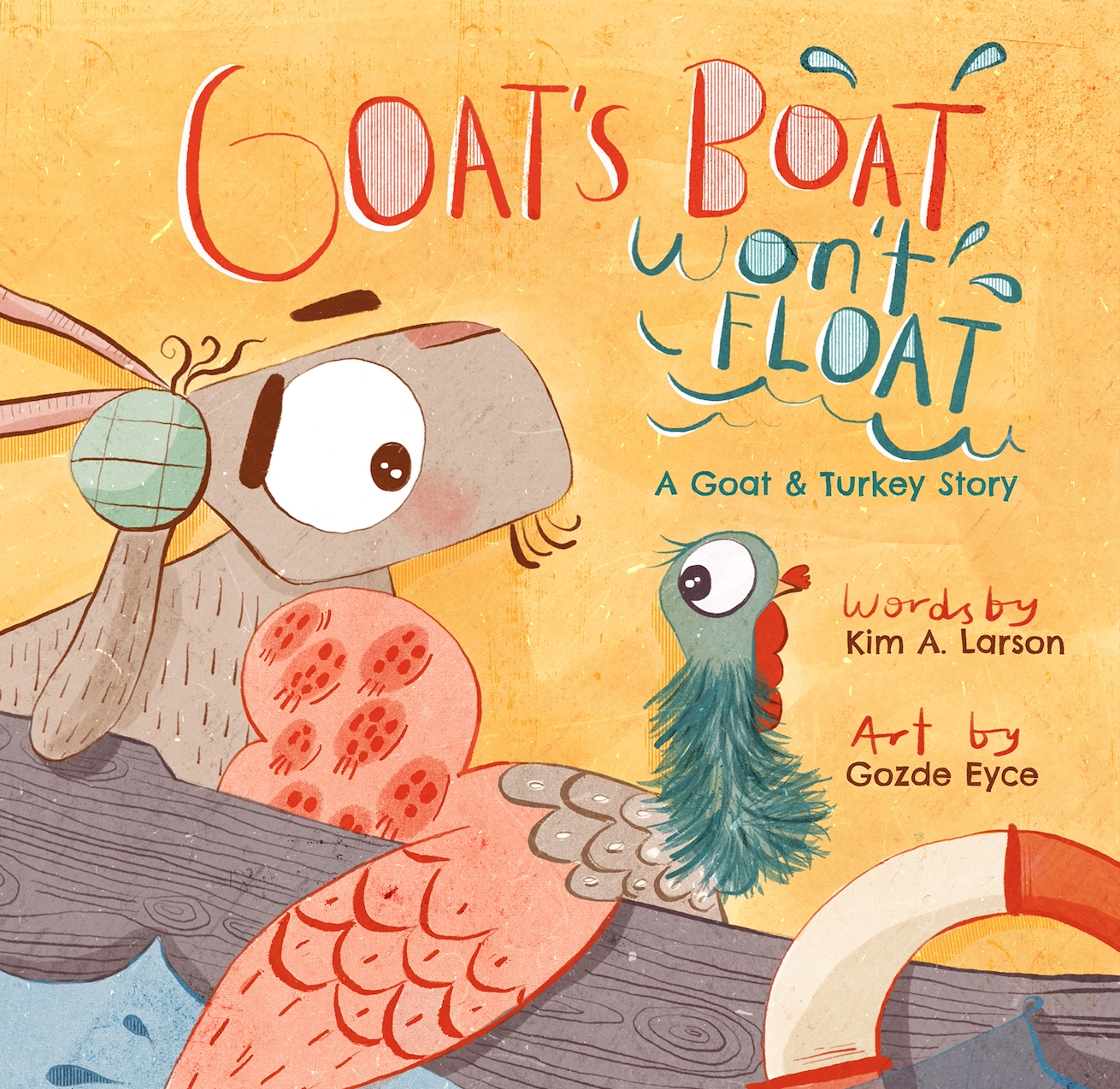
In 2020, I wrote Goat’s Boat Won’t Float after attending an SCBWI webinar on writing early readers by Ann Ingalls. I learned that most early readers use sight words—common words kids recognize without sounding them out. To know which words I could use, I bought the Children’s Writer’s WORD BOOK by Alijandra Mogilner and Tayopa Mogilner. The book has word lists for each grade K-6, in addition to a helpful thesaurus that gives the grade level for each synonym.
Early readers and picture books have similar audiences: children ages four to eight. The most obvious difference is that early readers are written for beginning readers to read independently. Early readers must use simple words and short sentences, often with subject-verb-object construction (e. g. Bob bounced the ball) to help young readers gain the confidence to read on their own. Picture books can have more complex words and sentence structures because it’s expected that adults will read them to children.
Beginning readers do not have complicated plots. They may not have a story arc or character arc either. They can be episodic. The story should be linear and simple yet hold a child’s attention. Familiar topics such as family, school, or animals are often best, and humor is always appreciated. Unlike picture books, where illustrations tell half the story, an early reader’s illustrations will support the text and provide clues to decipher the words.
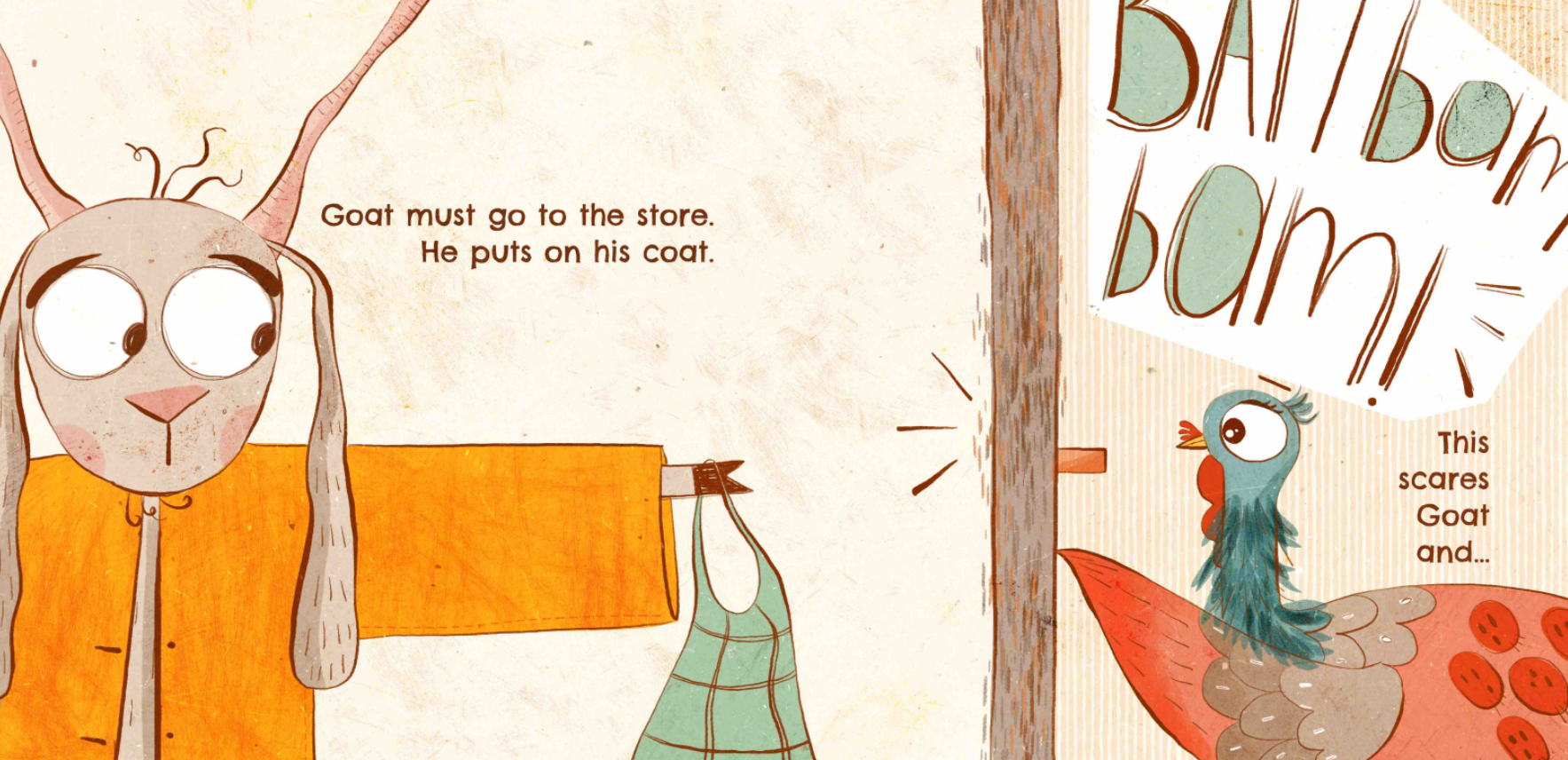
After Ingalls’ webinar, I visited my local library and immersed myself in early readers. I also researched online, learning the differences among the various publishers’ requirements. Some early reader imprints include Acorn, Step into Reading, Leveled Readers, I Can Read, My First I Can Read, and Ready-to-Read.
From my research, I saw that early readers are often done by author-illustrators. It’s also common to see popular picture book series or television shows made into early readers. Having series potential is the key, as most early readers are a series. That is because familiar characters and settings help young readers strengthen their sight-reading skills. Knowing this, I wrote two more stories with the same characters, and my agent pitched all three to my publisher as the Goat and Turkey series. My contract with The Little Press gives them the option to publish my other two stories in the series.
The Little Press acquired Goat’s Boat Won’t Float as an early reader. Most early readers are printed as paperbacks and have a lower price point. They are usually smaller and rectangular in size. But like picture books, they are fully illustrated and often have the same number of pages (32-40). So when I learned my publisher wanted to print my story as a hardcover picture book, to reach a larger audience, I was more than pleased.
If you’re thinking about writing an early reader, consider the marketplace. I’m unaware of any publishers that accept unsolicited early reader manuscripts. I’ve also read that some publishers write them in-house or produce them on a work-for-hire basis. It may be a tough sell, though there is a market for these books, especially in schools and libraries.
I wrote the Goat and Turkey series as a writing challenge—and for the fun of writing something different, as I like to explore new genres and formats. I’m so glad I did. I never imagined Goat’s Boat Won’t Float would be my debut picture book!
Don’t forget to leave a comment below to be entered in the GIVEAWAY for GOAT’S BOAT WON’T FLOAT! (US addresses only, please. Winner announced 11/8/24)
AND 😃 when you enjoy a book, please support authors and illustrators by posting reviews online.
Bio:
Kim A. Larson grew up surrounded by every imaginable farm animal—except fainting goats. Her grandchildren introduced her to these skittish creatures, and she knew she had to write about them. Goat’s Boat Won’t Float is her debut picture book, the first in the Goat & Turkey series. Her second book, Doll Trouble, will be released in 2025 (Clavis Publishing). In 2021, Kim won the Ann Whitford Paul Award for most promising picture book manuscript. She was a #PBParty finalist in 2022 and 2023. When she’s not reading or writing, you may find Kim gardening or playing Sequence. She and her husband live in Moorhead, Minnesota.
 Beth Anderson, Children's Writer
Congrats on your debut!
LikeLiked by 2 people
Thanks, Melissa!
LikeLiked by 1 person
Love Kim’s story and background information on Early Readers. Will have to try it as a writing challenge and share with my critique group. Thanks.
LikeLiked by 2 people
Thank you, Bedwards!
LikeLiked by 1 person
Thanks for sharing, Beth and Kim! And congratulations on your your new book! I love goats! Wishing you both the best of success. Lynne Marie
LikeLiked by 2 people
Thanks, Lynne Marie!
LikeLiked by 1 person
Thanks for this opportunity, Beth!
LikeLiked by 1 person
Hi, Beth! This is such a valuable article. I can’t wait to share it with my students who are learning to write picture books. Thank you for the resource suggestion on sight words. The best part of the article is when Kim showcases the differences between an early reader and picture book.
LikeLiked by 2 people
Thanks, Kim! I’m glad you found it helpful!
LikeLiked by 1 person
Hi, Kim! Glad you enjoyed this article from Kim!
LikeLike
Congratulations, Kim! Thanks for giving us a peek inside your publishing journey.
LikeLiked by 2 people
Thank you so much!
LikeLiked by 1 person
Thank you for the post–I now know more about early readers. My daughter relied on early readers to increase her confidence in her own reading abilities. I still have the two books I bought that were the first books she read independently because they mean so much to me. Congratulations on your series!
LikeLiked by 2 people
Thank you, Danielle! I hope my book helps children like your daughter learn to read.
LikeLiked by 1 person
Early readers have just jumped onto my radar. thanks forsharing your insightsmand experience.
LikeLiked by 3 people
You’re welcome, Kathryn!
LikeLiked by 2 people
Great info! Not only about early readers but about your process for studying the genre!
LikeLiked by 2 people
Thank you!
LikeLiked by 1 person