Back matter in a book serves a multitude of purposes—it’s like a bonus book that can extend the journey, spark curiosity, and answer questions! If you’re a person who tends to skip over back matter or a writer who’s looking for ideas, here’s a great article from Kelly Rice Schmitt about all that back matter can offer.
And a GIVEAWAY! Kelly is offering a copy of I SHIP or a 30-minute brainstorming session on backmatter. Just leave a comment after the post to be entered in the drawing!
Expanding Your Book with Back Matter 
by Kelly Rice Schmitt
I am a back matter junkie. I rarely have a story make it to the finish line of “submission ready” without fully fleshed out back matter, or at least a bulleted list of possible back matter ideas. I think, when done well, it only adds to your submission, especially if you title it “Possible Back Matter” and show that you are open to suggestions from a future editor. Many think that back matter is just for nonfiction, but back matter can also be wonderful for layered fiction texts too! So, why does this work and how can you do this for your own manuscripts?
Add More Hooks: In this competitive picture book market, having an informative layer to your story can help it stand out. Back matter adds more hooks to your book and allows you to expand on additional themes. Consider your fictional story or nonfiction work – are there related themes/ layers you can amp up in the main text as a secondary layer that can be built upon further in the back matter?
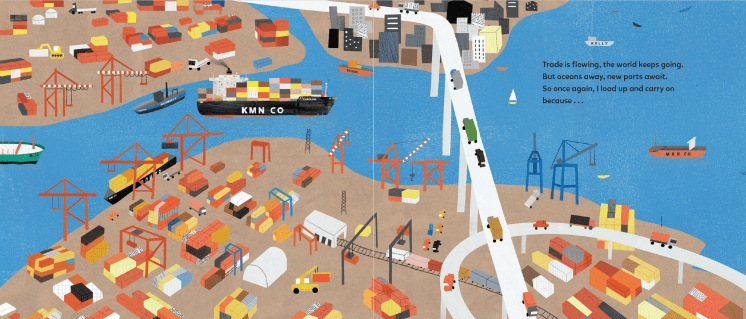
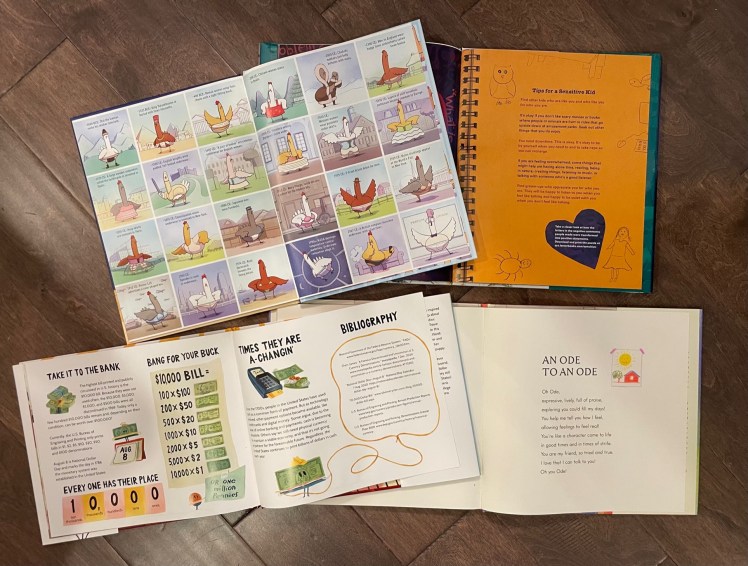
In Kirsten W. Larson’s WOOD, WIRE, and WINGS (ill. by Tracy Subisak) and THE FIRE IN OUR STARS (ill. by Katherine Roy), she pairs her nonfiction biography topics with science topics as well (engineering design process and the creation of a star). In Kimberly B. Wilson’s A PENNY’S WORTH (ill. by Mark Hoffman) she adds money math and facts into her story and backmatter. In I SHIP the main text follows a container ship’s journey from load to discharge, but one underlying theme is international trade and global economies. “Global economy” and “trade” are only in the book once each, but with my detailed backmatter (plus more in the activity guide) it’s a whole jumping off point for older readers and teachers.


Tie it to Curriculums: Teachers for elementary through high school use picture books in lesson plans. Look at the Next Generation Science Standards and Common Core Standards for curriculum areas that your book could fit with. If you know which standards it aligns with, this is a selling point for your book. In addition to subject matter tie ins, you can also look for ways to tie your book into the language arts and research curriculum in schools. Timelines, highlighting primary and secondary sources, and creative writing elements of your book could all fit here.
For I SHIP, I realized I had a lot of figurative language in the book. So I looked up all the figurative language types and added the few I didn’t have. The I SHIP free Teaching and Activity Guide lists these and challenges readers to find examples of them in the book. I also tied in points for geography, STEM (buoyancy), and Earth and Human Activity segments. Another great example is Ode to a Bad Day by Chelsea Lin Wallace and Hyewon Yum—Wallace formatted her book around the ode poem structure and included back matter about how to write an ode, which can tie into poetry curriculum.


Spark More Interest: Back matter can…
Satisfy both story lovers and fact lovers with added facts and info for expository nonfiction lovers
Ex. More About, Facts About, Did You Know?, Labeled Diagrams, Glossary, Words in Translation, Timeline, Photos
Mentor Texts: LULI AND THE LANGUAGE OF TEA by Andrea Wang and Hyewon Yum A HISTORY OF UNDERWEAR WITH PROFESSOR CHICKEN by Hannah Holt and Korwin Briggs, NINE MONTHS BEFORE A BABY IS BORN by Miranda Paul and Jason Chin, LET’S DANCE! By Vallerie Bolling and Maine Diaz, CLOAKED IN COURAGE by Beth Anderson and Anne Lambelet.

Go deeper, often with more mature language, to appeal to older readers and expand readership
Ex. Perhaps share the full history of a topic, point out any parts that were made up or implied, show research process
Mentor Texts: A LAND OF BOOKS: DREAMS OF YOUNG MEXIHCAH WORD PAINTERS by Duncan Tonatiuh, THE OLDEST STUDENT: HOW MARY WALKER LEARNED TO READ by Rita Lorraine Hubbard and Oge Mora
Challenge readers to take action (both kids and/or adults)
Ex. Tips For _____, How You Can ______
Mentor Texts: THE BIG BEACH CLEAN UP by Charlotte Offsay and Katie Rewse, RISSY NO KISSIES by Katey Howes and Jess Engle, SENSITIVE by Sara Levine and Mehrdokht Amini,
Show your connection to the book as a creator (Author’s / Illustrator’s Note)
Ex. HOME IN THE WOODS by Eliza Wheeler, THE GREATEST SONG OF ALL: HOW ISSAC STERN UNITED THE WORLD TO SAVE CARNEGIE HALL by Megan Hoyt and Katie Hickey
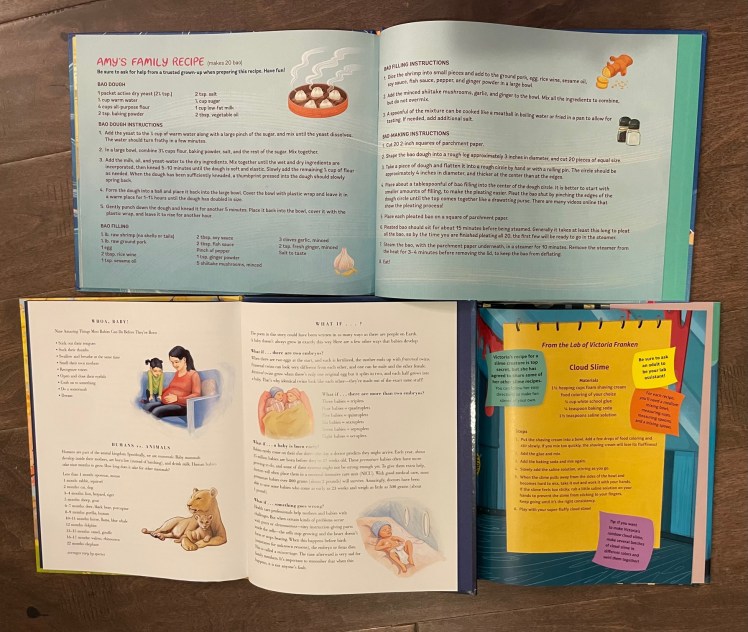
Get Kids Interacting with the Ideas or Characters
Ex. Science experiments, Recipes, Crafts, Discussion Questions
Mentor Texts: FRANKENSLIME by Joy Keller and Ashley Belote, AMY WU AND THE PERFECT BAO (the whole series is great) by Kat Zhang and Charlene Chua
Get Kids Interacting with the Book to Increase Re-readability (Search & Finds, Secondary Stories in the Art, Can you find examples of ______ in the book?)
Ex. THE NEIGHBORS by Einat Tsarfati, SENSITIVE by Sara Levine and Mehrdokht Amini,

In I SHIP, I have sections about the history of containers and the benefits and of using them, more facts about container shipping, a science of buoyancy explanation (with related experiments in the activity guide), a list of jobs for kids interested in shipping and trading, and I pitched that we ask their illustrator to embed a search and find with objects in the book to increase re-readability.
I hope my love for back matter has been infectious and that these examples have gotten your ideas flowing. Go make some beautiful back matter!!
Listen to NPR’s Science Friday where Jen Swanson mentions I SHIP HERE!
 Don’t forget to leave a comment below for a chance to win the GIVEAWAY! (copy of I SHIP – US addresses only, please. Winner announced 12/1/23.)
BIO:
Kelly Rice Schmitt is a former energy trader and children’s writer who loves getting small humans excited about big ideas . . . like container shipping! Although she has scheduled ship logistics and tracked energy shipments around the world, she has never worked on a container ship. Kelly lives in North Carolina with her husband, young children, and many stacks of books. I Ship is her debut book.
 Beth Anderson, Children's Writer
AWESOME IDEAS. I need to beef up my back matter based on this article. Thanks for the opportunity to be a part of this giveaway.
LikeLiked by 1 person
Kelly, your back matter mentor texts made me go to my shelves and dig out some more. I love the activities in your teaching guides, too! Congratulations on I SHIP!
LikeLiked by 1 person
This post is fascinating! I enjoyed all the ideas and examples of mentor text to check out. I always enjoy backmatter in picture books to help explain more about the presented material or expand on themes as you mentioned here. Thank you for the chance to win a copy of your book and congratulations on your publication!
LikeLiked by 1 person
Kelly, these tips are fantastic! Digging deeper & broader into our backmatter ideas can only help make our stories more viable/enjoyable to readers. Thanks for the idea to brainstorm deeper!
LikeLiked by 1 person
Wonderful writing advice. Thank you!
LikeLiked by 1 person
Great post, Kelly & Beth. I am a huge fan of back matter and feel like it’s a great way to expand the audience of your book and help teachers and parents extend the learning and make connections. Wonderful ideas, thank you!
LikeLiked by 1 person
I too love back matter. I put lots in all my books. Thanks for your post and congrats on your book.
LikeLiked by 1 person