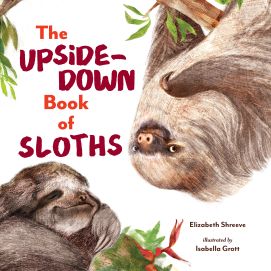
Kids love sloths! I love sloths! And I love the bonus of science in language arts lessons. Here’s a science book that’s perfect for teaching language arts—on a topic that students can’t resist. Elizabeth Shreeve shares a flexible, fun “Discovery Tree” activity developed with a STEM teacher especially for busy classrooms.
GIVEAWAY! Just leave a comment after the post to enter the drawing for a copy of THE UPSIDE-DOWN BOOK OF SLOTHS.
Congratulations to Marcia Parks, winner of LILA AND THE JACK-O’-LANTERN from Nancy Churnin!
Using Science to Teach Language Arts by Elizabeth Shreeve
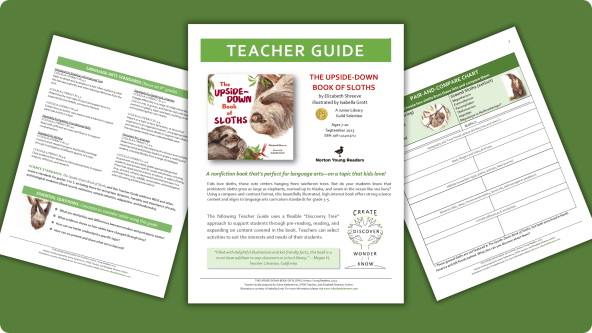
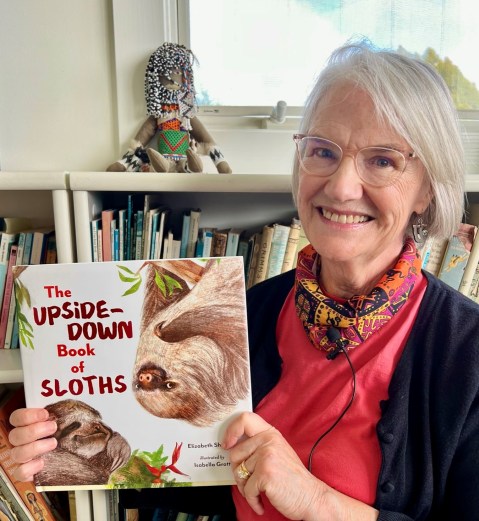 Hi Beth! Thanks for including me on your blog. I’m delighted to share ideas and resources with educators. Right off the bat I want to give credit to Sierra Satterstrom, STEM specialty teacher at Conway Academy of Expeditionary Learning, a public elementary school in Escondido, California. Sierra developed this “Discovery Tree” activity with me and co-authored the Teacher Guide for The Upside-Down Book of Sloths.
And you’re right—kids LOVE sloths! They’re adorably weird, hanging out in the rainforest of South and Central America. And there’s the added surprise of their prehistoric ancestors, who were gigantic! When it came to choosing a topic, I knew that sloths would appeal.
 But what about using the book in the classroom? As a writer, I aim to engage children with nature. I also know that teachers are hard-pressed to cover required curriculum and have limited time for science or social studies. Could a new, high-interest picture book provide a useful tool?
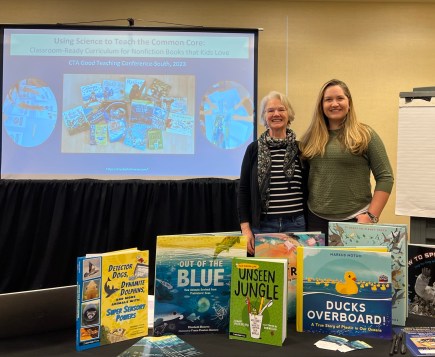
I turned to Sierra for help. With her students, Sierra had been beta-testing the curriculum for my previous book, Out of the Blue: How Animals Evolved from Prehistoric Seas. She and I went on to present together at NSTA and CTA conferences on the topic of “Using Science to Teach the Common Core.” For these conferences, we assembled bibliographies of books with classroom-ready curriculum. We brought newly published nonfiction books for giveaways, shared ideas and gathered input on teachers’ experiences—and we received rave reviews! (These presentations and bibliographies are available free on Visits & Resources page of my website.)
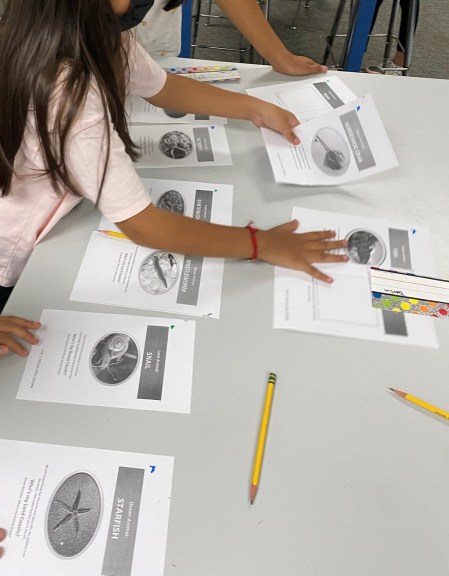 With all this in mind, Sierra and I set out to create a Teacher Guide to accompany The Upside-Down Book of Sloths. We wanted to develop tools that would:
- Align the book to language arts curriculum (grades 3-5)
- Allow teachers to select activities to suit the needs of their students
- Support reading comprehension while fostering science learning
- Be easy to use
Our brainstorming led to a flexible “Discovery Tree” approach. Most educators are familiar with the Know-Wonder-Learnmodel. We adapted this to reflect how a child starts from a “grounding” in a topic and expands upward toward the sky, branching and filling in as they learn. (The winsome sloths in the book helped to inspire the “tree” idea as well!) We also wanted to emphasize opportunities for sharing and creativity, whether in the form of art, movement, writing, or presentation.
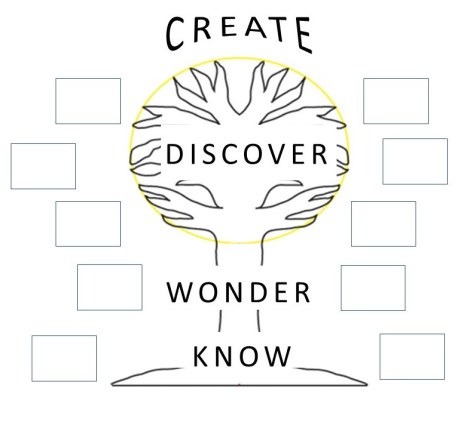 Here are steps for using the Discovery Tree with nonfiction books. For additional ideas and a full-size template, check out the Teacher Guide for The Upside-Down Book of Sloths.
- Gather Books: Assemble a set of nonfiction books for your classroom. Use existing books in your classroom, enlist a librarian, or check out bibliographies on my website. Here’s a link.
- Introduce the Activity: Provide the Discovery Tree template to students and/or post it at the front of the classroom; explain the steps.
- Select Books: Invite kids to choose books. They can vote on one for the entire class or split into two or three groups so that multiple books can be shared.
- “Know” and “Wonder”: For each book, ask students what they already know about the topic and what they wonder about. Their responses can go onto the Discovery Tree template or onto a chart as described in the Teacher Guide.
- “Discover”: Now it’s time to dig into books! While reading, students can:
-
- Look for answers to their questions. Some answers may be in the book while others may require further research using books, YouTube, or online sources.
- Jot down text features, such as titles, subtitles, captions, illustrations, or back matter.
- Find and look up unfamiliar vocabulary words; create a personal glossary.
- Take a first pass through just looking at illustrations; consider how the artwork explains the topic.
- Identify the “big idea,” theme, or major questions of the book.
- “Create”: After reading, students can:
-
- Prepare posters, mini-books, or other graphics inspired by the book
- Act out a dramatic scene or action from the book
- Brainstorm a list of related topics
- Prepare emails or letter to experts with questions about the book
- Come back together to share their work products and discoveries.
That’s it! I hope this approach inspires your students to enjoy nonfiction books. Visit my website and let me know!
Don’t forget to leave a comment below to be entered in the drawing for Elizabeth’s latest book! (US addresses, please. Winner announced 9/22/23)
When you enjoy a book, please take a moment to support authors and illustrators by leaving a review with online booksellers.
 BIO
BIO
Elizabeth Shreeve writes children’s books that celebrate the origins and diversity of life on Earth. Recent books include The Upside-Down Book of Sloths (Norton Young Readers, 2023, a Junior Library Guild Selection) and the award-winning Out of the Blue: How Animals Evolved from Prehistoric Seas (Candlewick Press, 2021). Elizabeth lives in northern California with her family, including Hector the PaleoDog. Visit her at www.elizabethshreeve.com, YouTube: Elizabeth Shreeve Books, and @ShreeveBooks.
 Beth Anderson, Children's Writer
I love Elizabeth’s book! My heart and head were nodding through the piece! Kids absolutely love nature and animals~the link between the world, using STEM tools, connecting rich learning with their environment ~I didn’t want to be slow as a sloth in commenting!
LikeLiked by 1 person
This information about creating teacher guides is both helpful and the kickstart I need to rethink teacher guides for my own books. I’m now off to your Resources page for more ideas! Thank you!
LikeLiked by 1 person
Thank you for sharing your story and resources. As an aspiring PB writer, I love hearing the story of other authors. The behind the scenes of writing for children to include all the teacher guides and the links you provided were extremely helpful. I had not heard of the Discovery Tree and plan to bookmark your entry. Congratulations on your book. Sloths are such neat creatures.
LikeLiked by 1 person
Ooh! Science and language arts together = fabulous combination! Congratulations on your new book!
LikeLiked by 1 person
This book is beautiful and the resources for teachers is excellent. Thank you for sharing today and congratulations on your book!
LikeLiked by 1 person
Thank you for introducing this book and suggested activities to me. I always learn so much from your newsletters!
LikeLiked by 1 person
👋🏻 hi Elizabeth! I love your new book ! And I’ve learned sooo much ❤️
LikeLike
This looks so cute! Sloths are a favorite for my students!
LikeLiked by 1 person
Oh, I love the idea of the Discovery Tree! What a fantastic way to organize exploration. Congrats to Elizabeth and Isabella on this new book!
LikeLike
Love the teacher guide!
LikeLiked by 1 person
The resources and ideas in this post are phenomenal! I will be using these as references and models—and can’t wait to read the book!
LikeLiked by 1 person