Stories of inanimate objects offer their own special challenge. As with all stories, I think the secret is to find a meaningful personal connection that also connects to children. In Jessica Stremer’s new book, GREAT CARRIER REEF, she was drawn to the idea of transformation. Read on to find out how this idea played out in the writing.
Jessica is offering a GIVEAWAY! If you write for children, let us know in a comment below and we’ll put you in the drawing for a NonFiction Picture Book critique.
Congratulations to Robin Brett Wechsler, winner of RIVKA’S PRESENTS from Laurie Wallmark!
A Transformation Invites New Life by Jessica Stremer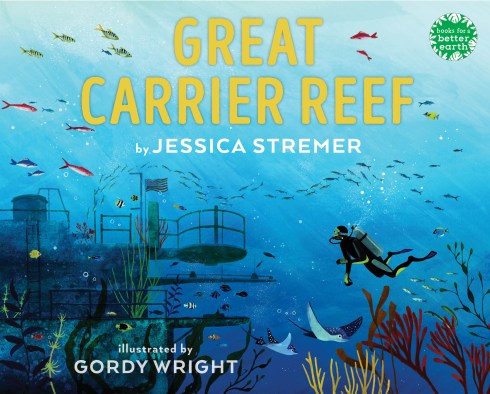
What happens when something designed to be unsinkable gets bombed to the bottom of the ocean floor? With careful preparation, new life can take root! GREAT CARRIER REEF brings young readers along on the journey of the aircraft carrier USS Oriskany—nicknamed the Mighty O—as it gets stripped down to a steel shell for a new life below the waves.
I first discovered the Mighty O’s story in early March of 2021, when my youngest daughter turned on a documentary about reefing ships. This was also right before my husband, a USMC helicopter pilot, left for a nine-month deployment. For those who aren’t familiar with military deployments, the few weeks before the service member leaves can be quite awkward as both parties mentally prepare to spend months apart. I dove into research as a way to distract myself from his upcoming departure.
I was instantly intrigued by the fact that the Mighty O, designed to be unsinkable and to keep service members safe, was deliberately sent to the bottom of the ocean. What pulled me in even more was all the planning, work, and coordination it took for the reefing to be successful, as well as the impact scientists hoped this artificial reef would have on this particular spot in the ocean.
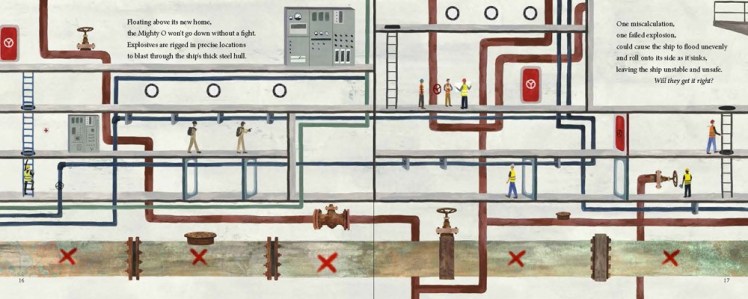
It became pretty clear that the heart of this story was transformation. For the Mighty O it’s about starting over with a new purpose and a new mission; to become a home for marine life. Then once the ship is sunk, readers see the ocean floor also transform from nearly void to teaming with activity.
To keep the theme of transformation at the forefront I first had to show both the Mighty O and the ocean floor in their original state. For the Mighty O, I described what aircraft carriers do while at sea. For the ocean floor, it was a matter of comparing a healthy coral reef to the in-need spot where the ship would eventually sink. This bit actually took the most revising because my brain, which was in full deployment mode, initially gave the ship more attention than the ocean. Luckily, I was able to move some of the details of the Oriskany’s time in service to the back matter.
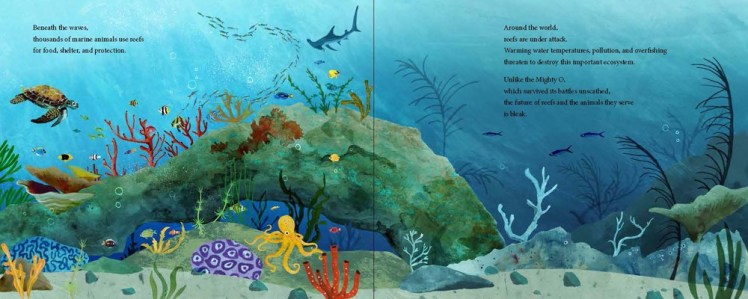
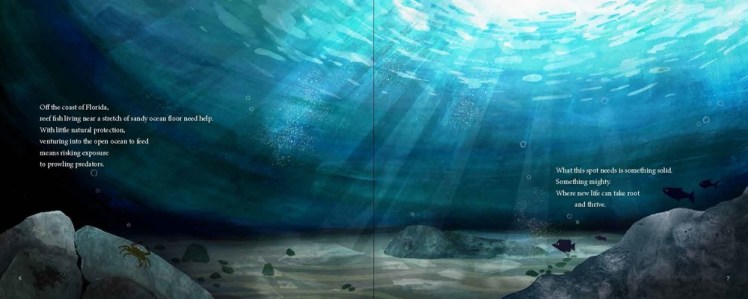
The next thing I had to do was include as many steps of the reefing process as possible. I chose to use short, direct sentences with strong verbs to keep things from being too wordy for young readers. My other goal regarding word choice was to try and evoke an emotional connection to a non-human main character, and build tension during the periods where engineers and scientists faced challenges. Once the ship was sunk, I tried to use a similar style of language to explain how artificial reefs become populated.
This book has so many additional layers that I hope kids will like. From coral reefs and ocean health, to engineering, critical thinking, and problem solving, to ships and military history, there’s a little bit of something for everyone. But ultimately when readers finish this book, I hope they walk away with a sense of optimism. That they see this success story and feel inspired to continue to invent creative solutions to other environmental struggles our planet faces.
Circling back to where we started, every deployment comes with its own challenges that force me to change and grow. Each manuscript I write poses its own challenges, too. Remembering what first inspired me to write the story and what I hope readers will take away from it can help me stay focused. Ask your critique partners what they think the main theme is. Be open to feedback, but true to your vision. In the end, it’s your story to tell.
Don’t forget to leave a comment if you’d like to be entered in the drawing for a NonFiction Picture Book critique from Jessica. (<1000m words, non-rhyming) Winner announced 6/30/23.
 Beth Anderson, Children's Writer
Jessica, I cannot imagine the heartaches families process in preparation for deployment. Thanks for using your time to research for this intriguing book.
LikeLiked by 1 person
I’ve seen your book all over the Twittersphere this week & now I understand why everyone is loving it-what a fab idea for a book!! Congrats & thank you
LikeLiked by 1 person
This book sounds great. I love how Jessica came up with the theme of transformation! Yes, I write for kids.
LikeLiked by 1 person
Thanks for sharing this peak into your process, Jessica. You’ve written such a beautiful book! Gordy Wright’s illustrations are stunning!
LikeLiked by 1 person
Ah, I believe the word is “peek” 🤣 But your process is definitely a pinnacle….
LikeLiked by 1 person
Fascinating story and luscious illustration. Congratulations ❤️
LikeLiked by 1 person
Congrats, Jessica! So excited for your book, and I was fascinated to learn some of its backstory.
LikeLiked by 1 person
This sounds awesome! Thank you for sharing!
LikeLiked by 1 person
I love the idea of transformation. The book sounds wonderful!
LikeLiked by 1 person
What a great topic! It takes such skill to bring an object to life on the page. I love writing NF!
LikeLiked by 1 person
Jessica, I love the theme of your new book: transformation and optimism. Thank you for sharing your inspiration behind the story, your writing process and writing tips. Congrats!
LikeLiked by 1 person