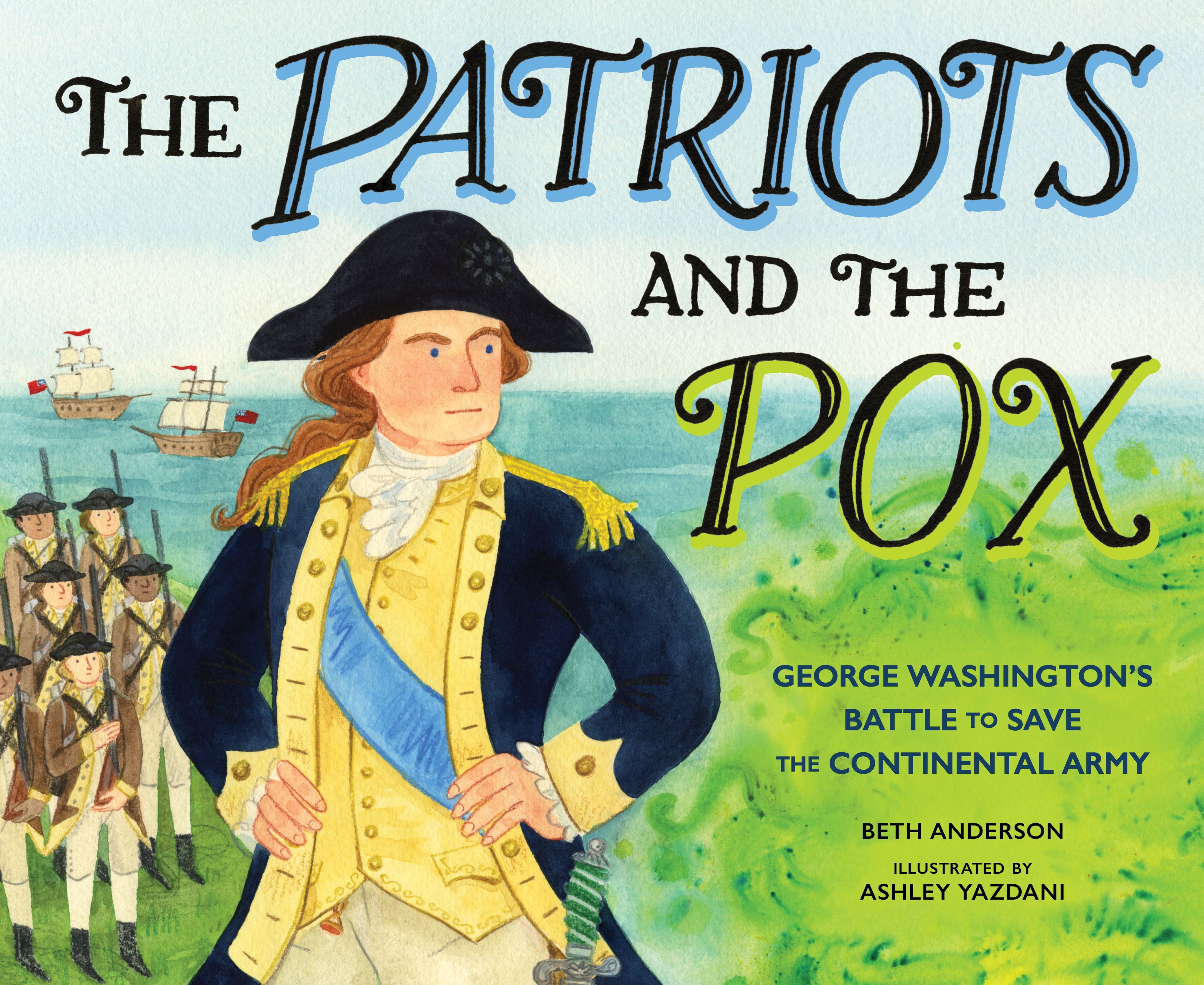
The Patriots and the Pox: George Washington’s Battle to Save the Continental Army
illustrated by Ashley Yazdani
This nonfiction illustrated book for young readers reveals the true, and often overlooked, story of General George Washington’s brave decision to inoculate his troops against smallpox during the American Revolution.
1775
General George Washington and his ragtag army are preparing to battle the powerful British military when the first attack comes— from an enemy that is invisible and deadly—smallpox!
The disease wreaks havoc on his troops, foils his plans, and threatens to extinguish hope for independence. Desperate to get smallpox under control, Washington faces an agonizing decision—one that could either destroy his army or save it. He knew what he had to do, but how? The fate of a nation was on the line.
Here is a new look at a founding father that uniquely shows what some historians call Washington’s most important strategic decision of the war. His battle against smallpox deepens understanding about the complexity of the revolution and connects to the present with the vital role vaccines continue to play.
This unforgettable story is not only about the war for independence but also about independence from disease, the power of science, and how George Washington laid the foundation for public health in the United States.
EDUCATOR RESOURCES to download. MORE on the way!
Cause and Effect Math Activity
KidLit Grove: STEAM Spotlight: How Do you fight an enemy you can’t see? Educator activities
LitLinks: How to connect the American Revolution to STEM with 3 activities
Resource: The Children’s Book Review— Soldiers, Spies, and Smallpox: Outstanding Children’s Books About the American Revolution
REVIEWS AND HONORS

Thorough research is delivered in digestible quantities, readers will likely be inspired to investigate the extensive back matter, filled with an author’s note and primary and secondary sources, to learn more about this little-known moment in American history. VERDICT This unique approach to the story of the American Revolutionary War will inspire thought-provoking and relatable discussions about the complexities of life that are not always visible; it is a positive addition to curricula on war, history, and inoculation science. ~School Library Journal
Anderson has a keen eye for U.S. history’s lesser-known stories, and she distills her account into bite-size details, moving quickly through time as she imparts nuggets of historical wisdom…Yazdani’s illustrations juxtapose bird’s-eye views of soldiers marching or setting up camp with abstract images of smallpox depicted as a miasmic greenish-yellow cloud…In her author’s note, Anderson draws parallels between this story and the recent Covid-19 pandemic. A relevant and insightful tale of courageous leadership and epidemic prevention. Kirkus Reviews
“…well researched…appealing history…” Booklist
“…The text provides a sense of what an agonizing choice this was at this early moment in the history of inoculation and interweaves descriptions of Washington’s battle strategy with the fight against the disease…”—The Horn Book
video review ~ @MaryLanniReads
“…Bottom line, this book would be an excellent addition to any teacher or library. It’s well researched and presented in an easy to grasp manner. As noted, it approaches the deadly threat of smallpox as a human event, not just a side fact of the war. Kudos to the author for reminding us that one decision can make a huge difference, its impact leading to one thing after another…Adults, as well as children, will find much to ponder here.” ~ history teacher reviewer on Goodreads
“…Trust and courage are at the heart of the story, and that never changes. How our leaders meet those hurdles matters. This title should be welcomed in classrooms, libraries, and homes to inform, inspire, and spark conversations about difficult choices in modern times as well as in the past.” ~Sandy Brehl, Unpacking the POWER of Picture Books
“…This is an excellent book. The illustrations…are beautiful and full of eye-catching details, as well as imaginative touches that help visualize the threat of contagion. I really enjoyed the writing and the imagery, and I am also giving the author bonus points for sticking to history. I honestly expected this book to preach at readers about contemporary vaccination controversies, and am pleasantly surprised that it did not…I recommend this to people who are interested in Revolutionary War history, as well as to anyone who is looking for inspiring books about brave and thoughtful leadership.” ~ Goodreads reviewer
BLOG POSTS, PODCASTS, AND INTERVIEWS
PODCAST @MaryLanniReads: interview on the research, writing, and more!
PODCAST: Heartful of History with Selene Castrovilla: The Untold Human Stories of the American Revolution | America 250
PODCAST: Nerd Out with Gina!
GROG BLOG: Scaffolding Understanding Along with the Arc by guest author Beth Anderson
RYS Newsletter Interview: Beth Anderson Explores Patriots, Pox, and America’s First President
Blog article: Cover Reveal: How Research Becomes Story
Unpacking the Power of Picture Books blog review
RYS March on w/Mentor Texts blog article: The Challenge of Unseeable, Complex, and Mind-blowing Characters
Interview: The Picture Book Buzz with Maria Marshall
~~~~~~~~~~~~~~~~~
Available online and at bookstores everywhere!
Amazon • Barnes & Noble • Bookshop.org • Books a Million
Publisher page: Calkins Creek/Astra Books for Young Readers
Sept. 29, 2026 | ISBN 9781662681240 | Hardcover $19.99

